Study Notes
Overview
Reactions of ions in aqueous solution is an A-level practical-inorganic topic in which candidates use visible test-tube evidence to identify metal ions and explain the chemistry behind it. The provided reference number and wording match AQA A-level Chemistry 7405, section 3.2.6, rather than GCSE content; there is therefore no Foundation/Higher split for this guide. The section combines complex-ion formation, Brønsted–Lowry acid-base chemistry, ligand substitution, redox, and qualitative analysis. 1
In an exam, candidates may be shown an unknown coloured solution, given a reagent such as aqueous sodium hydroxide, ammonia, or sodium carbonate, and asked to describe, explain, compare, or write an ionic equation. Marks are not awarded merely for recognising a colour. The strongest answers connect the observation to the species present: a more highly charged metal ion polarises water ligands, hydroxide removes protons, aluminium hydroxide is amphoteric, or a ligand substitution produces a new complex. Think like an examiner: identify the ion, identify the reagent, record the exact observation, then explain the chemical cause.
Scope and specification position
The AQA specification limits the required hexaaqua ions to Fe²⁺ and Cu²⁺ for [M(H_2O)_6]^{2+}, and Al³⁺ and Fe³⁺ for [M(H_2O)_6]^{3+}. Candidates must explain why a 3+ hexaaqua ion is more acidic than a 2+ ion in terms of charge/size ratio, and describe and explain reactions with OH⁻, NH₃, and CO₃²⁻. 1 The official AQA reaction resource supplies the expected colours and the change on adding an excess of reagent. 2
Exam focus: Learn the observations precisely, but revise them as a set of linked chemical rules. That gives you a route to unfamiliar questions rather than a fragile list of colours.
Key Concepts
Concept 1: Metal-aqua ions and co-ordinate bonding
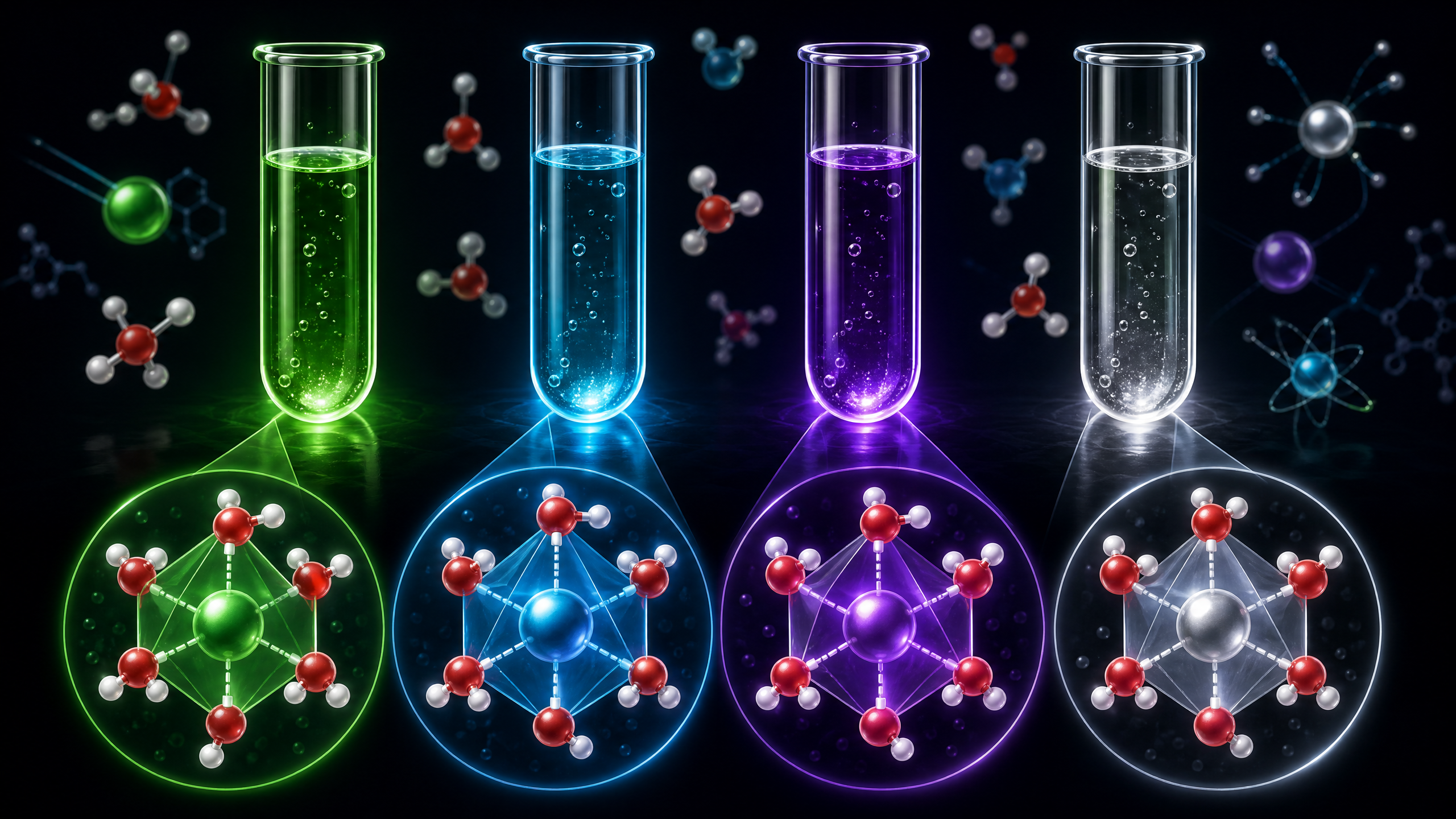
When a metal salt dissolves in water, the metal ion is surrounded by water molecules. The oxygen atom in each water molecule has a lone pair of electrons, which it donates to the positively charged metal ion. This forms a co-ordinate bond. Water is the ligand and the whole species is a complex ion. Six water ligands arrange around the metal ion in an octahedral pattern, so the correct formula is written with square brackets, for example [Cu(H_2O)_6]^{2+}.
The brackets matter. They show that the six water molecules and the copper ion make one complex with an overall 2+ charge. A common low-level response writes Cu²⁺ and six separate water molecules; that does not demonstrate the required complex-ion idea. Although aluminium is not a transition metal, its [Al(H_2O)_6]^{3+} ion is included because it shows the same hydrolysis pattern and forms an amphoteric hydroxide.
Concept 2: Why 3+ metal-aqua ions are more acidic
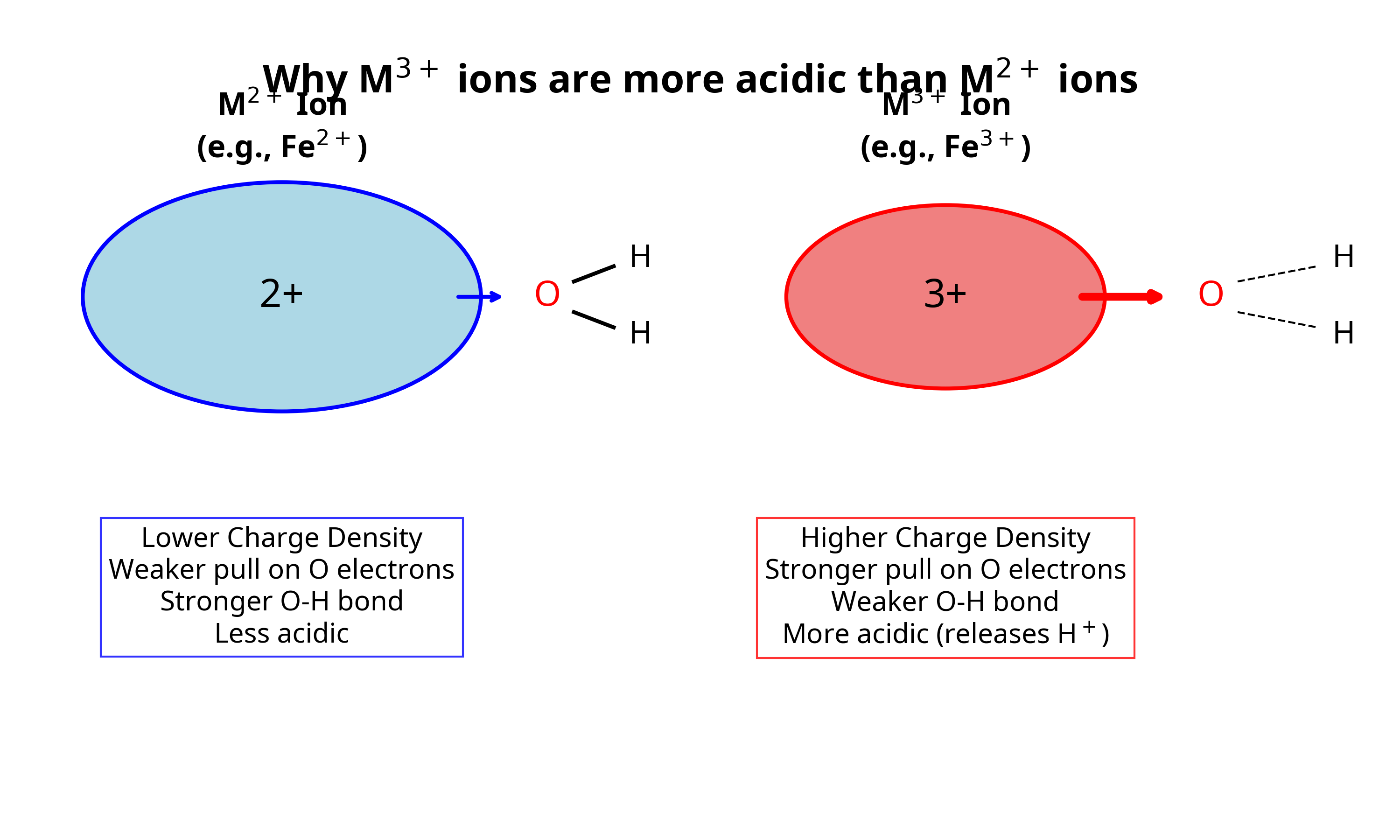
The acidity is not caused by a metal ion simply “attracting water”. The mark-winning explanation is a chain of particle-level ideas. A 3+ metal ion has a greater positive charge and, for comparable ions, a smaller radius than a 2+ metal ion. Its charge/size ratio—also called charge density—is therefore higher. It has greater polarizing power and pulls electron density towards itself from the oxygen atom in a co-ordinated water molecule. That electron withdrawal weakens the O–H bond in the water ligand. A proton is then more readily released into solution, so the 3+ hexaaqua ion is more acidic.
Use this ordered chain in any “explain” question: higher charge density → stronger attraction for O electron density → weaker O–H bond → easier release of H⁺. An answer that only states “Fe³⁺ has a higher charge” is incomplete. It earns credit only for the first idea; candidates must link the charge to O–H bond weakening and H⁺ release for full marks.
The first hydrolysis equilibrium can be represented as:
$[M(H_2O)6]^{3+}{(aq)} \rightleftharpoons [M(H_2O)5(OH)]^{2+}{(aq)} + H^+_{(aq)}$
This also explains why the purple Fe³⁺ aqua ion may appear yellow-brown in practice: some hydrolysed [Fe(H_2O)_5(OH)]^{2+} is present. 2
Concept 3: Hydroxide and ammonia reactions
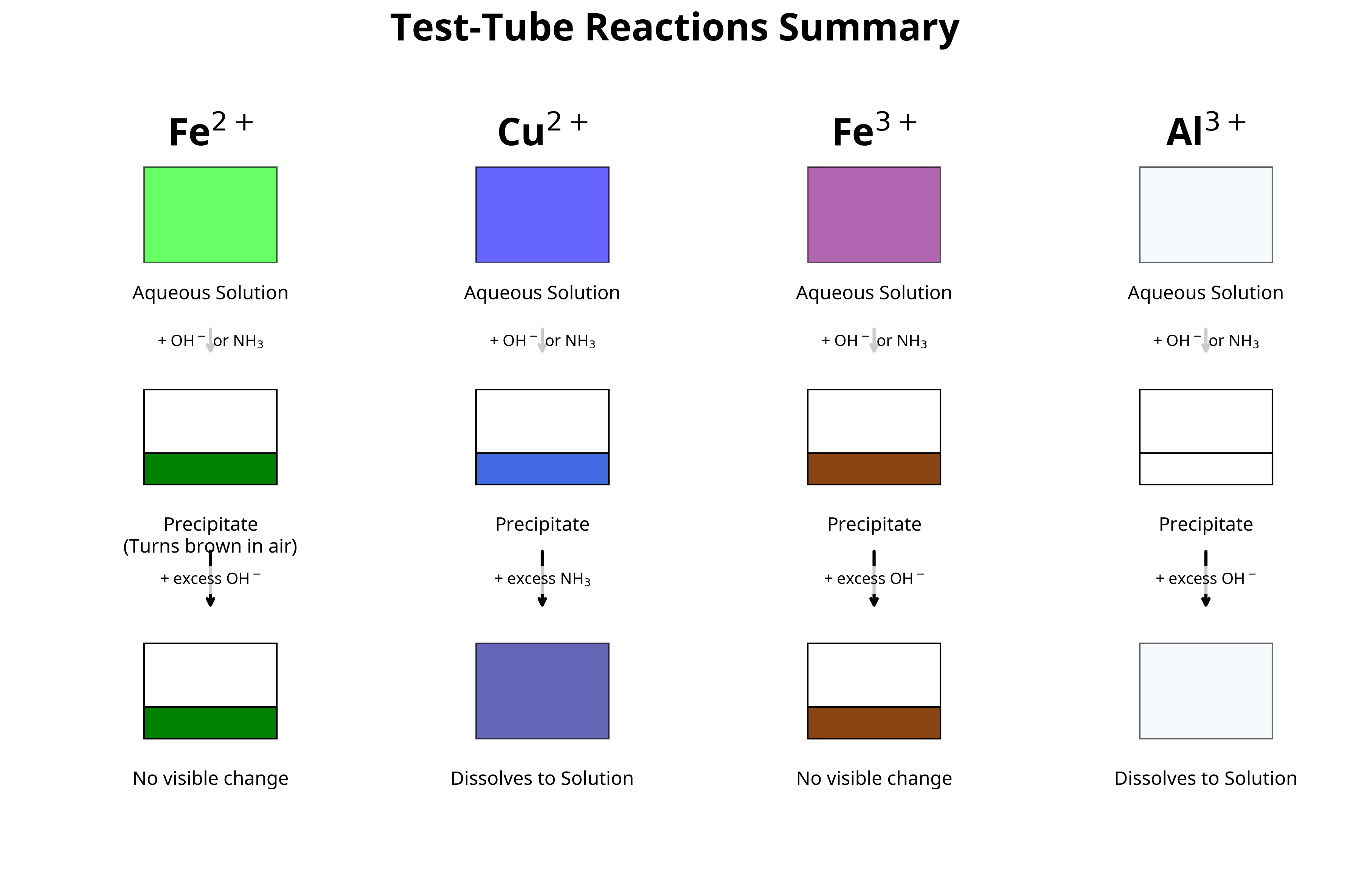
Both hydroxide ions and ammonia behave as bases. They remove protons from water ligands, causing neutral metal hydroxide complexes to form as precipitates. With hydroxide ions, the general equations are:
$[M(H_2O)6]^{2+}{(aq)} + 2OH^-{(aq)} \rightarrow M(H_2O)4(OH){2(s)} + 2H_2O{(l)}$
$[M(H_2O)6]^{3+}{(aq)} + 3OH^-{(aq)} \rightarrow M(H_2O)3(OH){3(s)} + 3H_2O{(l)}$
Ammonia produces OH⁻ chemistry by acting as a proton acceptor, forming NH₄⁺. Therefore it initially gives the same hydroxide precipitates. In excess ammonia, copper(II) is the important exception: its pale-blue precipitate dissolves and a deep-blue complex is formed:
$[Cu(H_2O)6]^{2+}{(aq)} + 4NH_{3(aq)} \rightarrow [Cu(H_2O)2(NH_3)4]^{2+}{(aq)} + 4H_2O{(l)}$
| Aqua ion | Initial solution | Add NaOH or NH₃ | Add excess NaOH | Add excess NH₃ |
|---|---|---|---|---|
| $[Fe(H_2O)_6]^{2+}$ | Green | Green precipitate; turns brown on standing in air | No further change | No further change |
| $[Cu(H_2O)_6]^{2+}$ | Blue | Blue precipitate | No further change | Precipitate dissolves; deep-blue solution |
| $[Fe(H_2O)_6]^{3+}$ | Purple or yellow-brown | Brown or orange-brown precipitate | No further change | No further change |
| $[Al(H_2O)_6]^{3+}$ | Colourless | White precipitate | Precipitate dissolves; colourless solution | No further change |
This table represents the required AQA observations. 2 For Fe²⁺, “turns brown on standing in air” is a redox detail, not an optional extra when a question asks what happens on standing. Oxygen oxidises iron(II) to iron(III), giving the brown iron(III) hydroxide product.
Concept 4: Amphoteric aluminium hydroxide
A substance is amphoteric if it reacts with both acids and bases. Aluminium hydroxide, Al(H_2O)_3(OH)_3, does exactly this. With acid, it behaves as a base: protons neutralise the hydroxide groups and the precipitate dissolves to re-form the hexaaqua aluminium ion.
$Al(H_2O)3(OH){3(s)} + 3H^+_{(aq)} \rightarrow [Al(H_2O)6]^{3+}{(aq)}$
With excess sodium hydroxide, it behaves as an acid and dissolves to give tetrahydroxoaluminate:
$Al(H_2O)3(OH){3(s)} + OH^-{(aq)} \rightarrow [Al(OH)4]^-{(aq)} + 3H_2O{(l)}$
The two observations must be stated in sequence: a white precipitate forms with a few drops of NaOH; it dissolves in excess NaOH to give a colourless solution. Do not claim that all metal hydroxides are amphoteric. In this topic, the specified amphoteric hydroxide is the aluminium(III) hydroxide.
Concept 5: Carbonate reactions—your diagnostic shortcut
Carbonate ions distinguish between 2+ and 3+ metal-aqua ions because the 3+ ions are much more acidic. With Fe²⁺ and Cu²⁺, carbonate acts chiefly as a precipitating ion: FeCO₃ is green and CuCO₃ is blue-green. There is no effervescence.
$[Fe(H_2O)6]^{2+}{(aq)} + CO_3^{2-}{(aq)} \rightarrow FeCO{3(s)} + 6H_2O_{(l)}$
With Fe³⁺ and Al³⁺, carbonate acts as a base. It removes H⁺ from acidic water ligands, so a metal hydroxide precipitate forms and CO₂ gas is evolved. The observation is therefore a precipitate and effervescence. Fe³⁺ gives a brown precipitate; Al³⁺ gives a white precipitate.
$2[Fe(H_2O)6]^{3+}{(aq)} + 3CO_3^{2-}{(aq)} \rightarrow 2Fe(H_2O)3(OH){3(s)} + 3CO{2(g)} + 3H_2O_{(l)}$
The phrase “3+ fizzes; 2+ does not” is a useful memory hook, but do not let it replace the equation. A common error is writing Fe_2(CO_3)_3 or Al_2(CO_3)_3 as the product. That ignores the acidity of the 3+ aqua ion and does not earn the product mark.
Practical skill, data skill, and safety
This section is not listed as a separately numbered AQA required practical, but the specification explicitly identifies test-tube reactions with NaOH, NH₃, and Na₂CO₃ as practical opportunities. 1 Treat it as assessable practical chemistry. Use a test-tube rack, clean test tubes, dropping pipettes, aqueous metal-ion samples, aqueous sodium hydroxide, aqueous ammonia, aqueous sodium carbonate, distilled water, goggles, and a labelled waste container. Wear eye protection; sodium hydroxide and ammonia are irritants/corrosive, and ammonia should be used with good ventilation.
Place equal small volumes of the unknown solution into three separate test tubes. Record the original solution colour. To the first tube, add the reagent dropwise while swirling; then add excess, recording whether a precipitate dissolves. Repeat with fresh samples for ammonia and carbonate. Fresh samples are essential: a reagent added in one test changes the chemistry, so it cannot fairly be used for a second independent test. In a method question, credit is given for “dropwise, then in excess”, use of separate samples, and precise observations.
There is no compulsory graph for this specification point. If candidates are given pH values or a table of results, they should state the trend from data first—for example, a lower pH means greater acidity—then explain it using charge density and O–H bond weakening. Do not infer acidity from solution colour. For linked quantitative chemistry, remember 1,\mathrm{cm^3}=1\times10^{-3},\mathrm{dm^3} and 1,\mathrm{mol,dm^{-3}}=1000,\mathrm{mol,m^{-3}}.
Mathematical and scientific relationships
| Relationship or equation | Use in an answer | Formula-sheet status |
|---|---|---|
| Charge density $\propto \dfrac{\text{ionic charge}}{\text{ionic radius}}$ | Explains the relative acidity and polarizing power of M³⁺ and M²⁺ ions | Must memorise as a concept |
| $[M(H_2O)_6]^{3+} \rightleftharpoons [M(H_2O)_5(OH)]^{2+}+H^+$ | Shows hydrolysis and acid formation by a 3+ aqua ion | Must memorise/derive |
| $K_a=\dfrac{[M(H_2O)_5(OH)]^{2+}[H^+]}{[M(H_2O)_6]^{3+}}$ | Used only in synoptic acid-base equilibrium questions | Must memorise/derive |
| Hydroxide, carbonate, and ligand-substitution ionic equations above | Required for equations and explanation questions | Must memorise |
Retrieval checkpoint
Cover the table and answer aloud. What colour does each ion produce with hydroxide? Which hydroxide dissolves in excess NaOH? Which ion gives a deep-blue solution in excess ammonia? Which oxidation state produces CO₂ with carbonate? If you cannot answer in under 30 seconds, revisit the test-tube table rather than rereading the whole topic.
References
Visual Resources
2 diagrams and illustrations
Interactive Diagrams
2 interactive diagrams to visualise key concepts
Conceptual Flow Outline
Decision pathway for the NaOH test. All node labels are quoted so the diagram can be rendered reliably.
Conceptual Flow Outline
Decision pathway showing why carbonate distinguishes the more acidic M³⁺ aqua ions from M²⁺ aqua ions.
Worked Examples
3 detailed examples with solutions and examiner commentary
Practice Questions
Test your understanding — click to reveal model answers
State the colour of the precipitate formed when aqueous sodium hydroxide is added to a solution containing [Fe(H_2O)_6]^{3+} ions. [1 mark]
Hint: Connect iron(III) with the colour of rust.
A student adds aqueous sodium hydroxide dropwise, then in excess, to an aluminium(III) solution. Describe both observations. [2 marks]
Hint: The first stage makes the hydroxide precipitate; the second tests amphoteric behaviour.
Explain why [Al(H_2O)_6]^{3+} is more acidic than [Cu(H_2O)_6]^{2+}. [3 marks]
Hint: Write the charge-density chain, not just the first fact.
Describe the observations when excess aqueous ammonia is added to a solution containing [Cu(H_2O)_6]^{2+} ions, and write the equation for the final reaction. [4 marks]
Hint: There are two visual stages and then a ligand-substitution equation.
An unknown colourless solution is either aluminium sulfate or sodium sulfate. Design a test using only aqueous sodium hydroxide to identify the aluminium salt. Include the observation and explain the chemistry. [5 marks]
Hint: A sodium salt has no metal-aqua ion that forms a hydroxide precipitate. Use the ‘dropwise then excess’ sequence.
Compare the reactions of Fe²⁺ and Fe³⁺ aqua ions with carbonate ions. Include observations, products, and an explanation for the difference. [6 marks]
Hint: A comparison needs both ions in linked statements; make the role of acidity explicit.