AQA · A-Level · Chemistry
Course version: 7405 · Version from Sept 2016
Relative atomic mass and relative molecular mass in terms of C.
Full specification wording
Relative atomic mass and relative molecular mass: Relative atomic mass and relative molecular mass in terms of C.
Relative atomic mass is a ratio, so it has no units.
Checked against the AQA 7405 specification (opens in a new tab) on .
- Point 1 of 2
- 4 key terms
Study notes
From the checked teaching notes for this specification point.
The idea
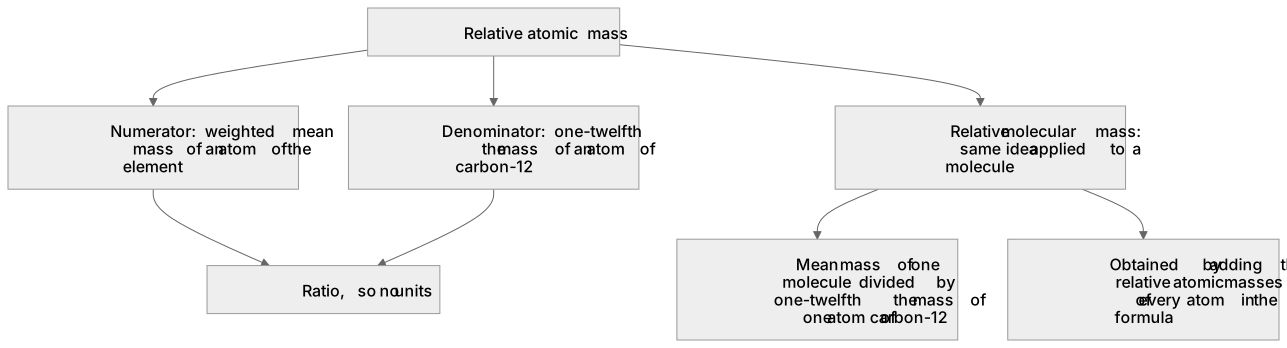
Relative atomic mass is a ratio, so it has no units. It is the weighted mean mass of an atom of the element divided by one-twelfth the mass of an atom of carbon-12. Both halves of that definition carry a mark, and the two halves must be consistent: atoms compared with atoms, or moles compared with moles, never one of each. Carbon-12 is the reference because its mass is defined as exactly 12 on this scale. Relative molecular mass is the same idea applied to a molecule: the mean mass of one molecule of the substance divided by one-twelfth the mass of one atom of carbon-12, obtained in practice by adding the relative atomic masses of every atom in the formula.
What earns the marks
- The numerator given as the average or mean mass of an atom of the element.
- The denominator given as one-twelfth the mass of one atom of carbon-12.
- Relative molecular mass defined as the mean mass of a molecule on the same scale.
- Keeping atoms with atoms or moles with moles throughout the definition.
Common mistakes and how to put them right
Mixing moles in one half of the definition with atoms in the other, which is capped at one mark.
Writing mass of one atom without the word average or mean.
Comparing with the mass of a carbon-12 atom while forgetting the one-twelfth.
Giving units such as grams to a quantity that is a ratio.
Exam tips
- Write the definition as a fraction with a horizontal line so the examiner can mark each line separately.
- Say carbon-12 explicitly rather than just carbon; ordinary carbon is a mixture of isotopes.
- Add average or weighted mean to the top line even when the question seems to be about a single atom.
Try the lesson
The start of the Relative atomic mass and relative molecular mass: Relative atomic mass and relative molecular mass in terms of C. lesson, made from checked teaching notes for this specification point.
Have a go first
How is the relative molecular mass of a substance defined?
Listen
Relative atomic mass is a ratio, so it has no units. It is the weighted mean mass of an atom of the element divided by one-twelfth the mass of an atom of carbon-12. Both halves of that definition carry a mark, and the two halves must be consistent: atoms compared with atoms, or moles compared with moles, never one of each. Carbon-12 is the reference because its mass is defined as exactly 12 on this scale. Relative molecular mass is the same idea applied to a molecule: the mean mass of one molecule of the substance divided by one-twelfth the mass of one atom of carbon-12, obtained in practice by adding the relative atomic masses of every atom in the formula. A strong answer earns marks for these points. the numerator given as the average or mean mass of an atom of the element. the denominator given as one-twelfth the mass of one atom of carbon-12. relative molecular mass defined as the mean mass of a molecule on the same scale. keeping atoms with atoms or moles with moles throughout the definition. Exam tip: Write the definition as a fraction with a horizontal line so the examiner can mark each line separately.
See it
Key words
Say what each word means before you turn the card.
relative atomic mass
Try answering aloud or in your head before turning the card.
carbon-12 scale
Try answering aloud or in your head before turning the card.
relative molecular mass
Try answering aloud or in your head before turning the card.
dimensionless ratio
Try answering aloud or in your head before turning the card.
See every definition
- relative atomic mass
- The weighted mean mass of an atom of the element divided by one-twelfth the mass of an atom of carbon-12.
- carbon-12 scale
- The scale on which the mass of an atom of carbon-12 is defined as exactly 12.
- relative molecular mass
- The mean mass of one molecule of the substance divided by one-twelfth the mass of one atom of carbon-12.
- dimensionless ratio
- A quantity that has no units because it is a ratio.
Label the diagram
Some boxes have lost their names. Pick the right name for each number.
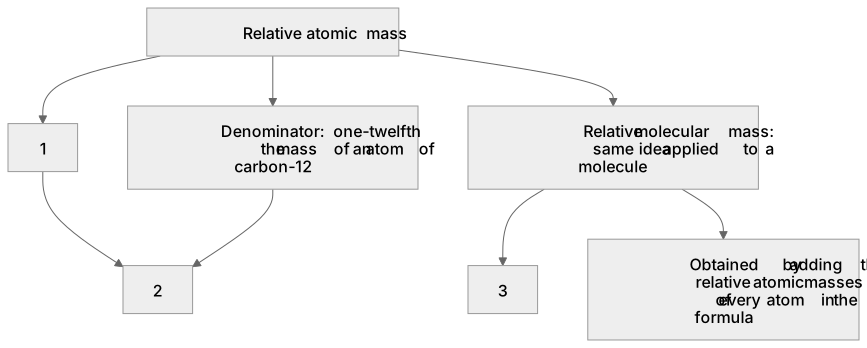
1Box 1
2Box 2
3Box 3
There is more to this lesson
The full lesson goes on to check your understanding and help you earn the marks. Create a free account to carry on, with your progress saved.
A week of Premium from your first lesson · Then the free plan continues · No card, no charge
Test your understanding of Relative atomic mass and relative molecular mass: Relative atomic mass and relative molecular mass in terms of C.
Active recall beats re-reading. Take an instant quiz now to test what you’ve learned and lock it into long-term memory.
A week of Premium from your first lesson · Then the free plan continues · No card, no charge