AQA · A-Level · Chemistry
Course version: 7405 · Version from Sept 2016
The term relative formula mass will be used for ionic compounds.
Full specification wording
Relative atomic mass and relative molecular mass: The term relative formula mass will be used for ionic compounds.
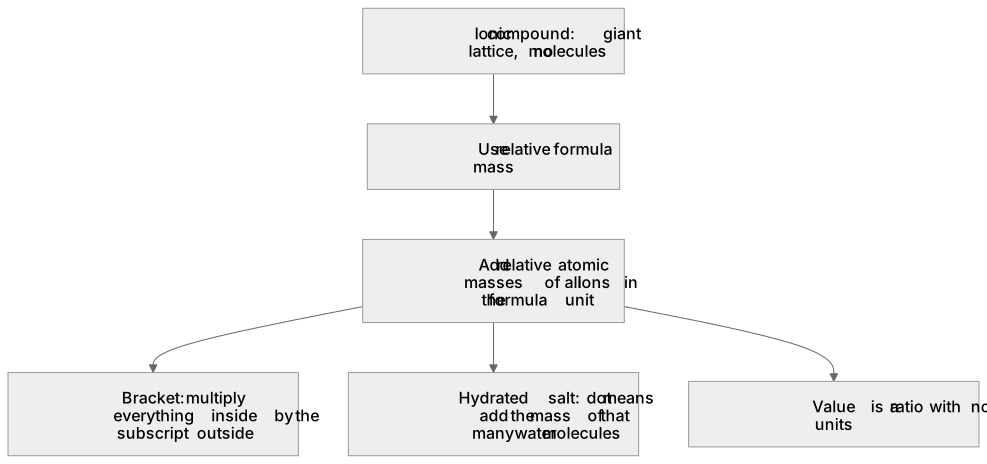
Ionic compounds are giant lattices, not collections of molecules, so there is no molecule whose mass could be quoted.
Checked against the AQA 7405 specification (opens in a new tab) on .
- Point 2 of 2
- 4 key terms
Study notes
From the checked teaching notes for this specification point.
The idea
Ionic compounds are giant lattices, not collections of molecules, so there is no molecule whose mass could be quoted. The term relative formula mass is used instead: it is the sum of the relative atomic masses of the ions in the simplest formula unit. Sodium chloride is 23.0⁺ 35.5 = 58.5, and calcium chloride is 40.1⁺ 2 × 35.5 = 111.1. Where a formula contains a bracketed compound ion, everything inside the bracket is multiplied by the subscript outside, so calcium hydroxide is 40.1⁺ 2(16.0⁺ 1.0) = 74.1. Hydrated salts include the water: the dot in the formula means add the mass of that many water molecules. Like relative molecular mass, the value is a ratio with no units.
What earns the marks
- Adding the relative atomic masses of all the ions in the formula unit.
- Multiplying everything inside a bracket by the subscript outside it.
- Including the water of crystallisation shown after the dot in a hydrated formula.
- The value quoted without units.
Common mistakes and how to put them right
Multiplying only the first atom inside a bracket, so calcium hydroxide comes out too light.
Treating sodium chloride as a molecule and calling the answer a relative molecular mass.
Leaving out the water of crystallisation in a hydrated salt.
Adding the subscripts instead of using them as multipliers.
Exam tips
- Expand any bracketed formula on the page before you add anything up.
- Use the relative atomic masses printed in the data booklet, not rounded whole numbers, when the answer needs decimals.
- Say relative formula mass rather than relative molecular mass whenever the substance is ionic.
Try the lesson
The start of the Relative atomic mass and relative molecular mass: The term relative formula mass will be used for ionic compounds. lesson, made from checked teaching notes for this specification point.
Have a go first
Which term is used for the mass of one formula unit of an ionic compound such as sodium chloride?
Listen
Ionic compounds are giant lattices, not collections of molecules, so there is no molecule whose mass could be quoted. The term relative formula mass is used instead: it is the sum of the relative atomic masses of the ions in the simplest formula unit. Sodium chloride is 23.0⁺ 35.5 = 58.5, and calcium chloride is 40.1⁺ 2 × 35.5 = 111.1. Where a formula contains a bracketed compound ion, everything inside the bracket is multiplied by the subscript outside, so calcium hydroxide is 40.1⁺ 2(16.0⁺ 1.0) = 74.1. Hydrated salts include the water: the dot in the formula means add the mass of that many water molecules. Like relative molecular mass, the value is a ratio with no units. A strong answer earns marks for these points. adding the relative atomic masses of all the ions in the formula unit. multiplying everything inside a bracket by the subscript outside it. including the water of crystallisation shown after the dot in a hydrated formula. the value quoted without units. Exam tip: Expand any bracketed formula on the page before you add anything up.
See it
Key words
Say what each word means before you turn the card.
relative formula mass
Try answering aloud or in your head before turning the card.
ionic lattices
Try answering aloud or in your head before turning the card.
formula units
Try answering aloud or in your head before turning the card.
water of crystallisation
Try answering aloud or in your head before turning the card.
See every definition
- relative formula mass
- The sum of the relative atomic masses of the ions in the simplest formula unit, used for ionic compounds.
- ionic lattices
- Giant lattices that ionic compounds form, rather than collections of molecules, so there is no molecule whose mass could be quoted.
- formula units
- The simplest unit of an ionic compound, whose ions' relative atomic masses are added to give the relative formula mass.
- water of crystallisation
- The water shown after the dot in a hydrated formula, whose mass must be included in the calculation.
Label the diagram
Some boxes have lost their names. Pick the right name for each number.
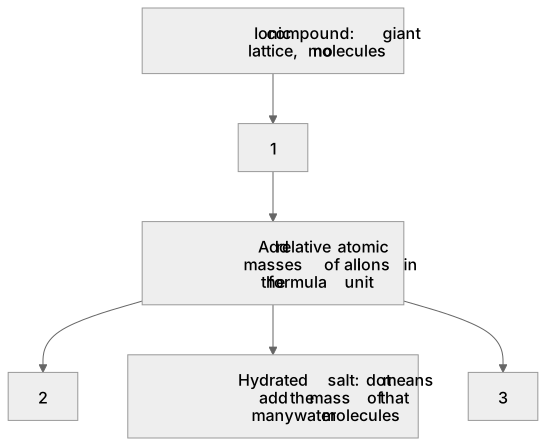
1Box 1
2Box 2
3Box 3
There is more to this lesson
The full lesson goes on to check your understanding and help you earn the marks. Create a free account to carry on, with your progress saved.
A week of Premium from your first lesson · Then the free plan continues · No card, no charge
Test your understanding of Relative atomic mass and relative molecular mass: The term relative formula mass will be used for ionic compounds.
Active recall beats re-reading. Take an instant quiz now to test what you’ve learned and lock it into long-term memory.
A week of Premium from your first lesson · Then the free plan continues · No card, no charge