AQA · A-Level · Chemistry
Course version: 7405 · Version from Sept 2016
Square planar complexes are also formed and can display cis–trans isomerism.
Full specification wording
Shapes of complex ions (A-level only): Square planar complexes are also formed and can display cis–trans isomerism.
Square planar complexes have four ligands in one plane at 90° to each other, and platinum(II) is the classic example.
Checked against the AQA 7405 specification (opens in a new tab) on .
- Point 2 of 3
- 3 key terms
Study notes
From the checked teaching notes for this specification point.
The idea
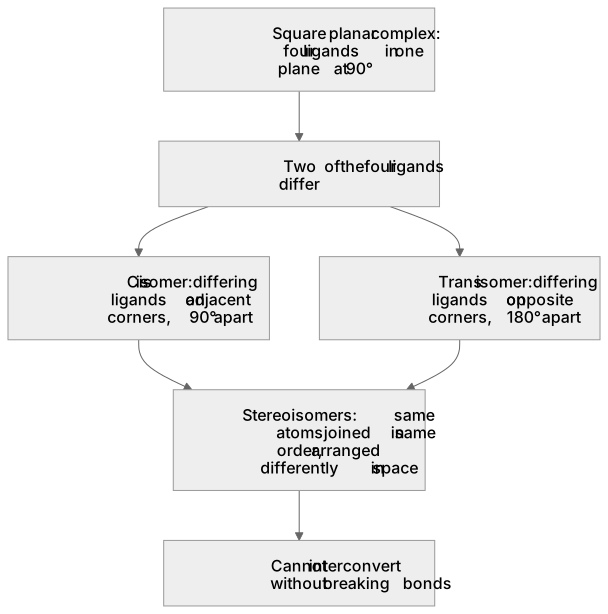
Square planar complexes have four ligands in one plane at 90° to each other, and platinum(II) is the classic example. When two of the four ligands differ, as in Pt(NH₃)₂Cl₂, two distinct compounds exist: the cis isomer with the chlorides on adjacent corners, 90° apart, and the trans isomer with them on opposite corners, 180° apart. They are stereoisomers, having the same atoms joined in the same order but arranged differently in space, and they cannot interconvert without breaking bonds. Octahedral complexes do the same: [Cr(NH₃)₄Cl₂]⁺ has cis and trans forms. A mark scheme for drawing them gives one mark for the pair of structures and a separate mark for showing the charge on the complex ion.
What earns the marks
- Two correctly drawn isomers, with ligands on adjacent corners for cis and opposite corners for trans.
- Showing the overall charge on the complex ion in the drawing.
- Naming the isomerism as cis-trans or geometric.
- The bond angles, 90° between cis ligands and 180° between trans ligands.
Common mistakes and how to put them right
Drawing a square planar complex as a tetrahedron, which cannot show cis-trans isomerism at all.
Omitting the charge on the complex ion in a drawing, which loses a separate mark.
Drawing the same isomer twice with the square simply rotated.
Calling the two forms optical isomers or structural isomers rather than stereoisomers.
Using E-Z nomenclature, which applies to alkenes, not square planar complexes.
Exam tips
- Draw the square with ligands at the corners, not on the edges, so adjacent and opposite are unambiguous.
- Write the charge outside the square bracket every time you draw a complex ion.
- Rotate your second drawing mentally to check that it really is a different isomer.
Try the lesson
The start of the Shapes of complex ions (A-level only): Square planar complexes are also formed and can display cis–trans isomerism. lesson, made from checked teaching notes for this specification point.
Have a go first
Which bond angle is found between adjacent ligands in a square planar complex ion?
Listen
Square planar complexes have four ligands in one plane at 90° to each other, and platinum(II) is the classic example. When two of the four ligands differ, as in Pt(NH₃)₂Cl₂, two distinct compounds exist: the cis isomer with the chlorides on adjacent corners, 90° apart, and the trans isomer with them on opposite corners, 180° apart. They are stereoisomers, having the same atoms joined in the same order but arranged differently in space, and they cannot interconvert without breaking bonds. Octahedral complexes do the same: [Cr(NH₃)₄Cl₂]⁺ has cis and trans forms. A mark scheme for drawing them gives one mark for the pair of structures and a separate mark for showing the charge on the complex ion. A strong answer earns marks for these points. two correctly drawn isomers, with ligands on adjacent corners for cis and opposite corners for trans. showing the overall charge on the complex ion in the drawing. naming the isomerism as cis-trans or geometric. the bond angles, 90° between cis ligands and 180° between trans ligands. Exam tip: Draw the square with ligands at the corners, not on the edges, so adjacent and opposite are unambiguous.
See it
Key words
Say what each word means before you turn the card.
cis-trans isomerism
Try answering aloud or in your head before turning the card.
stereoisomerism
Try answering aloud or in your head before turning the card.
90° and 180° arrangements
Try answering aloud or in your head before turning the card.
See every definition
- cis-trans isomerism
- A type of isomerism shown by square planar complexes in which two of the four ligands differ, giving a cis form with them 90° apart and a trans form with them 180° apart.
- stereoisomerism
- Having the same atoms joined in the same order but arranged differently in space, and the forms cannot interconvert without breaking bonds.
- 90° and 180° arrangements
- The bond angle between two ligands in the cis arrangement is 90°, and between two ligands in the trans arrangement is 180°.
Label the diagram
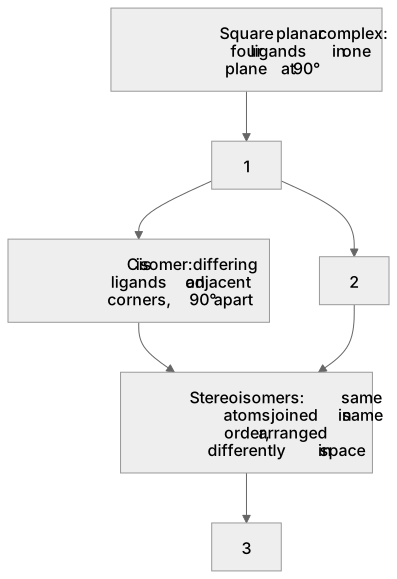
Some boxes have lost their names. Pick the right name for each number.
1Box 1
2Box 2
3Box 3
There is more to this lesson
The full lesson goes on to check your understanding and help you earn the marks. Create a free account to carry on, with your progress saved.
A week of Premium from your first lesson · Then the free plan continues · No card, no charge
Test your understanding of Shapes of complex ions (A-level only): Square planar complexes are also formed and can display cis–trans isomerism.
Active recall beats re-reading. Take an instant quiz now to test what you’ve learned and lock it into long-term memory.
A week of Premium from your first lesson · Then the free plan continues · No card, no charge