AQA · A-Level · Chemistry
Course version: 7405 · Version from Sept 2016
Transition metal ions commonly form tetrahedral – complexes with larger…
Full specification wording
Shapes of complex ions (A-level only): Transition metal ions commonly form tetrahedral – complexes with larger ligands (eg Cl ).
Ligand size decides the shape.
Checked against the AQA 7405 specification (opens in a new tab) on .
- Point 1 of 3
- 4 key terms
Study notes
From the checked teaching notes for this specification point.
The idea
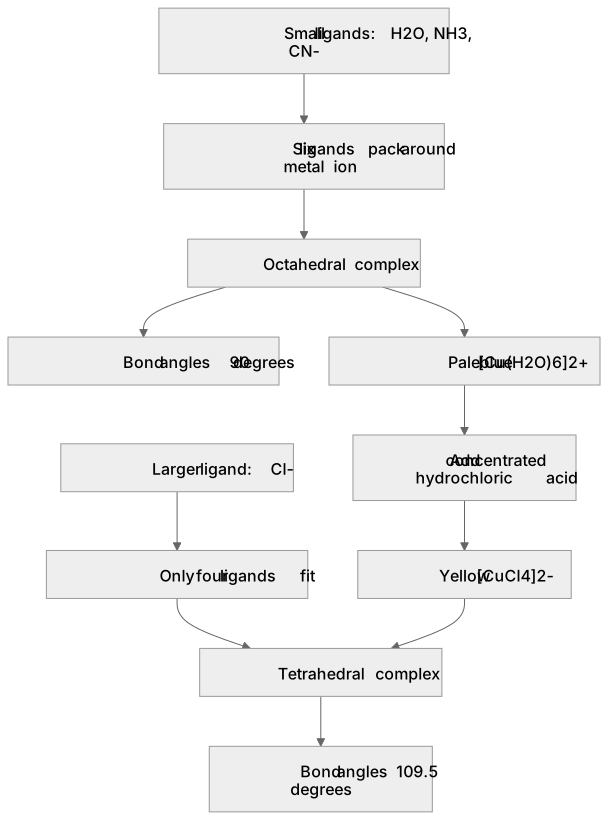
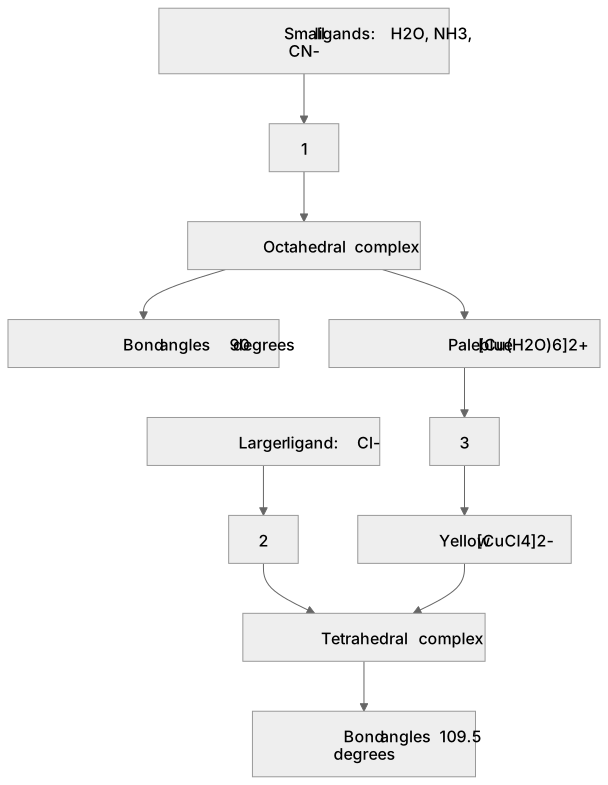
Ligand size decides the shape. Small ligands such as H₂O, NH₃ and CN⁻ pack six around a metal ion to give an octahedral complex with bond angles of 90°. Chloride is much bigger, so only four fit, and those four arrange themselves tetrahedrally with bond angles of 109.5°. [CuCl₄]²⁻ and [CoCl₄]²⁻ are the standard examples and both are tetrahedral, not square planar, a confusion that a multiple choice paper has tested directly. Adding concentrated hydrochloric acid to aqueous copper(II) shows the swap: pale blue octahedral [Cu(H₂O)₆]²⁺ becomes yellow tetrahedral [CuCl₄]²⁻, the co-ordination number falling from 6 to 4 and the colour changing as a result.
What earns the marks
- Identifying a chloride complex such as [CoCl₄]²⁻ or [CuCl₄]²⁻ as tetrahedral.
- The bond angle, 109.5° in a tetrahedral complex against 90° in an octahedral one.
- Attributing the co-ordination number of 4 to the larger size of the chloride ligand.
- A correct substitution equation that includes all six displaced water molecules.
Common mistakes and how to put them right
Calling [CoCl₄]²⁻ square planar, which is the distractor used in the multiple choice papers.
Quoting 90° as the bond angle in a tetrahedral chloride complex.
Keeping six ligands when writing the chloride complex, so giving [CuCl₆]⁴⁻.
Explaining the change of shape by the charge on chloride rather than by its size.
Exam tips
- Read the ligand first, because Cl⁻ almost always means four ligands and a tetrahedral shape.
- Give the bond angle whenever you name a shape, since it is often a separate mark.
- Show all six water molecules on the right hand side when chloride replaces them.
Try the lesson
The start of the Shapes of complex ions (A-level only): Transition metal ions commonly form tetrahedral – complexes with larger ligands (eg Cl ). lesson, made from checked teaching notes for this specification point.
Have a go first
Which shape is commonly adopted by complex ions, such as [CoCl₄]²⁻ and [CuCl₄]²⁻, where a transition metal ion bonds to four large chloride ligands?
Listen
Ligand size decides the shape. Small ligands such as H₂O, NH₃ and CN⁻ pack six around a metal ion to give an octahedral complex with bond angles of 90°. Chloride is much bigger, so only four fit, and those four arrange themselves tetrahedrally with bond angles of 109.5°. CuCl₄]²⁻ and [CoCl₄]²⁻ are the standard examples and both are tetrahedral, not square planar, a confusion that a multiple choice paper has tested directly. Adding concentrated hydrochloric acid to aqueous copper(II) shows the swap: pale blue octahedral [Cu(H₂O)₆]²⁺ becomes yellow tetrahedral [CuCl₄]²⁻, the co-ordination number falling from 6 to 4 and the colour changing as a result. A strong answer earns marks for these points. identifying a chloride complex such as [CoCl₄]²⁻ or [CuCl₄]²⁻ as tetrahedral. the bond angle, 109.5° in a tetrahedral complex against 90° in an octahedral one. attributing the co-ordination number of 4 to the larger size of the chloride ligand. a correct substitution equation that includes all six displaced water molecules. Exam tip: Read the ligand first, because Cl⁻ almost always means four ligands and a tetrahedral shape.
See it
Key words
Say what each word means before you turn the card.
tetrahedral complexes
Try answering aloud or in your head before turning the card.
ligand size
Try answering aloud or in your head before turning the card.
co-ordination number 4
Try answering aloud or in your head before turning the card.
bond angle of 109.5°
Try answering aloud or in your head before turning the card.
See every definition
- tetrahedral complexes
- Complexes in which four ligands arrange themselves tetrahedrally around the metal ion, with bond angles of 109.5°.
- ligand size
- The factor that decides the shape, because small ligands pack six around a metal ion while larger ligands allow only four to fit.
- co-ordination number 4
- The number of ligands attached to the metal ion when larger ligands such as chloride are present, falling from 6.
- bond angle of 109.5°
- The angle found in a tetrahedral complex, against 90° in an octahedral one.
Label the diagram
Some boxes have lost their names. Pick the right name for each number.
1Box 1
2Box 2
3Box 3
There is more to this lesson
The full lesson goes on to check your understanding and help you earn the marks. Create a free account to carry on, with your progress saved.
A week of Premium from your first lesson · Then the free plan continues · No card, no charge
Test your understanding of Shapes of complex ions (A-level only): Transition metal ions commonly form tetrahedral – complexes with larger ligands (eg Cl ).
Active recall beats re-reading. Take an instant quiz now to test what you’ve learned and lock it into long-term memory.
A week of Premium from your first lesson · Then the free plan continues · No card, no charge