AQA · A-Level · Chemistry
Course version: 7405 · Version from Sept 2016
Bonding pairs and lone (non-bonding) pairs of electrons as charge clouds…
Full specification wording
Shapes of simple molecules and ions: Bonding pairs and lone (non-bonding) pairs of electrons as charge clouds that repel each other.
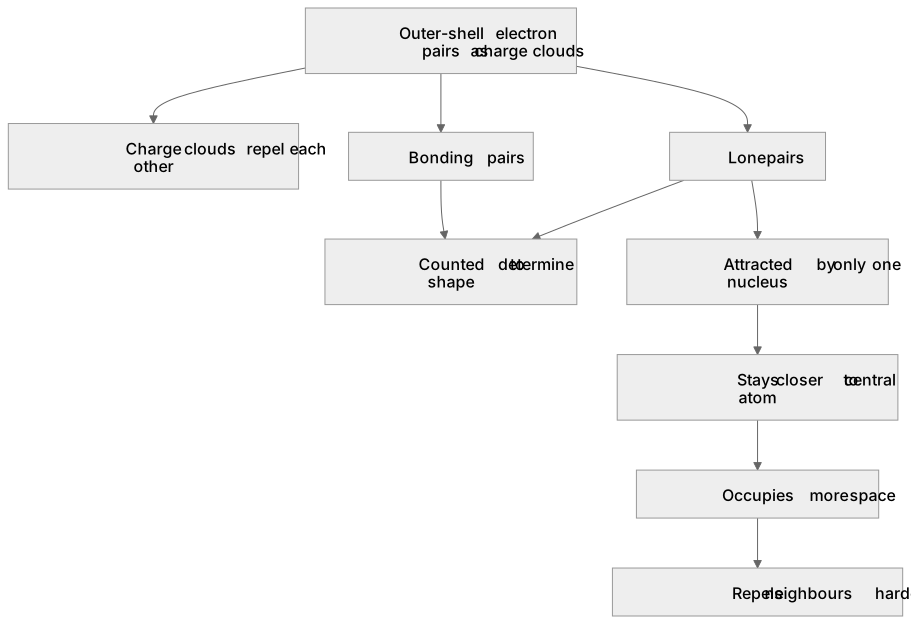
Electron pair repulsion theory treats each pair of outer-shell electrons around the central atom as a cloud of negative charge.
Checked against the AQA 7405 specification (opens in a new tab) on .
- Point 1 of 5
- 4 key terms
Study notes
From the checked teaching notes for this specification point.
The idea
Electron pair repulsion theory treats each pair of outer-shell electrons around the central atom as a cloud of negative charge. Like charges repel, so the clouds push each other as far apart as they can, and the positions they settle into fix the shape. Both kinds of pair count: bonding pairs, shared with another atom, and lone pairs, which belong to the central atom alone. A lone pair is attracted by only one nucleus rather than two, so it stays closer to the central atom and spreads out more, occupying more space and repelling its neighbours harder. That is why lone pairs must be counted when predicting a shape even though they are invisible in the finished molecule.
What earns the marks
- Describing electron pairs as regions or clouds of negative charge.
- Stating that these regions repel one another.
- Including lone pairs as well as bonding pairs in the count that determines the shape.
- A lone pair occupying more space because it is attracted by only one nucleus.
Common mistakes and how to put them right
Counting only the atoms attached and ignoring the lone pairs.
Saying lone pairs do not affect the shape because they cannot be seen.
Treating individual electrons rather than pairs as the repelling units.
Assuming a bonding pair repels more strongly than a lone pair.
Exam tips
- Count total electron pairs first, then separate them into bonding and lone pairs.
- Say charge clouds repel rather than electrons repel; the pair is the unit in this theory.
- When a question says include any lone pairs that influence the shape, they must appear in your drawing.
Try the lesson
The start of the Shapes of simple molecules and ions: Bonding pairs and lone (non-bonding) pairs of electrons as charge clouds that repel each other. lesson, made from checked teaching notes for this specification point.
Have a go first
In a molecule of ammonia, NH₃, the nitrogen atom has three bonding pairs and one lone pair of electrons. Which statement describes how these electron pairs behave?
Listen
Electron pair repulsion theory treats each pair of outer-shell electrons around the central atom as a cloud of negative charge. Like charges repel, so the clouds push each other as far apart as they can, and the positions they settle into fix the shape. Both kinds of pair count: bonding pairs, shared with another atom, and lone pairs, which belong to the central atom alone. A lone pair is attracted by only one nucleus rather than two, so it stays closer to the central atom and spreads out more, occupying more space and repelling its neighbours harder. That is why lone pairs must be counted when predicting a shape even though they are invisible in the finished molecule. A strong answer earns marks for these points. describing electron pairs as regions or clouds of negative charge. stating that these regions repel one another. including lone pairs as well as bonding pairs in the count that determines the shape. a lone pair occupying more space because it is attracted by only one nucleus. Exam tip: Count total electron pairs first, then separate them into bonding and lone pairs.
See it
Key words
Say what each word means before you turn the card.
charge clouds
Try answering aloud or in your head before turning the card.
electron pair repulsion
Try answering aloud or in your head before turning the card.
bonding pairs
Try answering aloud or in your head before turning the card.
lone pairs
Try answering aloud or in your head before turning the card.
See every definition
- charge clouds
- Regions of negative charge that each pair of outer-shell electrons around the central atom is treated as.
- electron pair repulsion
- Like charges repel, so the clouds push each other as far apart as they can, and the positions they settle into fix the shape.
- bonding pairs
- Pairs of electrons shared with another atom.
- lone pairs
- Pairs of electrons that belong to the central atom alone and are attracted by only one nucleus rather than two.
Label the diagram
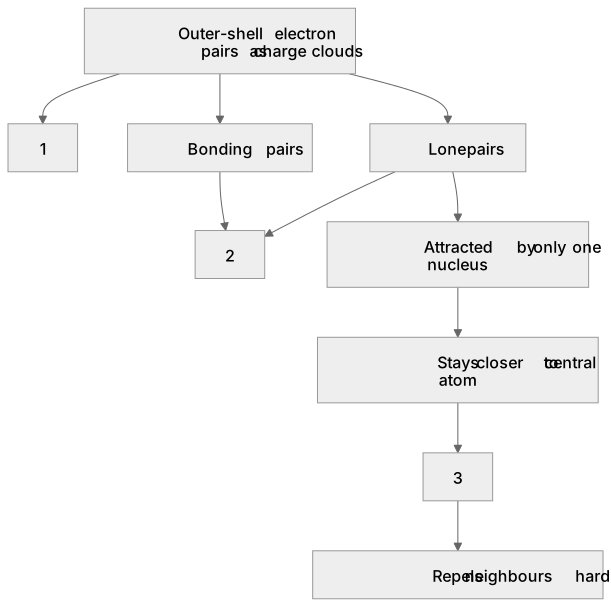
Some boxes have lost their names. Pick the right name for each number.
1Box 1
2Box 2
3Box 3
There is more to this lesson
The full lesson goes on to check your understanding and help you earn the marks. Create a free account to carry on, with your progress saved.
A week of Premium from your first lesson · Then the free plan continues · No card, no charge
Test your understanding of Shapes of simple molecules and ions: Bonding pairs and lone (non-bonding) pairs of electrons as charge clouds that repel each other.
Active recall beats re-reading. Take an instant quiz now to test what you’ve learned and lock it into long-term memory.
A week of Premium from your first lesson · Then the free plan continues · No card, no charge