AQA · A-Level · Chemistry
Course version: 7405 · Version from Sept 2016
Pairs of electrons in the outer shell of atoms arrange themselves as far…
Full specification wording
Shapes of simple molecules and ions: Pairs of electrons in the outer shell of atoms arrange themselves as far apart as possible to minimise repulsion.
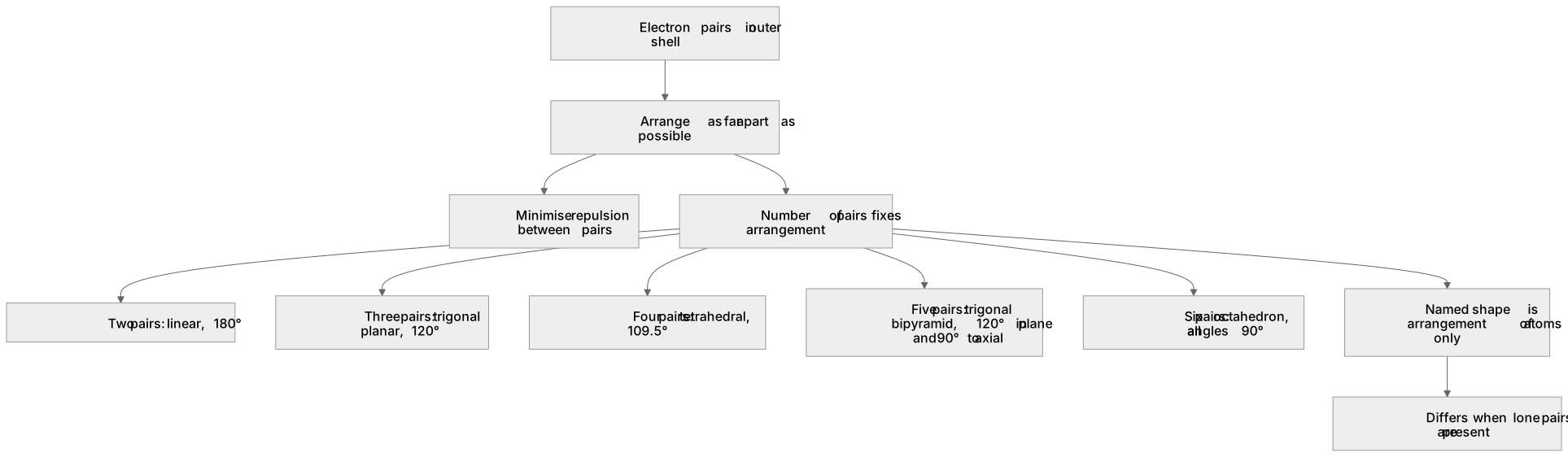
The governing rule is that electron pairs take up the arrangement that puts them as far apart as possible, because that minimises the repulsion between them.
Checked against the AQA 7405 specification (opens in a new tab) on .
- Point 2 of 5
- 4 key terms
Study notes
From the checked teaching notes for this specification point.
The idea
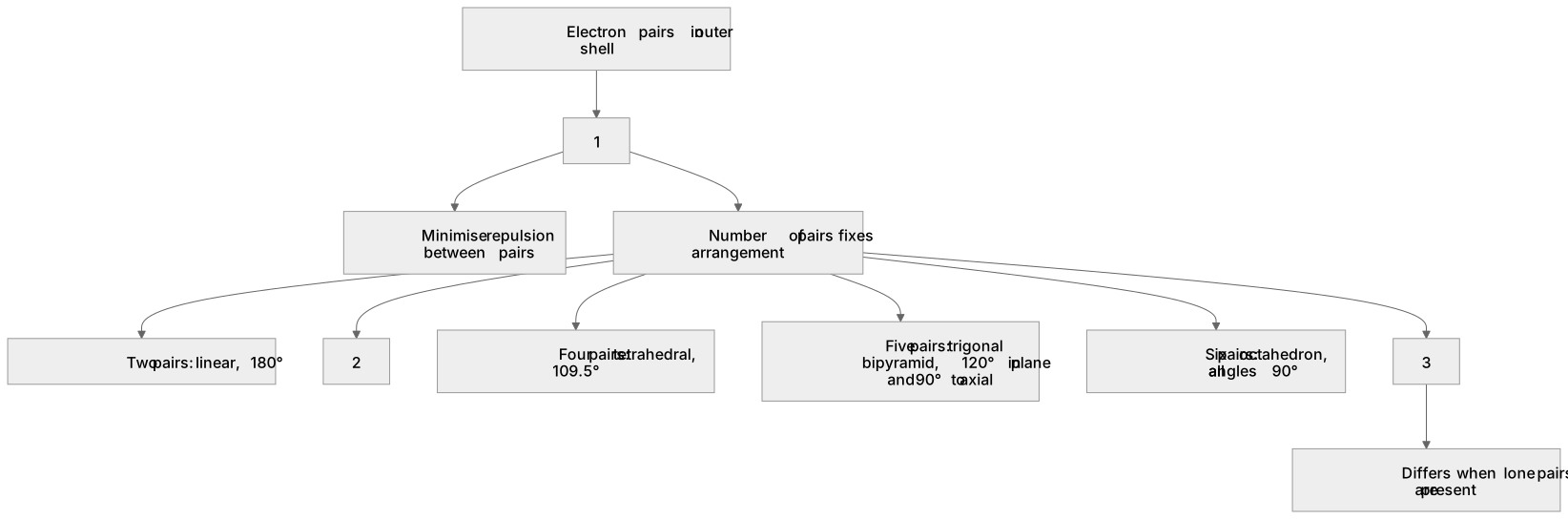
The governing rule is that electron pairs take up the arrangement that puts them as far apart as possible, because that minimises the repulsion between them. The number of pairs fixes the arrangement: two pairs go to opposite sides, linear at 180°; three spread into a flat triangle, trigonal planar at 120°; four move into three dimensions, tetrahedral at 109.5°; five form a trigonal bipyramid with angles of 120° in the plane and 90° to the axial positions; six form an octahedron with all angles 90°. These are the arrangements of the electron pairs. The shape you name is the arrangement of the atoms only, which differs whenever lone pairs are present.
What earns the marks
- Stating that the electron pairs move as far apart as possible.
- The reason, to minimise repulsion between the pairs.
- The correct arrangement for the total number of electron pairs.
- The bond angle quoted for that arrangement.
Common mistakes and how to put them right
Quoting 109.5° for any molecule with four electron pairs, including those with lone pairs.
Drawing a tetrahedral molecule flat on the page with 90° angles.
Saying the pairs repel in order to become stable rather than to minimise repulsion.
Naming the shape from the electron pair arrangement rather than from the positions of the atoms.
Exam tips
- Learn the five arrangements and their angles as a single list before attempting any shape question.
- Use wedges and dashed lines so a three-dimensional shape is unambiguous on paper.
- Write the number of pairs beside your diagram; it justifies the arrangement you chose.
Try the lesson
The start of the Shapes of simple molecules and ions: Pairs of electrons in the outer shell of atoms arrange themselves as far apart as possible to minimise repulsion. lesson, made from checked teaching notes for this specification point.
Have a go first
In a molecule of methane, CH₄, the carbon atom has four bonding pairs of electrons. According to electron pair repulsion theory, how do these four pairs arrange themselves?
Listen
The governing rule is that electron pairs take up the arrangement that puts them as far apart as possible, because that minimises the repulsion between them. The number of pairs fixes the arrangement: two pairs go to opposite sides, linear at 180°; three spread into a flat triangle, trigonal planar at 120°; four move into three dimensions, tetrahedral at 109.5°; five form a trigonal bipyramid with angles of 120° in the plane and 90° to the axial positions; six form an octahedron with all angles 90°. These are the arrangements of the electron pairs. The shape you name is the arrangement of the atoms only, which differs whenever lone pairs are present. A strong answer earns marks for these points. stating that the electron pairs move as far apart as possible. the reason, to minimise repulsion between the pairs. the correct arrangement for the total number of electron pairs. the bond angle quoted for that arrangement. Exam tip: Learn the five arrangements and their angles as a single list before attempting any shape question.
See it
Key words
Say what each word means before you turn the card.
maximum separation
Try answering aloud or in your head before turning the card.
minimising repulsion
Try answering aloud or in your head before turning the card.
linear and trigonal planar
Try answering aloud or in your head before turning the card.
tetrahedral arrangement
Try answering aloud or in your head before turning the card.
See every definition
- maximum separation
- Pairs of electrons in the outer shell of atoms arrange themselves as far apart as possible.
- minimising repulsion
- Electron pairs take up the arrangement that puts them as far apart as possible because that minimises the repulsion between them.
- linear and trigonal planar
- Two pairs go to opposite sides, linear at 180°; three spread into a flat triangle, trigonal planar at 120°.
- tetrahedral arrangement
- Four pairs move into three dimensions, tetrahedral at 109.5°.
Label the diagram
Some boxes have lost their names. Pick the right name for each number.
1Box 1
2Box 2
3Box 3
There is more to this lesson
The full lesson goes on to check your understanding and help you earn the marks. Create a free account to carry on, with your progress saved.
A week of Premium from your first lesson · Then the free plan continues · No card, no charge
Test your understanding of Shapes of simple molecules and ions: Pairs of electrons in the outer shell of atoms arrange themselves as far apart as possible to minimise repulsion.
Active recall beats re-reading. Take an instant quiz now to test what you’ve learned and lock it into long-term memory.
A week of Premium from your first lesson · Then the free plan continues · No card, no charge