AQA · A-Level · Chemistry
Course version: 7405 · Version from Sept 2016
Oxygen forms a co-ordinate bond to Fe(II) in haemoglobin, enabling oxygen…
Full specification wording
Substitution reactions (A-level only): Oxygen forms a co-ordinate bond to Fe(II) in haemoglobin, enabling oxygen to be transported in the blood.
Oxygen transport works because the bond formed is a co-ordinate bond and, crucially, a reversible one.
Checked against the AQA 7405 specification (opens in a new tab) on .
- Point 2 of 5
Study notes
From the checked teaching notes for this specification point.
The idea
Oxygen transport works because the bond formed is a co-ordinate bond and, crucially, a reversible one. In the lungs, where the partial pressure of oxygen is high, an O₂ molecule donates a lone pair into the vacant sixth co-ordination site on the Fe²⁺ of haem, forming oxyhaemoglobin. Blood carries this to respiring tissue, where the partial pressure of oxygen is low, the equilibrium shifts back, O₂ is released and a water molecule takes the site instead. The iron stays as Fe²⁺ throughout. The bond must be strong enough to pick oxygen up but weak enough to let it go again; a ligand that bound irreversibly would load the haemoglobin once and then stop it working, which is exactly what carbon monoxide does.
What earns the marks
- Stating that O₂ donates a lone pair to Fe(II) to form a co-ordinate bond.
- Identifying the sixth co-ordination site, previously occupied by water, as the binding site.
- Describing the binding as reversible, with uptake in the lungs and release in the tissues.
- Linking release of oxygen to the lower partial pressure of oxygen in respiring tissue.
Common mistakes and how to put them right
Saying the oxygen is reduced or that Fe²⁺ is oxidised to Fe³⁺ when oxygen binds.
Describing the bond as ionic, or as a normal covalent bond rather than a co-ordinate bond.
Claiming oxygen displaces the globin rather than the water at the sixth site.
Treating the binding as irreversible, which would leave no mechanism for delivering oxygen.
Exam tips
- Use the word reversible, because it is usually the mark that separates a transport answer from a bonding answer.
- Name the site that oxygen occupies rather than saying oxygen attaches to the haemoglobin.
- Link the direction of the shift to partial pressure whenever a question mentions lungs and tissues.
Try the lesson
The start of the Substitution reactions (A-level only): Oxygen forms a co-ordinate bond to Fe(II) in haemoglobin, enabling oxygen to be transported in the blood. lesson, made from checked teaching notes for this specification point.
Have a go first
How does an oxygen molecule bond to the haemoglobin complex during transport in the blood?
Listen
Oxygen transport works because the bond formed is a co-ordinate bond and, crucially, a reversible one. In the lungs, where the partial pressure of oxygen is high, an O₂ molecule donates a lone pair into the vacant sixth co-ordination site on the Fe²⁺ of haem, forming oxyhaemoglobin. Blood carries this to respiring tissue, where the partial pressure of oxygen is low, the equilibrium shifts back, O₂ is released and a water molecule takes the site instead. The iron stays as Fe²⁺ throughout. The bond must be strong enough to pick oxygen up but weak enough to let it go again; a ligand that bound irreversibly would load the haemoglobin once and then stop it working, which is exactly what carbon monoxide does. A strong answer earns marks for these points. stating that O₂ donates a lone pair to Fe(II) to form a co-ordinate bond. identifying the sixth co-ordination site, previously occupied by water, as the binding site. describing the binding as reversible, with uptake in the lungs and release in the tissues. linking release of oxygen to the lower partial pressure of oxygen in respiring tissue. Exam tip: Use the word reversible, because it is usually the mark that separates a transport answer from a bonding answer.
See it
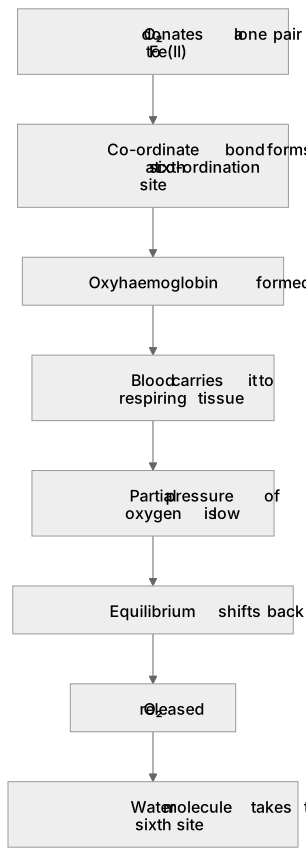
Put it in order
Put these steps in the order they happen.
- 1. Partial pressure of oxygen is low
- 2. Water molecule takes the sixth site
- 3. Equilibrium shifts back
- 4. O₂ donates a lone pair to Fe(II)
- 5. Co-ordinate bond forms at sixth co-ordination site
- 6. O₂ released
- 7. Oxyhaemoglobin formed
- 8. Blood carries it to respiring tissue
Label the diagram
Some boxes have lost their names. Pick the right name for each number.
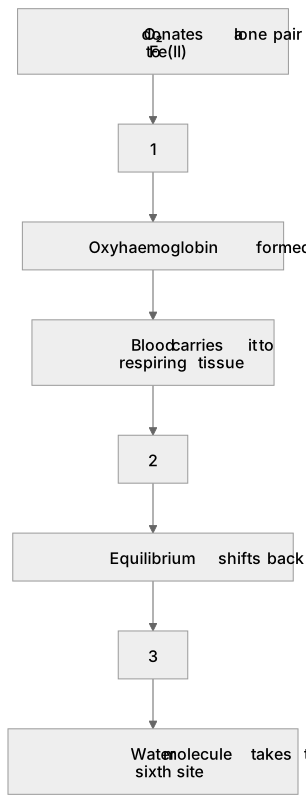
1Box 1
2Box 2
3Box 3
There is more to this lesson
The full lesson goes on to check your understanding and help you earn the marks. Create a free account to carry on, with your progress saved.
A week of Premium from your first lesson · Then the free plan continues · No card, no charge
Test your understanding of Substitution reactions (A-level only): Oxygen forms a co-ordinate bond to Fe(II) in haemoglobin, enabling oxygen to be transported in the blood.
Active recall beats re-reading. Take an instant quiz now to test what you’ve learned and lock it into long-term memory.
A week of Premium from your first lesson · Then the free plan continues · No card, no charge