AQA · A-Level · Chemistry
Course version: 7405 · Version from Sept 2016
Carbon monoxide is toxic because it replaces oxygen co- ordinately bonded…
Full specification wording
Substitution reactions (A-level only): Carbon monoxide is toxic because it replaces oxygen co- ordinately bonded to Fe(II) in haemoglobin.
Carbon monoxide is a ligand: the carbon atom carries a lone pair and donates it to Fe²⁺ exactly as oxygen does, forming carboxyhaemoglobin.
Checked against the AQA 7405 specification (opens in a new tab) on .
- Point 3 of 5
Study notes
From the checked teaching notes for this specification point.
The idea
Carbon monoxide is a ligand: the carbon atom carries a lone pair and donates it to Fe²⁺ exactly as oxygen does, forming carboxyhaemoglobin. The problem is strength. Carbon monoxide binds to haem around two hundred times more strongly than O₂ does, so the substitution is effectively irreversible at ordinary concentrations. Once carbon monoxide occupies the sixth site, that haemoglobin molecule can no longer pick up oxygen in the lungs or release it to tissue, so the oxygen carrying capacity of the blood falls and cells are starved of oxygen. The toxicity is therefore not a poison attacking a cell directly but a ligand substitution reaction with a far more favourable position of equilibrium.
What earns the marks
- Stating that carbon monoxide forms a co-ordinate bond to Fe(II) by donating a lone pair from the carbon atom.
- Identifying the process as ligand substitution, with carbon monoxide replacing O₂ or H₂O.
- Stating that carbon monoxide binds more strongly than oxygen, so the substitution is effectively irreversible.
- The consequence, that the haemoglobin can no longer transport oxygen.
Common mistakes and how to put them right
Saying carbon monoxide destroys or denatures the haemoglobin rather than bonding to it.
Drawing the donation from the oxygen atom of carbon monoxide instead of from the carbon atom.
Describing the binding of carbon monoxide as reversible in the same way as oxygen, which removes the reason for the toxicity.
Saying carbon monoxide reacts with oxygen in the blood to form carbon dioxide.
Exam tips
- Use the phrase ligand substitution and name the ligand that leaves as well as the one that arrives.
- Say the bond is stronger than the bond to oxygen, because carbon monoxide is poisonous gains nothing on its own.
- Keep the iron in the +2 oxidation state throughout your answer.
Try the lesson
The start of the Substitution reactions (A-level only): Carbon monoxide is toxic because it replaces oxygen co- ordinately bonded to Fe(II) in haemoglobin. lesson, made from checked teaching notes for this specification point.
Have a go first
Which ligand in haemoglobin is replaced by carbon monoxide?
Listen
Carbon monoxide is a ligand: the carbon atom carries a lone pair and donates it to Fe²⁺ exactly as oxygen does, forming carboxyhaemoglobin. The problem is strength. Carbon monoxide binds to haem around two hundred times more strongly than O₂ does, so the substitution is effectively irreversible at ordinary concentrations. Once carbon monoxide occupies the sixth site, that haemoglobin molecule can no longer pick up oxygen in the lungs or release it to tissue, so the oxygen carrying capacity of the blood falls and cells are starved of oxygen. The toxicity is therefore not a poison attacking a cell directly but a ligand substitution reaction with a far more favourable position of equilibrium. A strong answer earns marks for these points. stating that carbon monoxide forms a co-ordinate bond to Fe(II) by donating a lone pair from the carbon atom. identifying the process as ligand substitution, with carbon monoxide replacing O₂ or H₂O. stating that carbon monoxide binds more strongly than oxygen, so the substitution is effectively irreversible. the consequence, that the haemoglobin can no longer transport oxygen. Exam tip: Use the phrase ligand substitution and name the ligand that leaves as well as the one that arrives.
See it
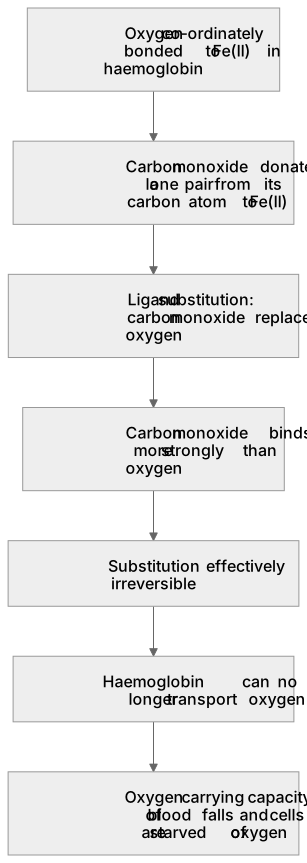
Put it in order
Put these steps in the order they happen.
- 1. Oxygen carrying capacity of blood falls and cells are starved of oxygen
- 2. Haemoglobin can no longer transport oxygen
- 3. Ligand substitution: carbon monoxide replaces oxygen
- 4. Substitution effectively irreversible
- 5. Oxygen co-ordinately bonded to Fe(II) in haemoglobin
- 6. Carbon monoxide donates a lone pair from its carbon atom to Fe(II)
- 7. Carbon monoxide binds more strongly than oxygen
Label the diagram
Some boxes have lost their names. Pick the right name for each number.
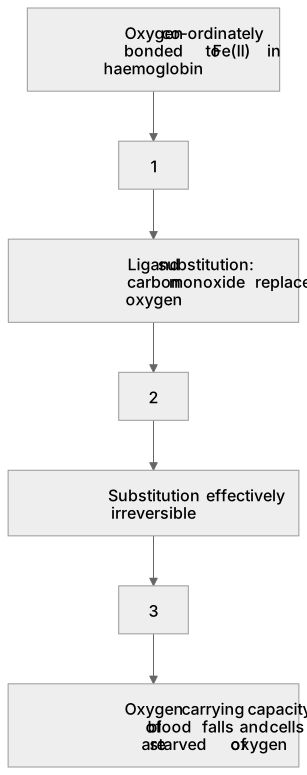
1Box 1
2Box 2
3Box 3
There is more to this lesson
The full lesson goes on to check your understanding and help you earn the marks. Create a free account to carry on, with your progress saved.
A week of Premium from your first lesson · Then the free plan continues · No card, no charge
Test your understanding of Substitution reactions (A-level only): Carbon monoxide is toxic because it replaces oxygen co- ordinately bonded to Fe(II) in haemoglobin.
Active recall beats re-reading. Take an instant quiz now to test what you’ve learned and lock it into long-term memory.
A week of Premium from your first lesson · Then the free plan continues · No card, no charge