AQA · A-Level · Chemistry
Course version: 7405 · Version from Sept 2016
Students should be able to: explain the chelate effect, in terms of the…
Full specification wording
Substitution reactions (A-level only): Students should be able to: explain the chelate effect, in terms of the balance between the entropy and enthalpy change in these reactions.
This is a Gibbs free energy argument and the marks are usually split between the two terms.
Checked against the AQA 7405 specification (opens in a new tab) on .
- Point 5 of 5
Study notes
From the checked teaching notes for this specification point.
The idea
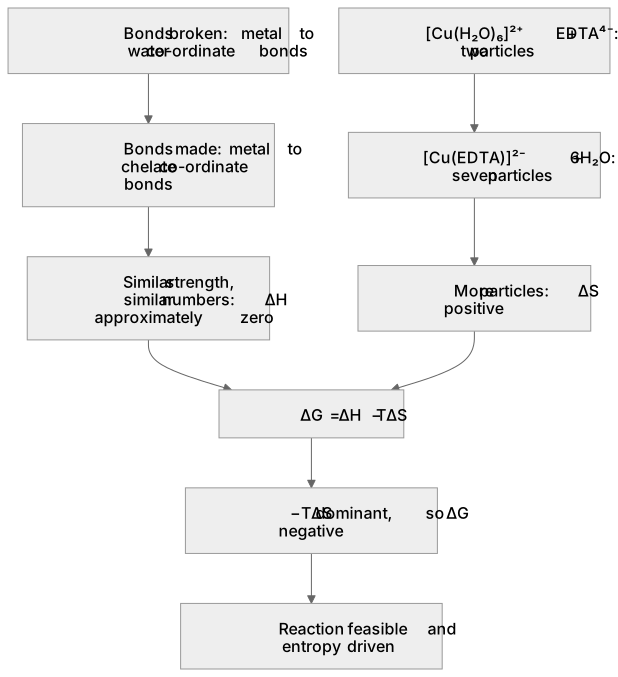
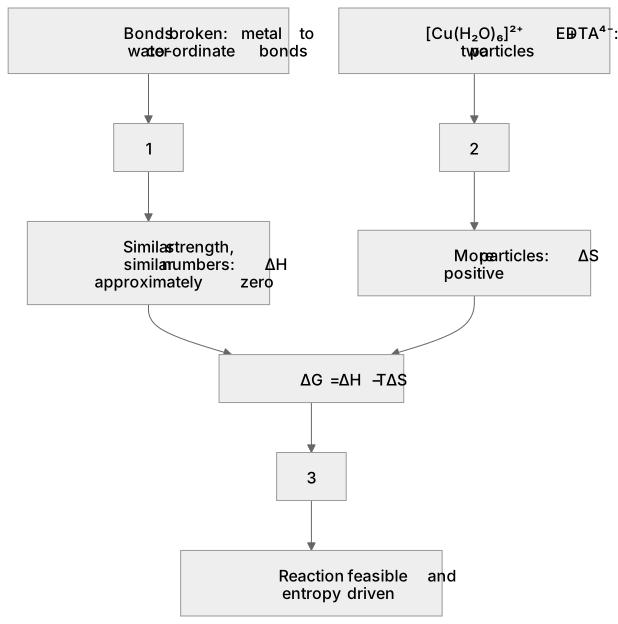
This is a Gibbs free energy argument and the marks are usually split between the two terms. The enthalpy change is close to zero because the bonds broken, metal to water co-ordinate bonds, and the bonds made, metal to chelate co-ordinate bonds, are of very similar strength, so ΔH barely contributes. The entropy change is clearly positive: [Cu(H₂O)₆]²⁺ + EDTA⁴⁻ → [Cu(EDTA)]²⁻ + 6H₂O turns two particles into seven, so the system has many more ways of arranging itself. Substituting into ΔG = ΔH − TΔS, a near zero ΔH with a positive ΔS makes −TΔS the dominant term, so ΔG is negative and the reaction is feasible. The chelate effect is entropy driven.
What earns the marks
- Stating that ΔH is approximately zero because similar numbers of co-ordinate bonds of similar strength are broken and made.
- A positive ΔS justified by the increase in the number of particles in solution.
- Using ΔG = ΔH − TΔS to show that ΔG is negative.
- Concluding that the reaction is entropy driven rather than enthalpy driven.
Common mistakes and how to put them right
Claiming ΔH is large and negative because the chelate forms a stronger complex.
Counting the wrong species, for example including solvent water, so getting the sign of ΔS wrong.
Writing ΔG = ΔH + TΔS and concluding the reaction is not feasible.
Stating that entropy increases without saying which side of the equation has more particles.
Exam tips
- Count the particles in the equation you have written and quote both numbers in your answer.
- Say ΔH is close to zero rather than there is no enthalpy change, which examiners read as careless.
- Finish with the sign of ΔG, because the conclusion usually carries a mark of its own.
Try the lesson
The start of the Substitution reactions (A-level only): Students should be able to: explain the chelate effect, in terms of the balance between the entropy and enthalpy change in these reactions. lesson, made from checked teaching notes for this specification point.
Have a go first
The replacement of monodentate ligands by bidentate ligands in an aqueous complex is known as the chelate effect. Which statement best explains why this process is thermodynamically favourable?
Listen
This is a Gibbs free energy argument and the marks are usually split between the two terms. The enthalpy change is close to zero because the bonds broken, metal to water co-ordinate bonds, and the bonds made, metal to chelate co-ordinate bonds, are of very similar strength, so ΔH barely contributes. The entropy change is clearly positive: [Cu(H₂O)₆]²⁺ + EDTA⁴⁻ → [Cu(EDTA)]²⁻ + 6H₂O turns two particles into seven, so the system has many more ways of arranging itself. Substituting into ΔG = ΔH − TΔS, a near zero ΔH with a positive ΔS makes −TΔS the dominant term, so ΔG is negative and the reaction is feasible. The chelate effect is entropy driven. A strong answer earns marks for these points. stating that ΔH is approximately zero because similar numbers of co-ordinate bonds of similar strength are broken and made. a positive ΔS justified by the increase in the number of particles in solution. using ΔG = ΔH − TΔS to show that ΔG is negative. concluding that the reaction is entropy driven rather than enthalpy driven. Exam tip: Count the particles in the equation you have written and quote both numbers in your answer.
See it
Label the diagram
Some boxes have lost their names. Pick the right name for each number.
1Box 1
2Box 2
3Box 3
There is more to this lesson
The full lesson goes on to check your understanding and help you earn the marks. Create a free account to carry on, with your progress saved.
A week of Premium from your first lesson · Then the free plan continues · No card, no charge
Test your understanding of Substitution reactions (A-level only): Students should be able to: explain the chelate effect, in terms of the balance between the entropy and enthalpy change in these reactions.
Active recall beats re-reading. Take an instant quiz now to test what you’ve learned and lock it into long-term memory.
A week of Premium from your first lesson · Then the free plan continues · No card, no charge