AQA · A-Level · Chemistry
Course version: 7405 · Version from Sept 2016
Bidentate and multidentate ligands replace monodentate ligands from…
Full specification wording
Substitution reactions (A-level only): Bidentate and multidentate ligands replace monodentate ligands from complexes. This is called the chelate effect.
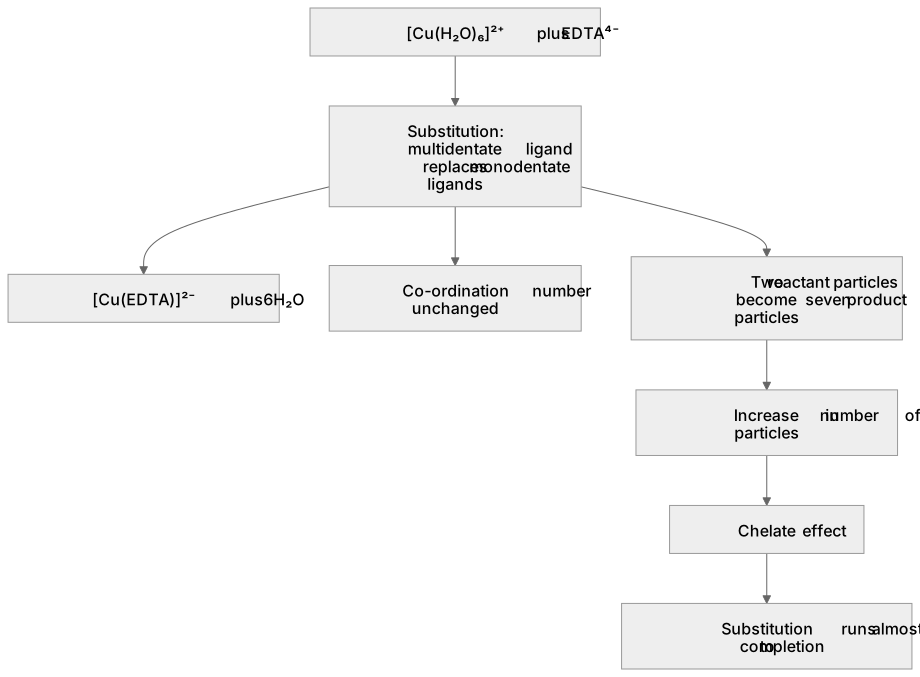
Put a bidentate or multidentate ligand into a solution containing a complex of monodentate ligands and the substitution runs almost to completion. [Cu(H₂O)₆]²⁺ + EDTA⁴⁻ → [Cu(EDTA)]²⁻ + 6H₂O is…
Checked against the AQA 7405 specification (opens in a new tab) on .
- Point 4 of 5
- 4 key terms
Study notes
From the checked teaching notes for this specification point.
The idea
Put a bidentate or multidentate ligand into a solution containing a complex of monodentate ligands and the substitution runs almost to completion. [Cu(H₂O)₆]²⁺ + EDTA⁴⁻ → [Cu(EDTA)]²⁻ + 6H₂O is the standard case: one EDTA⁴⁻ ion displaces all six water ligands because it has six donor atoms of its own. The co-ordination number does not change; only the number of separate particles does, as two reactant particles become seven product particles. The chelate effect is the name for this strong tendency, and its cause is that increase in the number of particles, not any great difference in bond strength, since the bonds broken and made are all co-ordinate bonds of similar strength.
What earns the marks
- A balanced equation showing the multidentate ligand displacing all the monodentate ligands, such as [Cu(H₂O)₆]²⁺ + EDTA⁴⁻ → [Cu(EDTA)]²⁻ + 6H₂O.
- Stating that the co-ordination number is unchanged by the substitution.
- Counting the particles on each side and noting the increase.
- Naming the chelate effect as the reason such substitutions go almost to completion.
Common mistakes and how to put them right
Changing the co-ordination number when the chelating ligand replaces the water molecules.
Forgetting to include the six displaced water molecules on the product side of the equation.
Giving the wrong overall charge on the product because the charge on EDTA⁴⁻ or C₂O₄²⁻ was ignored.
Explaining the chelate effect by claiming the new bonds are stronger, which is not what the mark scheme rewards.
Exam tips
- Balance chelate equations by donor atoms: six water ligands out means six lone pairs in.
- Check the overall charge on both sides of the equation before moving on.
- Name the effect when asked for the reason, then give the particle count as your evidence.
Try the lesson
The start of the Substitution reactions (A-level only): Bidentate and multidentate ligands replace monodentate ligands from complexes. This is called the chelate effect. lesson, made from checked teaching notes for this specification point.
Have a go first
What name is given to the effect when bidentate and multidentate ligands replace monodentate ligands from complexes?
Listen
Put a bidentate or multidentate ligand into a solution containing a complex of monodentate ligands and the substitution runs almost to completion. Cu(H₂O)₆]²⁺ + EDTA⁴⁻ → [Cu(EDTA)]²⁻ + 6H₂O is the standard case: one EDTA⁴⁻ ion displaces all six water ligands because it has six donor atoms of its own. The co-ordination number does not change; only the number of separate particles does, as two reactant particles become seven product particles. The chelate effect is the name for this strong tendency, and its cause is that increase in the number of particles, not any great difference in bond strength, since the bonds broken and made are all co-ordinate bonds of similar strength. A strong answer earns marks for these points. a balanced equation showing the multidentate ligand displacing all the monodentate ligands, such as [Cu(H₂O)₆]²⁺ + EDTA⁴⁻ → [Cu(EDTA)]²⁻ + 6H₂O. stating that the co-ordination number is unchanged by the substitution. counting the particles on each side and noting the increase. naming the chelate effect as the reason such substitutions go almost to completion. Exam tip: Balance chelate equations by donor atoms: six water ligands out means six lone pairs in.
See it
Key words
Say what each word means before you turn the card.
chelate effect
Try answering aloud or in your head before turning the card.
multidentate substitution
Try answering aloud or in your head before turning the card.
unchanged co-ordination number
Try answering aloud or in your head before turning the card.
increase in particles
Try answering aloud or in your head before turning the card.
See every definition
- chelate effect
- The name for the strong tendency of bidentate and multidentate ligands to replace monodentate ligands from complexes, so the substitution runs almost to completion.
- multidentate substitution
- A reaction in which a bidentate or multidentate ligand displaces all the monodentate ligands from a complex, as when one EDTA⁴⁻ ion displaces all six water ligands.
- unchanged co-ordination number
- The co-ordination number stays the same when a bidentate or multidentate ligand replaces the monodentate ligands; only the number of separate particles changes.
- increase in particles
- Two reactant particles become seven product particles, and this increase in the number of particles is the cause of the chelate effect.
Label the diagram
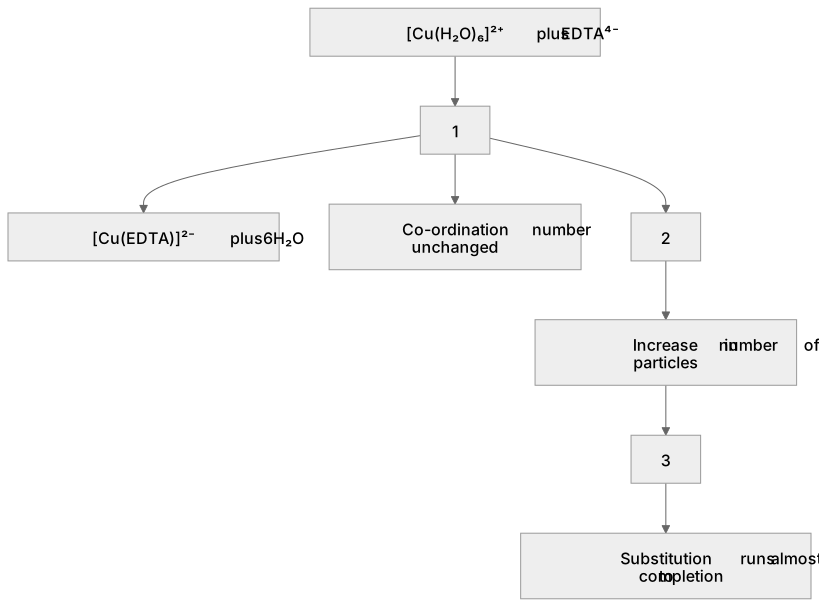
Some boxes have lost their names. Pick the right name for each number.
1Box 1
2Box 2
3Box 3
There is more to this lesson
The full lesson goes on to check your understanding and help you earn the marks. Create a free account to carry on, with your progress saved.
A week of Premium from your first lesson · Then the free plan continues · No card, no charge
Test your understanding of Substitution reactions (A-level only): Bidentate and multidentate ligands replace monodentate ligands from complexes. This is called the chelate effect.
Active recall beats re-reading. Take an instant quiz now to test what you’ve learned and lock it into long-term memory.
A week of Premium from your first lesson · Then the free plan continues · No card, no charge