AQA · A-Level · Chemistry
Course version: 7405 · Version from Sept 2016
Students should be able to: use the equation in calculations.
Full specification wording
The ideal gas equation: Students should be able to: use the equation in calculations.
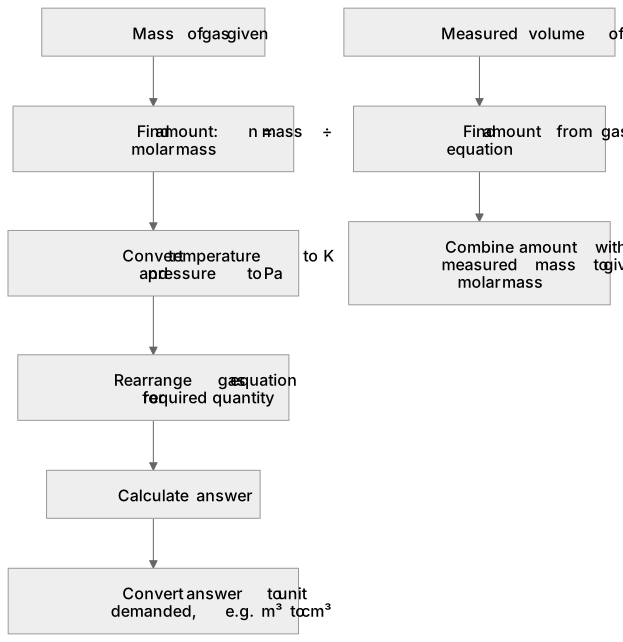
A typical calculation chains the gas equation to a mole calculation.
Checked against the AQA 7405 specification (opens in a new tab) on .
- Point 2 of 2
- 3 key terms
Study notes
From the checked teaching notes for this specification point.
The idea
A typical calculation chains the gas equation to a mole calculation. Given a mass of propanone, first find the amount using n = mass ÷ molar mass. Then convert the data: 95 °C becomes 368 K and 103 kPa becomes 103000 Pa. Rearranging gives V = nRT/p, which returns a volume in cubic metres; multiplying by 10⁶ converts to the cubic centimetres the question wanted, about 75 cm³. Working the other way, a measured volume of gas gives an amount, and combining that amount with a measured mass gives a molar mass. Each conversion and the rearrangement carry their own marks, so an arithmetic slip at the end still leaves most of them available.
What earns the marks
- The amount in moles obtained from mass divided by molar mass.
- Converting both the temperature and the pressure into SI units.
- The correct rearrangement of the gas equation for the required quantity.
- The final answer converted into the unit demanded by the question.
Common mistakes and how to put them right
Leaving the answer in cubic metres when cubic centimetres were requested.
Rounding the amount in moles to one or two significant figures early and carrying the error through.
Using the gas constant in joules alongside a pressure left in kilopascals.
Using the molar mass of the wrong species, for example the product rather than the gas measured.
Exam tips
- Show the substituted equation in full; substitution marks are awarded even when the final value is wrong.
- Convert the answer to the requested unit as a separate final line so it is clearly visible.
- Sense-check the result: roughly one mole of any gas occupies about 24 dm³ near room temperature and pressure.
Try the lesson
The start of the The ideal gas equation: Students should be able to: use the equation in calculations. lesson, made from checked teaching notes for this specification point.
Have a go first
Which rearrangement of the ideal gas equation pV = nRT gives the amount of gas n?
Listen
A typical calculation chains the gas equation to a mole calculation. Given a mass of propanone, first find the amount using n = mass ÷ molar mass. Then convert the data: 95 °C becomes 368 K and 103 kPa becomes 103000 Pa. Rearranging gives V = nRT/p, which returns a volume in cubic metres; multiplying by 10⁶ converts to the cubic centimetres the question wanted, about 75 cm³. Working the other way, a measured volume of gas gives an amount, and combining that amount with a measured mass gives a molar mass. Each conversion and the rearrangement carry their own marks, so an arithmetic slip at the end still leaves most of them available. A strong answer earns marks for these points. the amount in moles obtained from mass divided by molar mass. converting both the temperature and the pressure into SI units. the correct rearrangement of the gas equation for the required quantity. the final answer converted into the unit demanded by the question. Exam tip: Show the substituted equation in full; substitution marks are awarded even when the final value is wrong.
See it
Key words
Say what each word means before you turn the card.
moles from mass
Try answering aloud or in your head before turning the card.
unit conversion at the end
Try answering aloud or in your head before turning the card.
rearranging the gas equation
Try answering aloud or in your head before turning the card.
See every definition
- moles from mass
- The amount is found by dividing the mass by the molar mass.
- unit conversion at the end
- The final answer is converted into the unit demanded by the question, such as multiplying by 10⁶ to change cubic metres to cubic centimetres.
- rearranging the gas equation
- The gas equation is rearranged for the required quantity, giving V = nRT/p for a volume.
Label the diagram
Some boxes have lost their names. Pick the right name for each number.
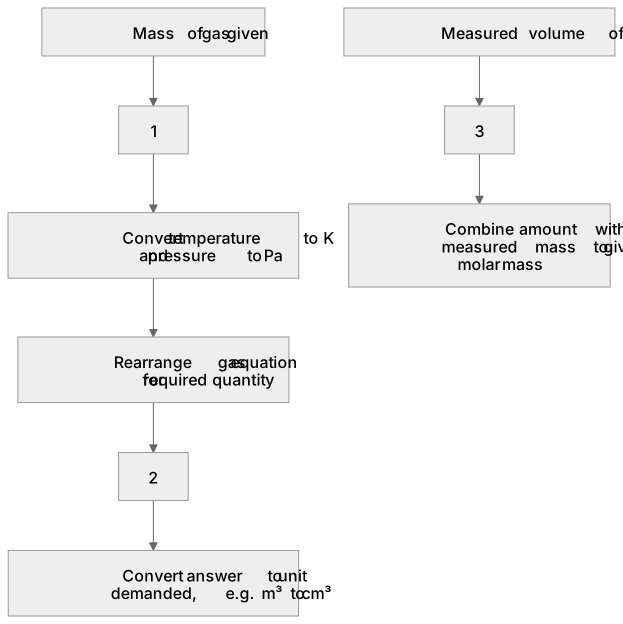
1Box 1
2Box 2
3Box 3
There is more to this lesson
The full lesson goes on to check your understanding and help you earn the marks. Create a free account to carry on, with your progress saved.
A week of Premium from your first lesson · Then the free plan continues · No card, no charge
Test your understanding of The ideal gas equation: Students should be able to: use the equation in calculations.
Active recall beats re-reading. Take an instant quiz now to test what you’ve learned and lock it into long-term memory.
A week of Premium from your first lesson · Then the free plan continues · No card, no charge