AQA · A-Level · Chemistry
Course version: 7405 · Version from Sept 2016
The ideal gas equation pV = nRT with the variables in SI units.
Full specification wording
The ideal gas equation: The ideal gas equation pV = nRT with the variables in SI units.
The ideal gas equation is pV = nRT, and it only works when every quantity is in base SI units.
Checked against the AQA 7405 specification (opens in a new tab) on .
- Point 1 of 2
Study notes
From the checked teaching notes for this specification point.
The idea
The ideal gas equation is pV = nRT, and it only works when every quantity is in base SI units. Pressure must be in pascals, so kilopascals are multiplied by 1000. Volume must be in cubic metres, so cubic centimetres are divided by 10⁶ and cubic decimetres by 1000. Temperature must be in kelvin, so add 273 to a Celsius value. The gas constant R is 8.31 J K⁻¹ mol⁻¹, and its units are the check: joules per kelvin per mole only cancel correctly when pressure is in pascals and volume in cubic metres. The equation applies to an ideal gas, in which the particles have negligible volume and no forces between them.
What earns the marks
- Converting a temperature in degrees Celsius into kelvin by adding 273.
- Converting a pressure in kilopascals into pascals.
- Converting a volume into cubic metres before substituting.
- A correct rearrangement of pV = nRT for the quantity required.
Common mistakes and how to put them right
Substituting a temperature in degrees Celsius.
Using kilopascals with a gas constant expressed in joules.
Dividing a volume in cubic centimetres by 1000 instead of by 10⁶.
Reporting a volume in cubic metres when the question asked for cubic centimetres.
Exam tips
- List p, V, n, R and T down the page with their converted values before substituting anything.
- Use the units of R printed in the question to confirm which units each other quantity needs.
- Rearrange the equation symbolically first, then substitute; it is easier to spot an inverted fraction that way.
Try the lesson
The start of the The ideal gas equation: The ideal gas equation pV = nRT with the variables in SI units. lesson, made from checked teaching notes for this specification point.
Have a go first
Which set of SI units is correct for the variables in the ideal gas equation pV = nRT?
Listen
The ideal gas equation is pV = nRT, and it only works when every quantity is in base SI units. Pressure must be in pascals, so kilopascals are multiplied by 1000. Volume must be in cubic metres, so cubic centimetres are divided by 10⁶ and cubic decimetres by 1000. Temperature must be in kelvin, so add 273 to a Celsius value. The gas constant R is 8.31 J K⁻¹ mol⁻¹, and its units are the check: joules per kelvin per mole only cancel correctly when pressure is in pascals and volume in cubic metres. The equation applies to an ideal gas, in which the particles have negligible volume and no forces between them. A strong answer earns marks for these points. converting a temperature in degrees Celsius into kelvin by adding 273. converting a pressure in kilopascals into pascals. converting a volume into cubic metres before substituting. a correct rearrangement of pV = nRT for the quantity required. Exam tip: List p, V, n, R and T down the page with their converted values before substituting anything.
See it
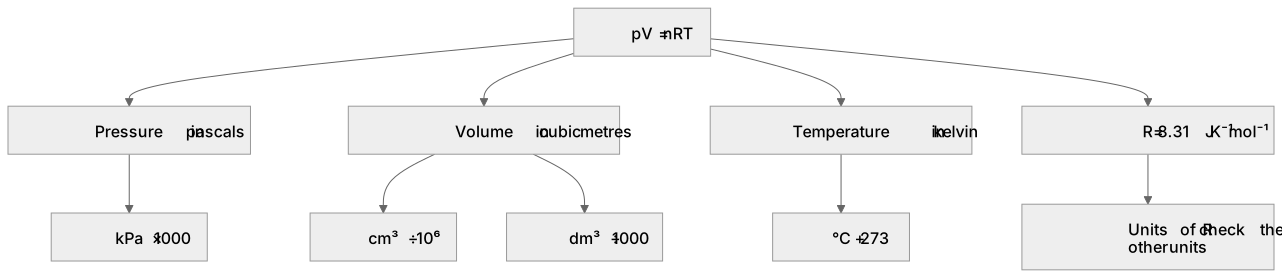
Label the diagram
Some boxes have lost their names. Pick the right name for each number.
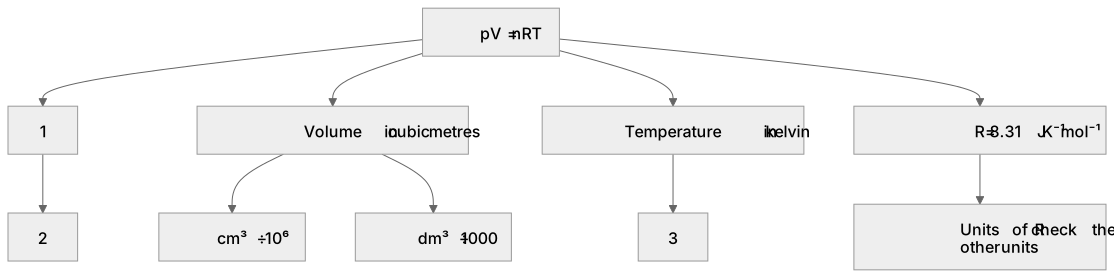
1Box 1
2Box 2
3Box 3
There is more to this lesson
The full lesson goes on to check your understanding and help you earn the marks. Create a free account to carry on, with your progress saved.
A week of Premium from your first lesson · Then the free plan continues · No card, no charge
Test your understanding of The ideal gas equation: The ideal gas equation pV = nRT with the variables in SI units.
Active recall beats re-reading. Take an instant quiz now to test what you’ve learned and lock it into long-term memory.
A week of Premium from your first lesson · Then the free plan continues · No card, no charge