AQA · A-Level · Chemistry
Course version: 7405 · Version from Sept 2016
Students should be able to explain why: silver nitrate solution is used to…
Full specification wording
Trends in properties: Students should be able to explain why: silver nitrate solution is used to identify halide ions the silver nitrate solution is acidified ammonia solution is added.
Three separate 'why' questions hang on this one test.
Checked against the AQA 7405 specification (opens in a new tab) on .
- Point 7 of 7
- 4 key terms
Study notes
From the checked teaching notes for this specification point.
The idea
Three separate 'why' questions hang on this one test. Silver nitrate is used because all nitrates are soluble, so nothing precipitates until a halide is present, and the silver halides that then form are insoluble and differ in colour. The solution is acidified with dilute nitric acid because carbonate, hydroxide and sulfite ions would give their own precipitates with silver ions and be misread as a halide; nitric acid removes them without adding an interfering ion, whereas hydrochloric acid would add chloride and sulfuric acid would precipitate silver sulfate. Ammonia is added afterwards to confirm which halide is present, because the three precipitates differ in how readily they dissolve to form the diamminesilver(I) complex.
What earns the marks
- Stating that the silver halides are insoluble and have distinguishable colours.
- Acidifying to remove carbonate ions, which would otherwise give a white precipitate of silver carbonate.
- Rejecting hydrochloric acid because it would add chloride ions.
- Adding ammonia to distinguish precipitates of similar colour by their differing solubilities.
- Identifying the halide from the precipitate colour together with the ammonia result.
Common mistakes and how to put them right
Saying the acid is added to speed the reaction up.
Acidifying with hydrochloric acid and then reporting the white precipitate as evidence of chloride.
Stating that ammonia dissolves all three precipitates, so nothing can be distinguished.
Giving silver carbonate as a yellow precipitate rather than a white one.
Naming the acidifying agent simply as 'acid', which is not a complete reagent.
Exam tips
- Answer each 'why' separately and in order; the three marks are awarded for three distinct reasons.
- Name the interfering ion you are removing, because 'to remove impurities' is too vague to score.
Try the lesson
The start of the Trends in properties: Students should be able to explain why: silver nitrate solution is used to identify halide ions the silver nitrate solution is acidified ammonia solution is added. lesson, made from checked teaching notes for this specification point.
Have a go first
Why is aqueous silver nitrate used in the chemical test to identify chloride, bromide and iodide ions?
Listen
Three separate 'why' questions hang on this one test. Silver nitrate is used because all nitrates are soluble, so nothing precipitates until a halide is present, and the silver halides that then form are insoluble and differ in colour. The solution is acidified with dilute nitric acid because carbonate, hydroxide and sulfite ions would give their own precipitates with silver ions and be misread as a halide; nitric acid removes them without adding an interfering ion, whereas hydrochloric acid would add chloride and sulfuric acid would precipitate silver sulfate. Ammonia is added afterwards to confirm which halide is present, because the three precipitates differ in how readily they dissolve to form the diamminesilver(I) complex. A strong answer earns marks for these points. stating that the silver halides are insoluble and have distinguishable colours. acidifying to remove carbonate ions, which would otherwise give a white precipitate of silver carbonate. rejecting hydrochloric acid because it would add chloride ions. adding ammonia to distinguish precipitates of similar colour by their differing solubilities. Exam tip: Answer each 'why' separately and in order; the three marks are awarded for three distinct reasons.
See it
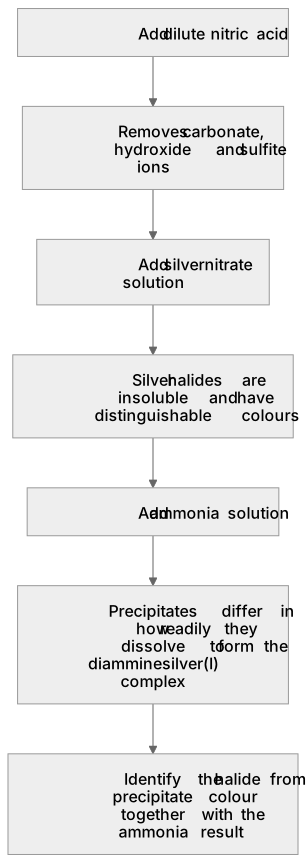
Put it in order
Put these steps in the order they happen.
- 1. Identify the halide from precipitate colour together with the ammonia result
- 2. Precipitates differ in how readily they dissolve to form the diamminesilver(I) complex
- 3. Add silver nitrate solution
- 4. Add ammonia solution
- 5. Add dilute nitric acid
- 6. Removes carbonate, hydroxide and sulfite ions
- 7. Silver halides are insoluble and have distinguishable colours
Key words
Say what each word means before you turn the card.
justifying a test
Try answering aloud or in your head before turning the card.
removing interfering ions
Try answering aloud or in your head before turning the card.
choice of acid
Try answering aloud or in your head before turning the card.
confirmation with ammonia
Try answering aloud or in your head before turning the card.
See every definition
- justifying a test
- Explaining why silver nitrate solution is used, why it is acidified and why ammonia solution is added.
- removing interfering ions
- Nitric acid removes carbonate, hydroxide and sulfite ions, which would give their own precipitates with silver ions and be misread as a halide.
- choice of acid
- Nitric acid removes interfering ions without adding an interfering ion, whereas hydrochloric acid would add chloride and sulfuric acid would precipitate silver sulfate.
- confirmation with ammonia
- Ammonia is added afterwards to confirm which halide is present, because the three precipitates differ in how readily they dissolve to form the diamminesilver(I) complex.
Label the diagram
Some boxes have lost their names. Pick the right name for each number.
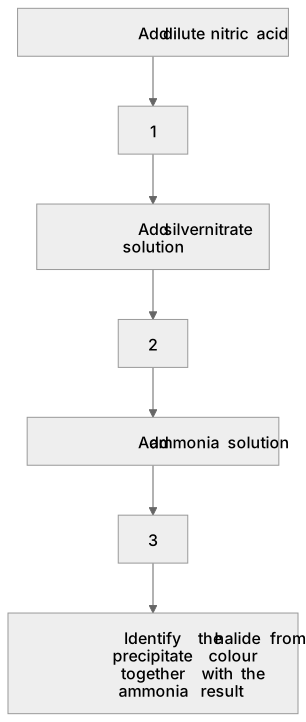
1Box 1
2Box 2
3Box 3
There is more to this lesson
The full lesson goes on to check your understanding and help you earn the marks. Create a free account to carry on, with your progress saved.
A week of Premium from your first lesson · Then the free plan continues · No card, no charge
Test your understanding of Trends in properties: Students should be able to explain why: silver nitrate solution is used to identify halide ions the silver nitrate solution is acidified ammonia solution is added.
Active recall beats re-reading. Take an instant quiz now to test what you’ve learned and lock it into long-term memory.
A week of Premium from your first lesson · Then the free plan continues · No card, no charge