AQA · A-Level · Chemistry
Course version: 7405 · Version from Sept 2016
The trend in solubility of the silver halides in ammonia.
Full specification wording
Trends in properties: The trend in solubility of the silver halides in ammonia.
White and cream are hard to tell apart in a test tube, so ammonia is used to separate the three precipitates by solubility.
Checked against the AQA 7405 specification (opens in a new tab) on .
- Point 6 of 7
- 4 key terms
Study notes
From the checked teaching notes for this specification point.
The idea
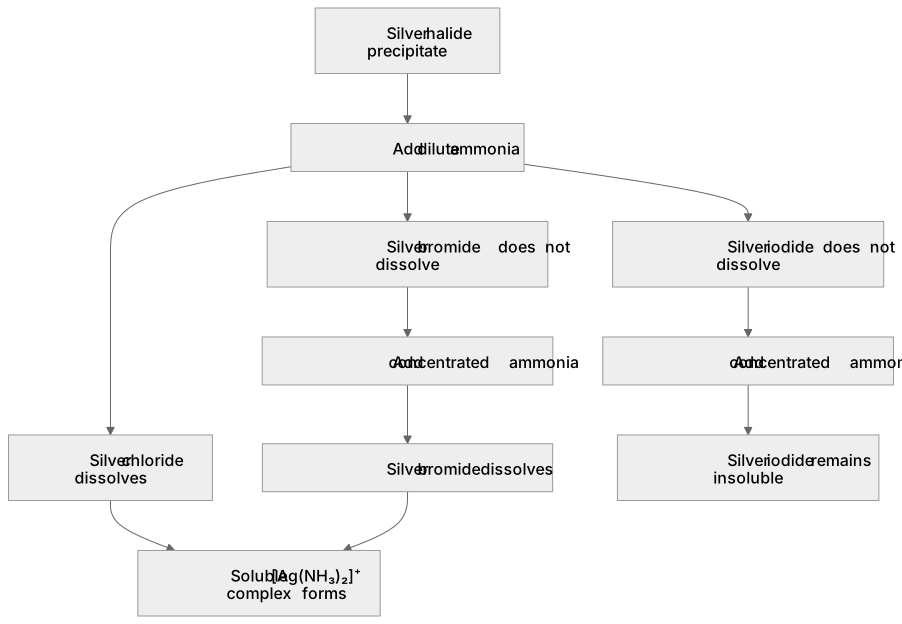
White and cream are hard to tell apart in a test tube, so ammonia is used to separate the three precipitates by solubility. Silver chloride dissolves in dilute ammonia. Silver bromide does not, but does dissolve in concentrated ammonia. Silver iodide is insoluble in both. Solubility in ammonia therefore falls down the group, matching the increasing insolubility of the silver halide itself. Dissolving is not a trick of the eye; the precipitate reacts to form a soluble complex ion, AgCl(s) + 2NH₃(aq) → [Ag(NH₃)₂]⁺(aq) + Cl⁻(aq). So a white precipitate that clears with dilute ammonia is chloride, a cream one that clears only with concentrated ammonia is bromide, and a yellow one that resists both is iodide.
What earns the marks
- Silver chloride dissolving in dilute ammonia.
- Silver bromide dissolving only in concentrated ammonia.
- Silver iodide remaining insoluble even in concentrated ammonia.
- Using the ammonia test to distinguish precipitates whose colours look similar.
- The equation forming the soluble [Ag(NH₃)₂]⁺ complex.
Common mistakes and how to put them right
Stating that all three silver halides dissolve in concentrated ammonia.
Using sodium hydroxide in place of ammonia.
Reporting that the precipitate turns colourless rather than dissolving.
Adding the ammonia before the nitric acid, so interfering ions have not been removed.
Claiming that silver fluoride gives a precipitate which then dissolves, when no precipitate forms at all.
Exam tips
- Say dilute or concentrated every time you mention ammonia here; the distinction is the whole point of the test.
- Describe the change as 'the precipitate dissolves', which is what mark schemes look for.
Try the lesson
The start of the Trends in properties: The trend in solubility of the silver halides in ammonia. lesson, made from checked teaching notes for this specification point.
Have a go first
Which of the following silver halides is insoluble in water but dissolves in dilute aqueous ammonia?
Listen
White and cream are hard to tell apart in a test tube, so ammonia is used to separate the three precipitates by solubility. Silver chloride dissolves in dilute ammonia. Silver bromide does not, but does dissolve in concentrated ammonia. Silver iodide is insoluble in both. Solubility in ammonia therefore falls down the group, matching the increasing insolubility of the silver halide itself. Dissolving is not a trick of the eye; the precipitate reacts to form a soluble complex ion, AgCl(s) + 2NH₃(aq) → [Ag(NH₃)₂]⁺(aq) + Cl⁻(aq). So a white precipitate that clears with dilute ammonia is chloride, a cream one that clears only with concentrated ammonia is bromide, and a yellow one that resists both is iodide. A strong answer earns marks for these points. silver chloride dissolving in dilute ammonia. silver bromide dissolving only in concentrated ammonia. silver iodide remaining insoluble even in concentrated ammonia. using the ammonia test to distinguish precipitates whose colours look similar. Exam tip: Say dilute or concentrated every time you mention ammonia here; the distinction is the whole point of the test.
See it
Key words
Say what each word means before you turn the card.
dilute and concentrated ammonia
Try answering aloud or in your head before turning the card.
confirming a halide
Try answering aloud or in your head before turning the card.
diamminesilver(I) complex
Try answering aloud or in your head before turning the card.
solubility trend
Try answering aloud or in your head before turning the card.
See every definition
- dilute and concentrated ammonia
- Silver chloride dissolves in the dilute form, silver bromide does not but dissolves in the concentrated form, and silver iodide is insoluble in both.
- confirming a halide
- A white precipitate that clears with dilute ammonia is chloride, a cream one that clears only with concentrated ammonia is bromide, and a yellow one that resists both is iodide.
- diamminesilver(I) complex
- The soluble complex ion formed when the precipitate reacts, shown as AgCl(s) + 2NH₃(aq) → [Ag(NH₃)₂]⁺(aq) + Cl⁻(aq).
- solubility trend
- Solubility in ammonia falls down the group, matching the increasing insolubility of the silver halide itself.
There is more to this lesson
The full lesson goes on to check your understanding and help you earn the marks. Create a free account to carry on, with your progress saved.
A week of Premium from your first lesson · Then the free plan continues · No card, no charge
Test your understanding of Trends in properties: The trend in solubility of the silver halides in ammonia.
Active recall beats re-reading. Take an instant quiz now to test what you’ve learned and lock it into long-term memory.
A week of Premium from your first lesson · Then the free plan continues · No card, no charge