AQA · A-Level · Chemistry
Course version: 7405 · Version from Sept 2016
The reaction of chlorine with cold, dilute, aqueous NaOH and uses of the…
Full specification wording
Uses of chlorine and chlorate(I): The reaction of chlorine with cold, dilute, aqueous NaOH and uses of the solution formed.
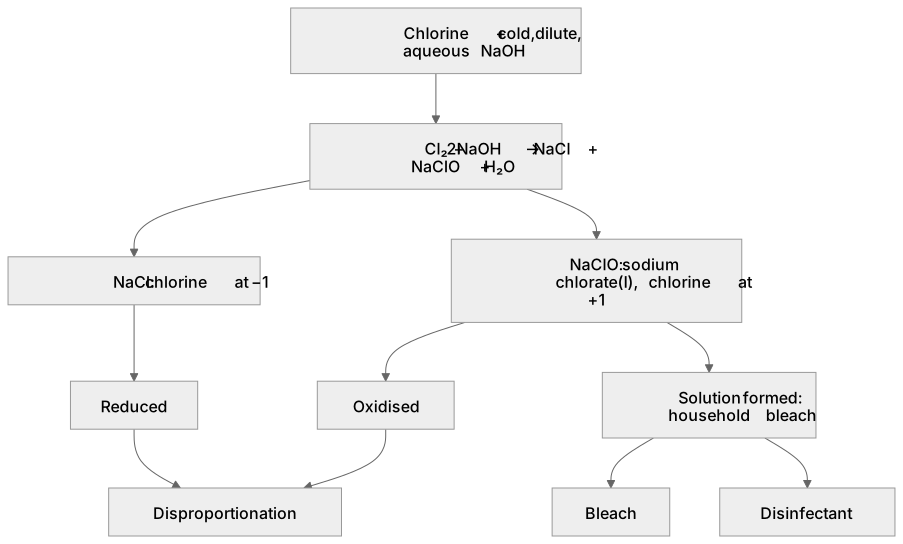
With cold, dilute, aqueous sodium hydroxide chlorine disproportionates again: Cl₂ + 2NaOH → NaCl + NaClO + H₂O, or ionically Cl₂ + 2OH⁻ → Cl⁻ + ClO⁻ + H₂O. Chlorine starts at 0 and finishes at −1…
Checked against the AQA 7405 specification (opens in a new tab) on .
- Point 6 of 6
- 3 key terms
Study notes
From the checked teaching notes for this specification point.
The idea
With cold, dilute, aqueous sodium hydroxide chlorine disproportionates again: Cl₂ + 2NaOH → NaCl + NaClO + H₂O, or ionically Cl₂ + 2OH⁻ → Cl⁻ + ClO⁻ + H₂O. Chlorine starts at 0 and finishes at −1 in the chloride and +1 in the sodium chlorate(I), so it is oxidised and reduced in the same reaction. The solution formed is household bleach: the chlorate(I) ion is a strong oxidising agent that destroys coloured compounds and kills bacteria, so the same product serves as a bleach and as a disinfectant. The conditions are part of the answer, because warm, concentrated alkali drives the reaction further, to sodium chlorate(V), NaClO₃, which is used as a weedkiller.
What earns the marks
- The equation Cl₂ + 2NaOH → NaCl + NaClO + H₂O.
- Stating the conditions as cold, dilute aqueous sodium hydroxide.
- Naming NaClO as sodium chlorate(I).
- Identifying the reaction as disproportionation, with chlorine going to −1 and +1.
- Naming a use of the solution as bleach or as a disinfectant.
Common mistakes and how to put them right
Giving sodium chlorate(V), NaClO₃, which requires hot concentrated alkali.
Naming NaClO as sodium chlorate without the Roman numeral (I).
Omitting the water from the right-hand side, so hydrogen and oxygen do not balance.
Stating the oxidation state of chlorine in NaClO as −1.
Describing the product as chlorine dissolved in alkali rather than as a new compound.
Exam tips
- Always write the Roman numeral in chlorate(I); leaving it out is treated as a different compound.
- Quote the conditions in your answer even when only the equation is asked for, since cold and dilute decide the product.
Try the lesson
The start of the Uses of chlorine and chlorate(I): The reaction of chlorine with cold, dilute, aqueous NaOH and uses of the solution formed. lesson, made from checked teaching notes for this specification point.
Have a go first
What is formed when chlorine reacts with cold, dilute, aqueous sodium hydroxide?
Listen
With cold, dilute, aqueous sodium hydroxide chlorine disproportionates again: Cl₂ + 2NaOH → NaCl + NaClO + H₂O, or ionically Cl₂ + 2OH⁻ → Cl⁻ + ClO⁻ + H₂O. Chlorine starts at 0 and finishes at −1 in the chloride and +1 in the sodium chlorate(I), so it is oxidised and reduced in the same reaction. The solution formed is household bleach: the chlorate(I) ion is a strong oxidising agent that destroys coloured compounds and kills bacteria, so the same product serves as a bleach and as a disinfectant. The conditions are part of the answer, because warm, concentrated alkali drives the reaction further, to sodium chlorate(V), NaClO₃, which is used as a weedkiller. A strong answer earns marks for these points. the equation Cl₂ + 2NaOH → NaCl + NaClO + H₂O. stating the conditions as cold, dilute aqueous sodium hydroxide. naming NaClO as sodium chlorate(I). identifying the reaction as disproportionation, with chlorine going to −1 and +1. Exam tip: Always write the Roman numeral in chlorate(I); leaving it out is treated as a different compound.
See it
Key words
Say what each word means before you turn the card.
sodium chlorate(I)
Try answering aloud or in your head before turning the card.
bleach and disinfectant
Try answering aloud or in your head before turning the card.
effect of conditions
Try answering aloud or in your head before turning the card.
See every definition
- sodium chlorate(I)
- The compound NaClO, formed with sodium chloride and water when chlorine reacts with cold, dilute, aqueous sodium hydroxide.
- bleach and disinfectant
- The uses of the solution formed, because the chlorate(I) ion is a strong oxidising agent that destroys coloured compounds and kills bacteria.
- effect of conditions
- Cold, dilute alkali gives sodium chlorate(I), whereas warm, concentrated alkali drives the reaction further to sodium chlorate(V), NaClO₃.
Label the diagram
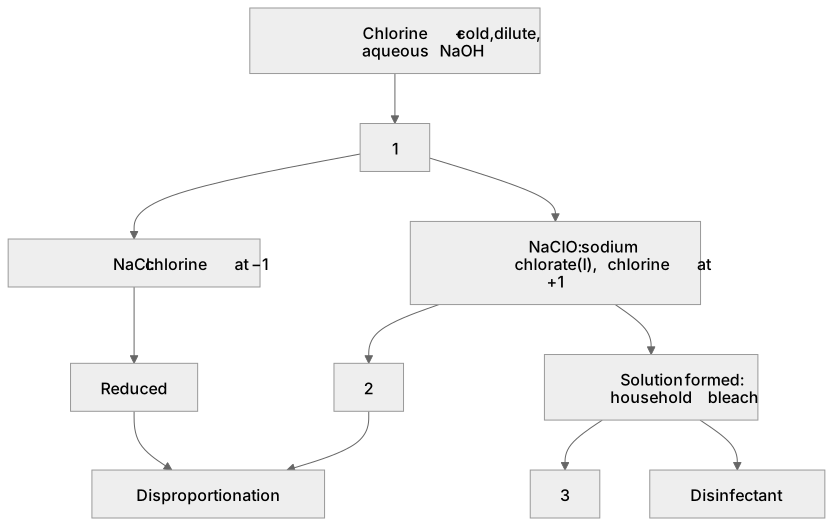
Some boxes have lost their names. Pick the right name for each number.
1Box 1
2Box 2
3Box 3
There is more to this lesson
The full lesson goes on to check your understanding and help you earn the marks. Create a free account to carry on, with your progress saved.
A week of Premium from your first lesson · Then the free plan continues · No card, no charge
Test your understanding of Uses of chlorine and chlorate(I): The reaction of chlorine with cold, dilute, aqueous NaOH and uses of the solution formed.
Active recall beats re-reading. Take an instant quiz now to test what you’ve learned and lock it into long-term memory.
A week of Premium from your first lesson · Then the free plan continues · No card, no charge