AQA · A-Level · Chemistry
Course version: 7405 · Version from Sept 2016
Uses of chlorine and chlorate(I): The use of chlorine in water treatment.
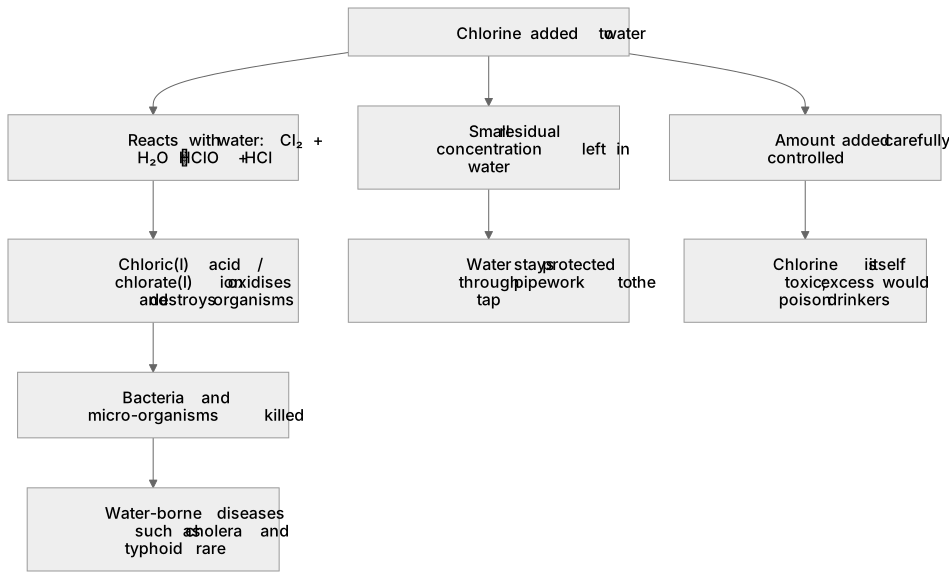
Chlorine is added to drinking water and to swimming pools to kill bacteria and other micro-organisms, which is why water-borne diseases such as cholera and typhoid are rare where supplies are treated.
Checked against the AQA 7405 specification (opens in a new tab) on .
- Point 4 of 6
- 4 key terms
Study notes
From the checked teaching notes for this specification point.
The idea
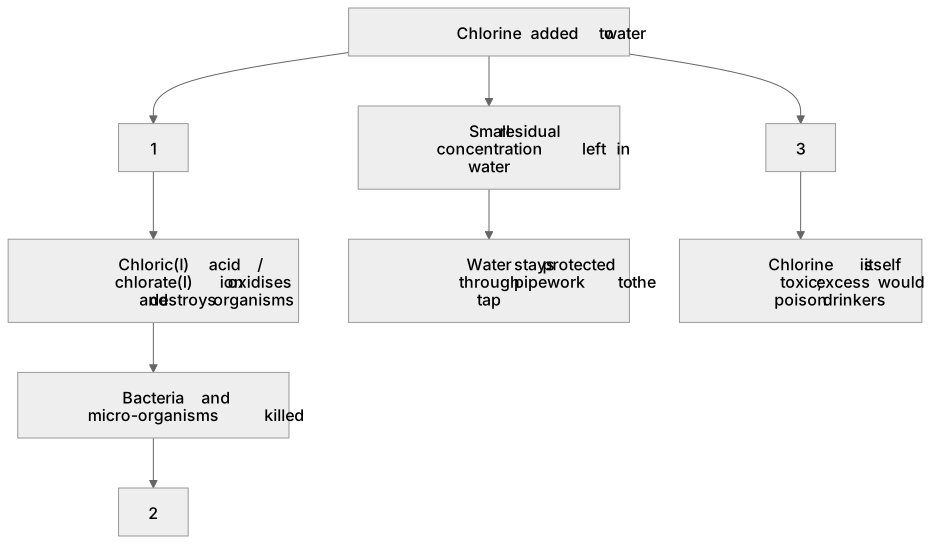
Chlorine is added to drinking water and to swimming pools to kill bacteria and other micro-organisms, which is why water-borne diseases such as cholera and typhoid are rare where supplies are treated. The chlorine is not itself the direct agent: it reacts with water, Cl₂ + H₂O ⇌ HClO + HCl, and the chloric(I) acid or chlorate(I) ion oxidises and destroys the organisms. A small residual concentration is deliberately left in the water so that it stays protected all the way through the pipework to the tap. The amount added must be carefully controlled, because chlorine is itself toxic and in excess would poison the people drinking it. The concentration used is only a few parts per million.
What earns the marks
- Stating that chlorine kills bacteria or micro-organisms in the water.
- Naming a disease such as cholera or typhoid that is prevented.
- Stating that the amount added must be controlled because chlorine is toxic or poisonous.
- Identifying chloric(I) acid or the chlorate(I) ion as the species that kills the organisms.
- Stating that a residual amount keeps the water safe along the pipework.
Common mistakes and how to put them right
Saying chlorine removes dirt or makes the water clear rather than killing bacteria.
Stating that all the chlorine is removed before the water reaches the tap.
Giving the smell or taste of chlorine as the reason for controlling the dose, rather than its toxicity.
Confusing the role of chlorine with that of fluoride.
Naming chloride ions as the species that kills the bacteria.
Exam tips
- 'Toxic' or 'poisonous' is the key word for the dose-control mark; vaguer answers about taste do not score.
- Name a specific disease; 'stops you getting ill' is not enough for the mark.
Try the lesson
The start of the Uses of chlorine and chlorate(I): The use of chlorine in water treatment. lesson, made from checked teaching notes for this specification point.
Have a go first
What is the main reason chlorine is added to drinking water supplies?
Listen
Chlorine is added to drinking water and to swimming pools to kill bacteria and other micro-organisms, which is why water-borne diseases such as cholera and typhoid are rare where supplies are treated. The chlorine is not itself the direct agent: it reacts with water, Cl₂ + H₂O ⇌ HClO + HCl, and the chloric(I) acid or chlorate(I) ion oxidises and destroys the organisms. A small residual concentration is deliberately left in the water so that it stays protected all the way through the pipework to the tap. The amount added must be carefully controlled, because chlorine is itself toxic and in excess would poison the people drinking it. The concentration used is only a few parts per million. A strong answer earns marks for these points. stating that chlorine kills bacteria or micro-organisms in the water. naming a disease such as cholera or typhoid that is prevented. stating that the amount added must be controlled because chlorine is toxic or poisonous. identifying chloric(I) acid or the chlorate(I) ion as the species that kills the organisms. Exam tip: 'Toxic' or 'poisonous' is the key word for the dose-control mark; vaguer answers about taste do not score.
See it
Key words
Say what each word means before you turn the card.
water treatment
Try answering aloud or in your head before turning the card.
killing micro-organisms
Try answering aloud or in your head before turning the card.
chloric(I) acid as the active species
Try answering aloud or in your head before turning the card.
controlling the dose
Try answering aloud or in your head before turning the card.
See every definition
- water treatment
- Chlorine is added to drinking water and to swimming pools to kill bacteria and other micro-organisms.
- killing micro-organisms
- Chlorine kills bacteria and other micro-organisms, which is why water-borne diseases such as cholera and typhoid are rare where supplies are treated.
- chloric(I) acid as the active species
- Chlorine is not itself the direct agent; it reacts with water and the chloric(I) acid or chlorate(I) ion oxidises and destroys the organisms.
- controlling the dose
- The amount added must be carefully controlled, because chlorine is itself toxic and in excess would poison the people drinking it.
Label the diagram
Some boxes have lost their names. Pick the right name for each number.
1Box 1
2Box 2
3Box 3
There is more to this lesson
The full lesson goes on to check your understanding and help you earn the marks. Create a free account to carry on, with your progress saved.
A week of Premium from your first lesson · Then the free plan continues · No card, no charge
Test your understanding of Uses of chlorine and chlorate(I): The use of chlorine in water treatment.
Active recall beats re-reading. Take an instant quiz now to test what you’ve learned and lock it into long-term memory.
A week of Premium from your first lesson · Then the free plan continues · No card, no charge