AQA · A-Level · Chemistry
Course version: 7405 · Version from Sept 2016
Transition elements show variable oxidation states.
Full specification wording
Variable oxidation states (A-level only): Transition elements show variable oxidation states.
The 4s and 3d sub-levels lie close in energy, so once 4s electrons are removed, 3d electrons can be lost without a large jump in ionisation energy.
Checked against the AQA 7405 specification (opens in a new tab) on .
- Point 1 of 3
- 3 key terms
Study notes
From the checked teaching notes for this specification point.
The idea
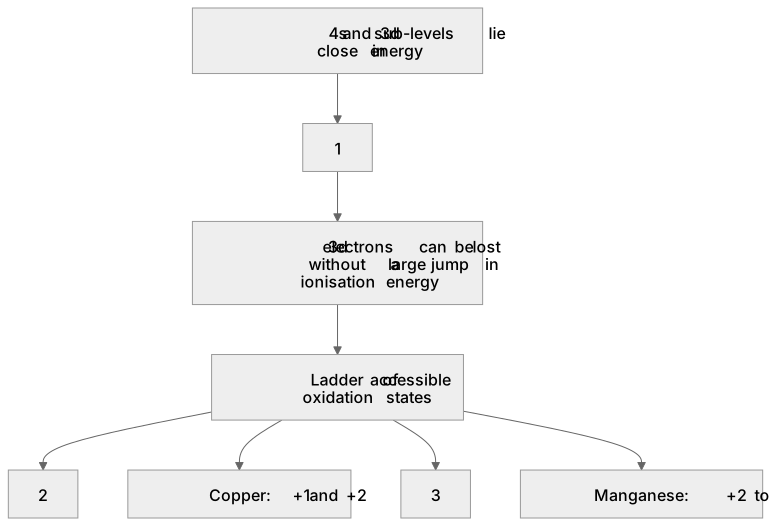
The 4s and 3d sub-levels lie close in energy, so once 4s electrons are removed, 3d electrons can be lost without a large jump in ionisation energy. This gives a ladder of accessible oxidation states. Iron shows +2 and +3, copper +1 and +2, chromium +2, +3 and +6, and manganese runs from +2 to +7. The highest states survive only when bonded to oxygen or fluorine, which is why manganese(VII) appears as MnO₄⁻ rather than a simple cation. Deducing an oxidation state from a formula is a standard task: oxygen counts as −2 and the sum equals the overall charge. Crucially, positive oxidation states must always include an explicit positive sign (e.g., +7, not 7).
What earns the marks
- Correct oxidation state of the metal in a given species, ensuring explicit signs are used (e.g., +7 in MnO₄⁻).
- Explaining variable oxidation states by the similar energies of the 4s and 3d sub-levels.
- Identifying the change in oxidation state during a named redox reaction.
- Using oxidation state changes to balance a half-equation with electrons.
Common mistakes and how to put them right
Reading the overall charge on MnO₄⁻ as the oxidation state of the manganese.
Omitting the positive sign on a positive oxidation state (writing 7 instead of +7).
Assuming every transition metal reaches +7, when only manganese does.
Forgetting that oxygen is −2 in an oxoanion when working out the metal's oxidation state.
Exam tips
- Set the arithmetic out: the sum of the oxidation states equals the overall charge on the species.
- Always include the sign for oxidation states, explicitly writing '+' for positive values.
Try the lesson
The start of the Variable oxidation states (A-level only): Transition elements show variable oxidation states. lesson, made from checked teaching notes for this specification point.
Have a go first
Which statement explains why transition elements can form ions with different positive charges?
Listen
The 4s and 3d sub-levels lie close in energy, so once 4s electrons are removed, 3d electrons can be lost without a large jump in ionisation energy. This gives a ladder of accessible oxidation states. Iron shows +2 and +3, copper +1 and +2, chromium +2, +3 and +6, and manganese runs from +2 to +7. The highest states survive only when bonded to oxygen or fluorine, which is why manganese(VII) appears as MnO₄⁻ rather than a simple cation. Deducing an oxidation state from a formula is a standard task: oxygen counts as −2 and the sum equals the overall charge. Crucially, positive oxidation states must always include an explicit positive sign (e.g., +7, not 7). A strong answer earns marks for these points. Correct oxidation state of the metal in a given species, ensuring explicit signs are used (e.g., +7 in MnO₄⁻). Explaining variable oxidation states by the similar energies of the 4s and 3d sub-levels. Identifying the change in oxidation state during a named redox reaction. Using oxidation state changes to balance a half-equation with electrons. Exam tip: Set the arithmetic out: the sum of the oxidation states equals the overall charge on the species.
See it
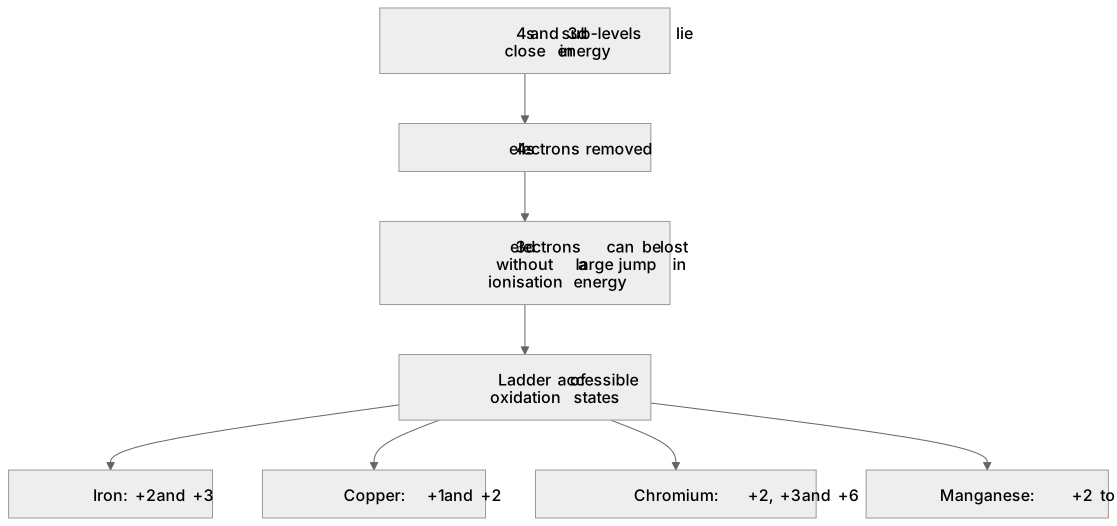
Key words
Say what each word means before you turn the card.
variable oxidation states
Try answering aloud or in your head before turning the card.
4s and 3d energies
Try answering aloud or in your head before turning the card.
deducing oxidation states
Try answering aloud or in your head before turning the card.
See every definition
- variable oxidation states
- Transition elements show this behaviour, in which more than one oxidation state is accessible.
- 4s and 3d energies
- These sub-levels lie close in energy, so once 4s electrons are removed, 3d electrons can be lost without a large jump in ionisation energy.
- deducing oxidation states
- A standard task in which oxygen counts as −2 and the sum equals the overall charge, with positive values always given an explicit positive sign.
Label the diagram
Some boxes have lost their names. Pick the right name for each number.
1Box 1
2Box 2
3Box 3
There is more to this lesson
The full lesson goes on to check your understanding and help you earn the marks. Create a free account to carry on, with your progress saved.
A week of Premium from your first lesson · Then the free plan continues · No card, no charge
Test your understanding of Variable oxidation states (A-level only): Transition elements show variable oxidation states.
Active recall beats re-reading. Take an instant quiz now to test what you’ve learned and lock it into long-term memory.
A week of Premium from your first lesson · Then the free plan continues · No card, no charge