AQA · A-Level · Chemistry
Course version: 7405 · Version from Sept 2016
Vanadium species in oxidation states IV, III and II are formed by the…
Full specification wording
Variable oxidation states (A-level only): Vanadium species in oxidation states IV, III and II are formed by the reduction of vanadate(V) ions by zinc in acidic solution.
Zinc in acid is a strong enough reducing agent to walk vanadium down the whole ladder, and each step has its own colour.
Checked against the AQA 7405 specification (opens in a new tab) on .
- Point 2 of 3
- 4 key terms
Study notes
From the checked teaching notes for this specification point.
The idea
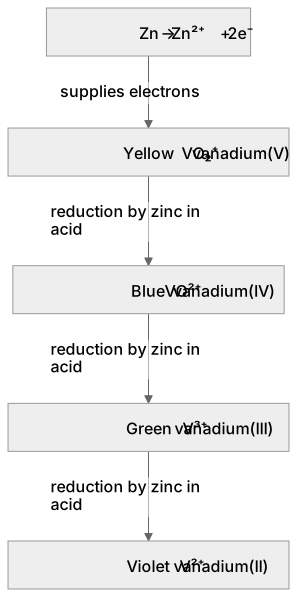
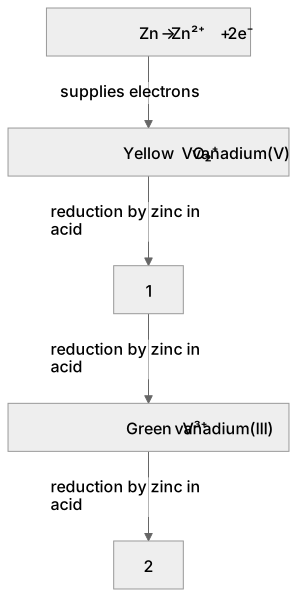
Zinc in acid is a strong enough reducing agent to walk vanadium down the whole ladder, and each step has its own colour. Yellow VO₂⁺, vanadium(V), becomes blue VO²⁺, vanadium(IV), then green V³⁺ and finally violet V²⁺. The half-equations need the acid: VO₂⁺ + 2H⁺ + e⁻ → VO²⁺ + H₂O, then VO²⁺ + 2H⁺ + e⁻ → V³⁺ + H₂O, then the simpler V³⁺ + e⁻ → V²⁺. Zinc supplies the electrons through Zn → Zn²⁺ + 2e⁻, so one mole of zinc reduces two moles of vanadium at each step. A green colour part way through can be genuine V³⁺, or a mixture of blue vanadium(IV) with yellow vanadium(V), so watch the sequence rather than one snapshot.
What earns the marks
- The correct sequence of colours, yellow then blue then green then violet.
- Each correct half-equation, balanced with H⁺ and H₂O as well as electrons.
- The oxidation half-equation Zn → Zn²⁺ + 2e⁻.
- Combining the half-equations so that the electrons cancel in the overall equation.
Common mistakes and how to put them right
Writing V⁵⁺ and V⁴⁺ as simple ions instead of the oxoions VO₂⁺ and VO²⁺.
Omitting H⁺ and H₂O from the half-equations, so leaving oxygen unbalanced.
Giving the wrong charge on VO²⁺, often writing VO⁺ by forgetting that oxygen contributes −2.
Assuming a green solution is always V³⁺ rather than possibly a mixture of the yellow and blue species.
Exam tips
- Balance oxygen with water first, then hydrogen with H⁺, then charge with electrons.
- Scale the half-equations so the electrons cancel exactly before adding them together.
- Learn the four colours as a sequence, because questions often ask you to predict the next change.
Try the lesson
The start of the Variable oxidation states (A-level only): Vanadium species in oxidation states IV, III and II are formed by the reduction of vanadate(V) ions by zinc in acidic solution. lesson, made from checked teaching notes for this specification point.
Have a go first
In the reduction of vanadate(V) ions by zinc in acidic solution, which reagent acts as the reducing agent?
Listen
Zinc in acid is a strong enough reducing agent to walk vanadium down the whole ladder, and each step has its own colour. Yellow VO₂⁺, vanadium(V), becomes blue VO²⁺, vanadium(IV), then green V³⁺ and finally violet V²⁺. The half-equations need the acid: VO₂⁺ + 2H⁺ + e⁻ → VO²⁺ + H₂O, then VO²⁺ + 2H⁺ + e⁻ → V³⁺ + H₂O, then the simpler V³⁺ + e⁻ → V²⁺. Zinc supplies the electrons through Zn → Zn²⁺ + 2e⁻, so one mole of zinc reduces two moles of vanadium at each step. A green colour part way through can be genuine V³⁺, or a mixture of blue vanadium(IV) with yellow vanadium(V), so watch the sequence rather than one snapshot. A strong answer earns marks for these points. the correct sequence of colours, yellow then blue then green then violet. each correct half-equation, balanced with H⁺ and H₂O as well as electrons. the oxidation half-equation Zn → Zn²⁺ + 2e⁻. combining the half-equations so that the electrons cancel in the overall equation. Exam tip: Balance oxygen with water first, then hydrogen with H⁺, then charge with electrons.
See it
Key words
Say what each word means before you turn the card.
colour sequence
Try answering aloud or in your head before turning the card.
half-equations in acid
Try answering aloud or in your head before turning the card.
reduction by zinc
Try answering aloud or in your head before turning the card.
combining half-equations
Try answering aloud or in your head before turning the card.
See every definition
- colour sequence
- Yellow then blue then green then violet, the colours seen as zinc reduces vanadium species in acidic solution.
- half-equations in acid
- Equations balanced with H⁺ and H₂O as well as electrons, such as VO₂⁺ + 2H⁺ + e⁻ → VO²⁺ + H₂O.
- reduction by zinc
- Zinc supplies the electrons through Zn → Zn²⁺ + 2e⁻, so one mole of zinc reduces two moles of vanadium at each step.
- combining half-equations
- Scaling the half-equations so the electrons cancel exactly before adding them together into the overall equation.
Label the diagram
Some boxes have lost their names. Pick the right name for each number.
1Box 1
2Box 2
There is more to this lesson
The full lesson goes on to check your understanding and help you earn the marks. Create a free account to carry on, with your progress saved.
A week of Premium from your first lesson · Then the free plan continues · No card, no charge
Test your understanding of Variable oxidation states (A-level only): Vanadium species in oxidation states IV, III and II are formed by the reduction of vanadate(V) ions by zinc in acidic solution.
Active recall beats re-reading. Take an instant quiz now to test what you’ve learned and lock it into long-term memory.
A week of Premium from your first lesson · Then the free plan continues · No card, no charge