AQA · GCSE · Chemistry
Course version: 8462 · Version from Sept 2018
Alcohols: Alcohols contain the functional group –OH.
The –OH group is the functional group of alcohols.
Checked against the AQA 8462 specification (opens in a new tab) on .
- Point 1 of 5
- 2 key terms
Study notes
From the checked teaching notes for this specification point.
The idea
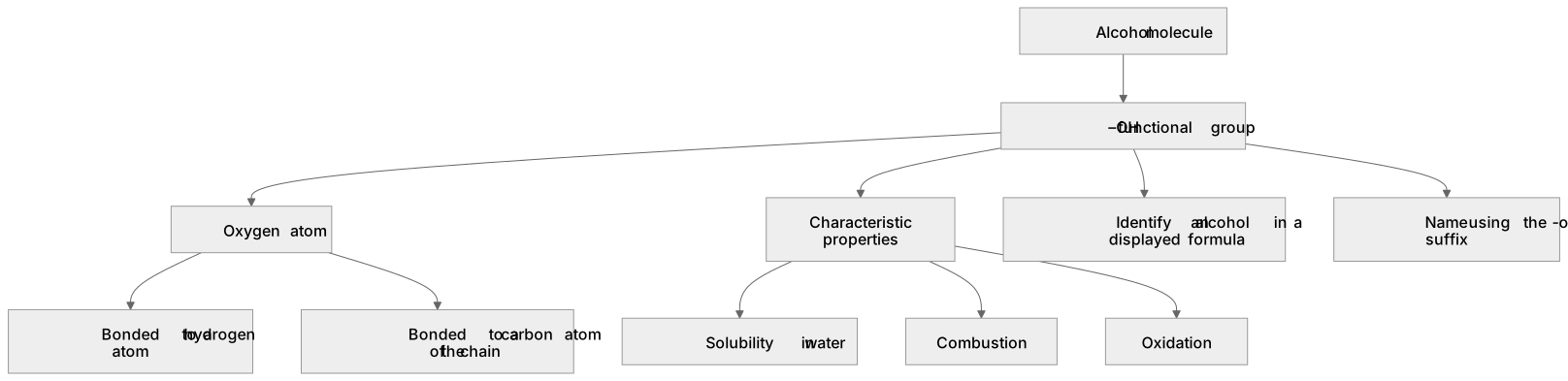
The –OH group is the functional group of alcohols. It consists of an oxygen atom covalently bonded to a hydrogen atom, and that oxygen is also bonded to a carbon atom of the hydrocarbon chain. The –OH group gives alcohols their characteristic properties, including solubility in water and reactions such as combustion and oxidation. In ethanol, CH₃CH₂OH, the –OH is attached to a carbon that already has two hydrogen atoms and one carbon neighbour, so the oxygen forms two single covalent bonds and retains two lone pairs. Recognising the –OH group allows you to identify an alcohol from a displayed formula, to name it using the -ol suffix, and to predict that it will react with sodium and be oxidised by acidified potassium dichromate(VI). The position of the –OH on the chain matters: propan-1-ol and propan-2-ol are structural isomers with different properties.
What earns the marks
- Identify the –OH group as the functional group present in all alcohols.
- Describe the –OH group as an oxygen atom bonded to a hydrogen atom and to a carbon atom of the molecule.
- Recognise the –OH group in a displayed formula and use it to classify the compound as an alcohol.
- Name alcohols using the -ol suffix and, where needed, a number to show the position of the –OH group.
- Link the –OH group to characteristic alcohol reactions such as reaction with sodium and oxidation by acidified potassium dichromate(VI).
Common mistakes and how to put them right
Confusing the –OH group in alcohols with the hydroxide ion, OH⁻.
Put it right by stating that alcohols contain a covalently bonded –OH group, not a hydroxide ion.
Treating –OH as a separate ion attached to the chain.
Put it right by drawing the oxygen bonded to both the carbon chain and the hydrogen atom.
Assuming every molecule containing oxygen is an alcohol.
Put it right by checking that the oxygen is bonded to hydrogen and to a carbon atom.
Ignoring the position of the –OH group when naming.
Put it right by numbering the carbon chain so the –OH has the lowest possible number.
Exam tips
- When identifying an alcohol, locate the oxygen and check that it is bonded to both a hydrogen atom and a carbon atom.
- In displayed formulae, draw the O–H bond explicitly so the functional group is unmistakable.
- Use the -ol ending in names and add a number only when the –OH could be in more than one position.
Try the lesson
The start of the Alcohols: Alcohols contain the functional group –OH. lesson, made from checked teaching notes for this specification point.
Have a go first
A student is identifying different organic molecules. Which specific functional group must be present for a molecule to be classified as an alcohol?
Listen
The –OH group is the functional group of alcohols. It consists of an oxygen atom covalently bonded to a hydrogen atom, and that oxygen is also bonded to a carbon atom of the hydrocarbon chain. The –OH group gives alcohols their characteristic properties, including solubility in water and reactions such as combustion and oxidation. In ethanol, CH₃CH₂OH, the –OH is attached to a carbon that already has two hydrogen atoms and one carbon neighbour, so the oxygen forms two single covalent bonds and retains two lone pairs. Recognising the –OH group allows you to identify an alcohol from a displayed formula, to name it using the -ol suffix, and to predict that it will react with sodium and be oxidised by acidified potassium dichromate(VI). The position of the –OH on the chain matters: propan-1-ol and propan-2-ol are structural isomers with different properties. A strong answer earns marks for these points. Identify the –OH group as the functional group present in all alcohols. Describe the –OH group as an oxygen atom bonded to a hydrogen atom and to a carbon atom of the molecule. Recognise the –OH group in a displayed formula and use it to classify the compound as an alcohol. Name alcohols using the -ol suffix and, where needed, a number to show the position of the –OH group. A common slip: Confusing the –OH group in alcohols with the hydroxide ion, OH⁻. Instead, stating that alcohols contain a covalently bonded –OH group, not a hydroxide ion. Exam tip: When identifying an alcohol, locate the oxygen and check that it is bonded to both a hydrogen atom and a carbon atom.
See it
Key words
Say what each word means before you turn the card.
–OH group
Try answering aloud or in your head before turning the card.
-ol suffix
Try answering aloud or in your head before turning the card.
See every definition
- –OH group
- An oxygen atom covalently bonded to a hydrogen atom, with that oxygen also bonded to a carbon atom of the hydrocarbon chain.
- -ol suffix
- The ending used to name alcohols, with a number added where needed to show the position of the –OH group.
Label the diagram
Some boxes have lost their names. Pick the right name for each number.
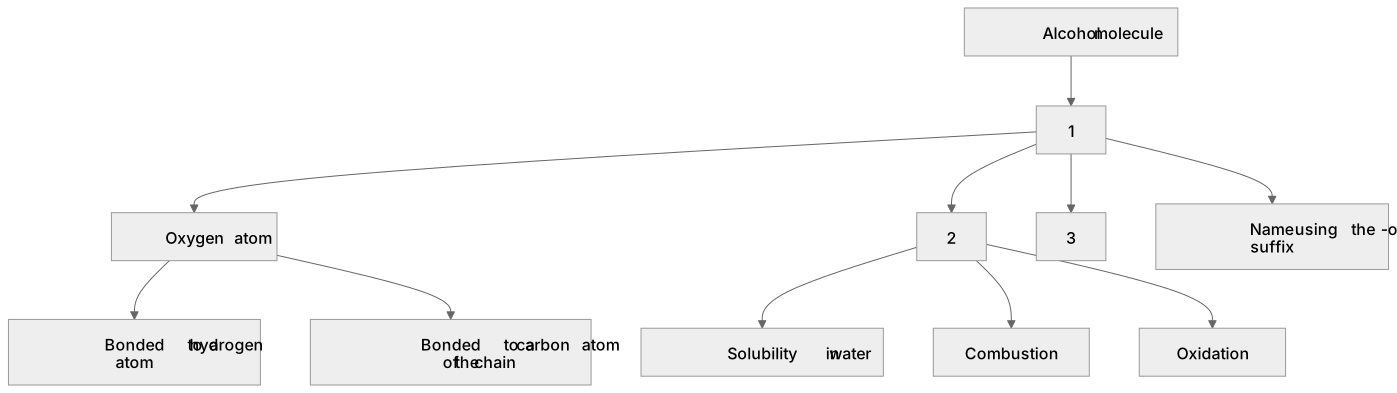
1Box 1
2Box 2
3Box 3
There is more to this lesson
The full lesson goes on to check your understanding and help you earn the marks. Create a free account to carry on, with your progress saved.
A week of Premium from your first lesson · Then the free plan continues · No card, no charge
Test your understanding of Alcohols: Alcohols contain the functional group –OH.
Active recall beats re-reading. Take an instant quiz now to test what you’ve learned and lock it into long-term memory.
A week of Premium from your first lesson · Then the free plan continues · No card, no charge