AQA · GCSE · Chemistry
Course version: 8462 · Version from Sept 2018
Methanol, ethanol, propanol and butanol are the first four members of a…
Full specification wording
Alcohols: Methanol, ethanol, propanol and butanol are the first four members of a homologous series of alcohols.
A homologous series is a family of compounds with the same functional group and a general formula, in which each member differs from the next by a CH₂ unit and shows a gradual change in physical…
Checked against the AQA 8462 specification (opens in a new tab) on .
- Point 2 of 5
Study notes
From the checked teaching notes for this specification point.
The idea
A homologous series is a family of compounds with the same functional group and a general formula, in which each member differs from the next by a CH₂ unit and shows a gradual change in physical properties. For alcohols the general formula is CₙH₂ₙ₊₁OH. The first four members are methanol, CH₃OH; ethanol, CH₃CH₂OH; propanol, CH₃CH₂CH₂OH; and butanol, CH₃CH₂CH₂CH₂OH. Each successive member has one more carbon and two more hydrogen atoms than the previous one. As the chain length increases, boiling point rises and solubility in water decreases, while the –OH group continues to give the same characteristic reactions. Propanol and butanol each have structural isomers in which the –OH is on a different carbon, so the position of the functional group must be specified in the name.
What earns the marks
- Define a homologous series as a family of compounds with the same functional group and a general formula, differing by CH₂ units.
- Name the first four alcohols in order as methanol, ethanol, propanol and butanol.
- Give the molecular formulae CH₄O, C₂H₆O, C₃H₈O and C₄H₁₀O, or the general formula CₙH₂ₙ₊₁OH.
- Explain that each successive member has one more carbon atom and two more hydrogen atoms than the previous member.
- Describe the trend in physical properties, such as increasing boiling point and decreasing solubility in water, as chain length increases.
- Recognise that propanol and butanol have structural isomers depending on the position of the –OH group.
Common mistakes and how to put them right
Writing the general formula as CₙH₂ₙOH.
Put it right by writing CₙH₂ₙ₊₁OH for alcohols.
Stating that all members have identical physical properties.
Put it right by describing the gradual trend in boiling point and solubility.
Naming the third member as propyl alcohol only.
Put it right by using the systematic name propanol, adding a number if the –OH position varies.
Assuming each member differs by one carbon atom only.
Put it right by stating that each member differs by a CH₂ unit.
Exam tips
- Learn the first four names and formulae as a sequence so you can move up or down the series quickly.
- When asked for a trend, quote a specific property and state the direction of change with increasing chain length.
- Check the general formula by counting atoms in a known member such as ethanol before applying it to another alcohol.
Try the lesson
The start of the Alcohols: Methanol, ethanol, propanol and butanol are the first four members of a homologous series of alcohols. lesson, made from checked teaching notes for this specification point.
Have a go first
Which of these four alcohols is the first member of the homologous series?
Listen
A homologous series is a family of compounds with the same functional group and a general formula, in which each member differs from the next by a CH₂ unit and shows a gradual change in physical properties. For alcohols the general formula is CₙH₂ₙ₊₁OH. The first four members are methanol, CH₃OH; ethanol, CH₃CH₂OH; propanol, CH₃CH₂CH₂OH; and butanol, CH₃CH₂CH₂CH₂OH. Each successive member has one more carbon and two more hydrogen atoms than the previous one. As the chain length increases, boiling point rises and solubility in water decreases, while the –OH group continues to give the same characteristic reactions. Propanol and butanol each have structural isomers in which the –OH is on a different carbon, so the position of the functional group must be specified in the name. A strong answer earns marks for these points. Define a homologous series as a family of compounds with the same functional group and a general formula, differing by CH₂ units. Name the first four alcohols in order as methanol, ethanol, propanol and butanol. Give the molecular formulae CH₄O, C₂H₆O, C₃H₈O and C₄H₁₀O, or the general formula CₙH₂ₙ₊₁OH. Explain that each successive member has one more carbon atom and two more hydrogen atoms than the previous member. A common slip: Writing the general formula as CₙH₂ₙOH. Instead, writing CₙH₂ₙ₊₁OH for alcohols. Exam tip: Learn the first four names and formulae as a sequence so you can move up or down the series quickly.
See it
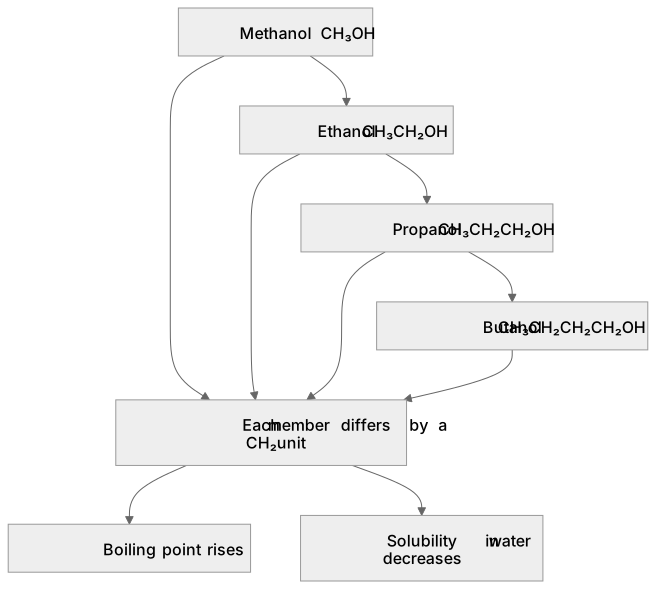
Label the diagram
Some boxes have lost their names. Pick the right name for each number.
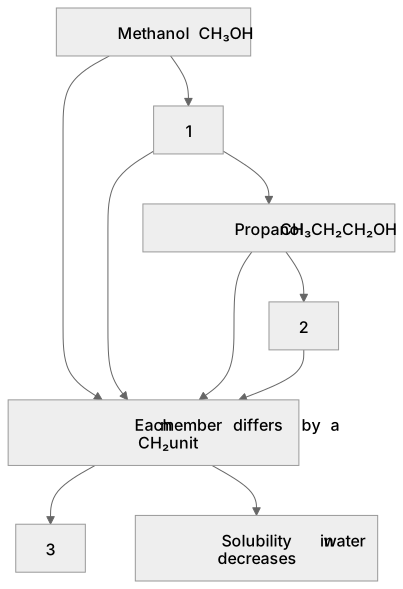
1Box 1
2Box 2
3Box 3
There is more to this lesson
The full lesson goes on to check your understanding and help you earn the marks. Create a free account to carry on, with your progress saved.
A week of Premium from your first lesson · Then the free plan continues · No card, no charge
Test your understanding of Alcohols: Methanol, ethanol, propanol and butanol are the first four members of a homologous series of alcohols.
Active recall beats re-reading. Take an instant quiz now to test what you’ve learned and lock it into long-term memory.
A week of Premium from your first lesson · Then the free plan continues · No card, no charge