AQA · GCSE · Chemistry
Course version: 8462 · Version from Sept 2018
Students should know the conditions used for fermentation of sugar using…
Full specification wording
Alcohols: Students should know the conditions used for fermentation of sugar using yeast.
Fermentation converts sugars such as glucose into ethanol and carbon dioxide using yeast.
Checked against the AQA 8462 specification (opens in a new tab) on .
- Point 4 of 5
Study notes
From the checked teaching notes for this specification point.
The idea
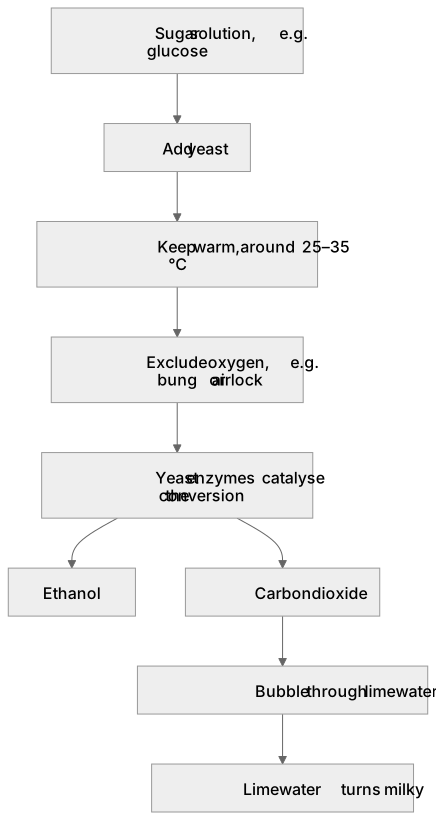
Fermentation converts sugars such as glucose into ethanol and carbon dioxide using yeast. The yeast provides enzymes that catalyse the reaction. The conditions are: a warm temperature, typically around 25–35 °C, but not so hot that enzymes denature; absence of oxygen, because oxygen would allow aerobic respiration instead; and a source of sugar in solution. A typical method mixes glucose solution with yeast in a flask, fits a bung and delivery tube to keep air out and collect gas, and keeps the mixture warm. The gas produced turns limewater milky, confirming carbon dioxide, while the liquid contains ethanol, which can be separated by fractional distillation.
What earns the marks
- States that yeast is added to a sugar solution, for example glucose solution.
- States that the mixture must be kept warm, typically around 25–35 °C, so enzymes work at a suitable rate.
- States that oxygen must be excluded, often by using an airlock or bung, so anaerobic respiration occurs.
- States that the products are ethanol and carbon dioxide.
- Explains that yeast enzymes catalyse the conversion of sugar to ethanol and carbon dioxide.
- Describes a test for carbon dioxide, such as bubbling the gas through limewater and observing a milky precipitate.
Common mistakes and how to put them right
Saying the mixture should be boiled or heated strongly.
Put it right: Keep it warm, around 25–35 °C, because higher temperatures denature the yeast enzymes.
Claiming oxygen is needed.
Put it right: Oxygen must be excluded so that anaerobic fermentation occurs rather than aerobic respiration.
Stating that fermentation produces only ethanol.
Put it right: Carbon dioxide is also produced and can be tested with limewater.
Exam tips
- Link each condition to its purpose: warmth for enzyme activity, no oxygen for anaerobic conditions, sugar as the reactant.
- When describing a practical, name the sugar solution and the yeast, and state how oxygen is kept out.
- If asked to identify a gas, describe the limewater test and the result rather than naming the gas alone.
Try the lesson
The start of the Alcohols: Students should know the conditions used for fermentation of sugar using yeast. lesson, made from checked teaching notes for this specification point.
Have a go first
Which set of conditions is required for the successful fermentation of sugar using yeast to produce ethanol?
Listen
Fermentation converts sugars such as glucose into ethanol and carbon dioxide using yeast. The yeast provides enzymes that catalyse the reaction. The conditions are: a warm temperature, typically around 25–35 °C, but not so hot that enzymes denature; absence of oxygen, because oxygen would allow aerobic respiration instead; and a source of sugar in solution. A typical method mixes glucose solution with yeast in a flask, fits a bung and delivery tube to keep air out and collect gas, and keeps the mixture warm. The gas produced turns limewater milky, confirming carbon dioxide, while the liquid contains ethanol, which can be separated by fractional distillation. A strong answer earns marks for these points. States that yeast is added to a sugar solution, for example glucose solution. States that the mixture must be kept warm, typically around 25–35 °C, so enzymes work at a suitable rate. States that oxygen must be excluded, often by using an airlock or bung, so anaerobic respiration occurs. States that the products are ethanol and carbon dioxide. A common slip: Saying the mixture should be boiled or heated strongly. Instead, keep it warm, around 25–35 °C, because higher temperatures denature the yeast enzymes. Exam tip: Link each condition to its purpose: warmth for enzyme activity, no oxygen for anaerobic conditions, sugar as the reactant.
See it
Label the diagram
Some boxes have lost their names. Pick the right name for each number.
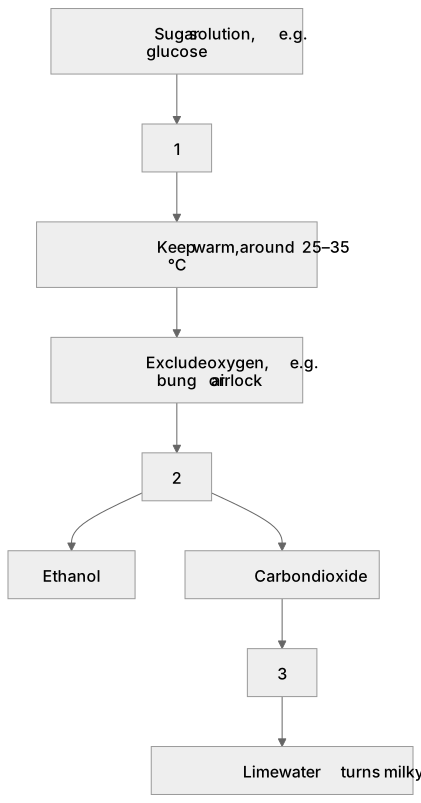
1Box 1
2Box 2
3Box 3
There is more to this lesson
The full lesson goes on to check your understanding and help you earn the marks. Create a free account to carry on, with your progress saved.
A week of Premium from your first lesson · Then the free plan continues · No card, no charge
Test your understanding of Alcohols: Students should know the conditions used for fermentation of sugar using yeast.
Active recall beats re-reading. Take an instant quiz now to test what you’ve learned and lock it into long-term memory.
A week of Premium from your first lesson · Then the free plan continues · No card, no charge