AQA · GCSE · Chemistry
Course version: 8462 · Version from Sept 2018
Aqueous solutions of ethanol are produced when sugar solutions are…
Full specification wording
Alcohols: Aqueous solutions of ethanol are produced when sugar solutions are fermented using yeast.
Fermentation is the breakdown of sugar by yeast to produce ethanol and carbon dioxide.
Checked against the AQA 8462 specification (opens in a new tab) on .
- Point 3 of 5
- 4 key terms
Study notes
From the checked teaching notes for this specification point.
The idea
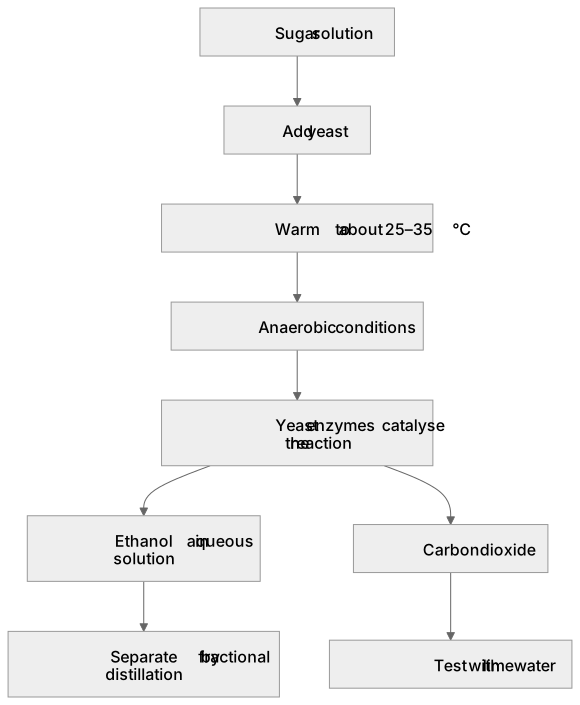
Fermentation is the breakdown of sugar by yeast to produce ethanol and carbon dioxide. Yeast provides enzymes that catalyse the reaction. A sugar solution, such as glucose solution, is warmed to about 25–35 °C and kept under anaerobic conditions; the yeast enzymes convert glucose into ethanol and carbon dioxide: C₆H₁₂O₆ → 2C₂H₅OH + 2CO₂. The ethanol formed is in aqueous solution because it is produced in water, and it can be separated by fractional distillation. Temperatures that are too high denature the enzymes and stop fermentation, while oxygen encourages aerobic respiration instead of fermentation. The reaction is exothermic and produces bubbles of carbon dioxide, which can be tested with limewater.
What earns the marks
- State that fermentation uses yeast to convert sugar into ethanol and carbon dioxide.
- Give the word equation glucose → ethanol + carbon dioxide, or the balanced symbol equation C₆H₁₂O₆ → 2C₂H₅OH + 2CO₂.
- Describe the conditions: a sugar solution, yeast, a warm temperature of about 25–35 °C and the absence of oxygen.
- Explain that enzymes in yeast catalyse the fermentation reaction.
- State that the ethanol produced is in aqueous solution and can be concentrated by fractional distillation.
- Describe the test for the carbon dioxide produced, such as bubbling it through limewater to form a white precipitate.
Common mistakes and how to put them right
Stating that fermentation produces only ethanol.
Put it right by including carbon dioxide as the other product.
Using very high temperatures to speed up fermentation.
Put it right by keeping the mixture warm but not hot, because high temperatures denature the yeast enzymes.
Writing the product as ethanoic acid.
Put it right by writing ethanol, because fermentation of sugar produces ethanol, not ethanoic acid.
Claiming that oxygen is needed.
Put it right by stating that anaerobic conditions favour fermentation.
Exam tips
- Learn the balanced equation for fermentation and check that carbon, hydrogen and oxygen atoms balance on both sides.
- When describing conditions, mention yeast, a sugar solution, a warm temperature and the absence of oxygen.
- Link the carbon dioxide produced to a limewater test to show how the gas can be identified.
Try the lesson
The start of the Alcohols: Aqueous solutions of ethanol are produced when sugar solutions are fermented using yeast. lesson, made from checked teaching notes for this specification point.
Have a go first
During the biological production of ethanol, which substance is fermented by yeast?
Listen
Fermentation is the breakdown of sugar by yeast to produce ethanol and carbon dioxide. Yeast provides enzymes that catalyse the reaction. A sugar solution, such as glucose solution, is warmed to about 25–35 °C and kept under anaerobic conditions; the yeast enzymes convert glucose into ethanol and carbon dioxide: C₆H₁₂O₆ → 2C₂H₅OH + 2CO₂. The ethanol formed is in aqueous solution because it is produced in water, and it can be separated by fractional distillation. Temperatures that are too high denature the enzymes and stop fermentation, while oxygen encourages aerobic respiration instead of fermentation. The reaction is exothermic and produces bubbles of carbon dioxide, which can be tested with limewater. A strong answer earns marks for these points. State that fermentation uses yeast to convert sugar into ethanol and carbon dioxide. Give the word equation glucose → ethanol + carbon dioxide, or the balanced symbol equation C₆H₁₂O₆ → 2C₂H₅OH + 2CO₂. Describe the conditions: a sugar solution, yeast, a warm temperature of about 25–35 °C and the absence of oxygen. Explain that enzymes in yeast catalyse the fermentation reaction. A common slip: Stating that fermentation produces only ethanol. Instead, including carbon dioxide as the other product. Exam tip: Learn the balanced equation for fermentation and check that carbon, hydrogen and oxygen atoms balance on both sides.
See it
Key words
Say what each word means before you turn the card.
Fermentation
Try answering aloud or in your head before turning the card.
Enzymes
Try answering aloud or in your head before turning the card.
Anaerobic conditions
Try answering aloud or in your head before turning the card.
Fractional distillation
Try answering aloud or in your head before turning the card.
See every definition
- Fermentation
- The breakdown of sugar by yeast to produce ethanol and carbon dioxide.
- Enzymes
- Provided by yeast, these catalyse the reaction that converts glucose into ethanol and carbon dioxide.
- Anaerobic conditions
- Conditions without oxygen, which favour fermentation rather than aerobic respiration.
- Fractional distillation
- The method by which the ethanol formed in aqueous solution can be separated.
Label the diagram
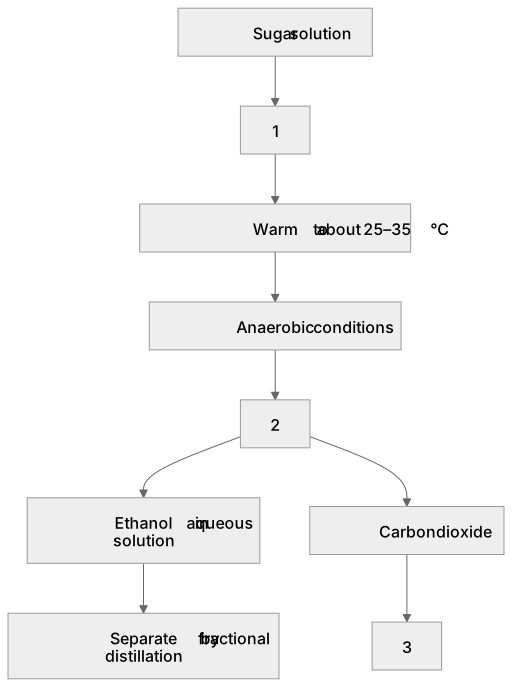
Some boxes have lost their names. Pick the right name for each number.
1Box 1
2Box 2
3Box 3
There is more to this lesson
The full lesson goes on to check your understanding and help you earn the marks. Create a free account to carry on, with your progress saved.
A week of Premium from your first lesson · Then the free plan continues · No card, no charge
Test your understanding of Alcohols: Aqueous solutions of ethanol are produced when sugar solutions are fermented using yeast.
Active recall beats re-reading. Take an instant quiz now to test what you’ve learned and lock it into long-term memory.
A week of Premium from your first lesson · Then the free plan continues · No card, no charge