AQA · GCSE · Chemistry
Course version: 8462 · Version from Sept 2018
Bronze is an alloy of copper and tin. Brass is an alloy of copper and zinc.
Full specification wording
Alloys as useful materials: Bronze is an alloy of copper and tin. Brass is an alloy of copper and zinc.
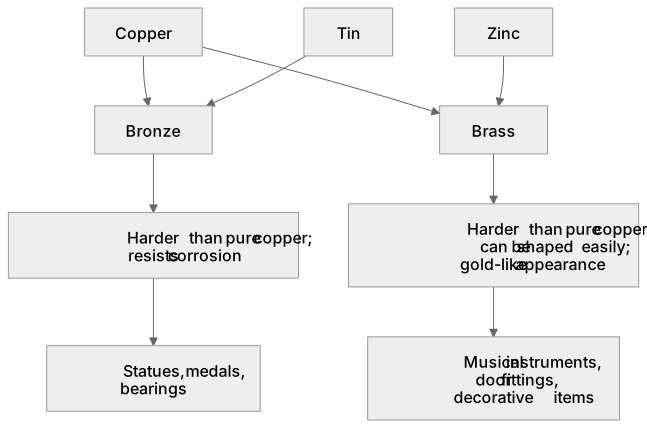
Bronze and brass are both alloys based on copper, but they contain different second metals.
Checked against the AQA 8462 specification (opens in a new tab) on .
- Point 2 of 10
- 4 key terms
Study notes
From the checked teaching notes for this specification point.
The idea
Bronze and brass are both alloys based on copper, but they contain different second metals. Bronze is a mixture of copper and tin. It is harder than pure copper and resists corrosion, so it is used for statues, medals and bearings. Brass is a mixture of copper and zinc. It is also harder than pure copper, can be shaped easily and has a gold-like appearance, so it is used for musical instruments, door fittings and decorative items. Because alloys are mixtures, their composition can be varied to adjust properties. Knowing the exact metals in each alloy allows you to compare their properties and suggest suitable uses. Both are examples of how alloying changes the properties of a metal.
What earns the marks
- States that bronze is an alloy of copper and tin.
- States that brass is an alloy of copper and zinc.
- Recognises that both are mixtures, so their composition can vary.
- Links a property of bronze or brass, such as hardness or corrosion resistance, to a suitable use.
- Compares the two alloys, noting that both contain copper but differ in the second metal.
Common mistakes and how to put them right
Mixing up the second metal.
Put it right: Bronze is copper with tin, and brass is copper with zinc.
Calling bronze or brass a compound.
Put it right: They are mixtures of metals, so they are alloys.
Assuming both alloys have identical properties because both contain copper.
Put it right: The different second metal gives different properties and uses.
Exam tips
- Learn the pairs as copper–tin for bronze and copper–zinc for brass, and use a memory link such as 'bronze has tin'.
- When asked for a use, name the alloy and give a property that explains the choice.
- If comparing, state one similarity and one difference between bronze and brass.
Try the lesson
The start of the Alloys as useful materials: Bronze is an alloy of copper and tin. Brass is an alloy of copper and zinc. lesson, made from checked teaching notes for this specification point.
Have a go first
Which two metals are combined to make the alloy bronze?
Listen
Bronze and brass are both alloys based on copper, but they contain different second metals. Bronze is a mixture of copper and tin. It is harder than pure copper and resists corrosion, so it is used for statues, medals and bearings. Brass is a mixture of copper and zinc. It is also harder than pure copper, can be shaped easily and has a gold-like appearance, so it is used for musical instruments, door fittings and decorative items. Because alloys are mixtures, their composition can be varied to adjust properties. Knowing the exact metals in each alloy allows you to compare their properties and suggest suitable uses. Both are examples of how alloying changes the properties of a metal. A strong answer earns marks for these points. States that bronze is an alloy of copper and tin. States that brass is an alloy of copper and zinc. Recognises that both are mixtures, so their composition can vary. Links a property of bronze or brass, such as hardness or corrosion resistance, to a suitable use. A common slip: Mixing up the second metal: saying bronze contains zinc or brass contains tin. Instead, bronze is copper with tin, and brass is copper with zinc. Exam tip: Learn the pairs as copper–tin for bronze and copper–zinc for brass, and use a memory link such as 'bronze has tin'.
See it
Key words
Say what each word means before you turn the card.
Alloys of copper
Try answering aloud or in your head before turning the card.
Composition and properties
Try answering aloud or in your head before turning the card.
Materials and their uses
Try answering aloud or in your head before turning the card.
Mixtures versus compounds
Try answering aloud or in your head before turning the card.
See every definition
- Alloys of copper
- Bronze and brass are both alloys based on copper, but they contain different second metals.
- Composition and properties
- Because alloys are mixtures, their composition can be varied to adjust properties.
- Materials and their uses
- Knowing the exact metals in each alloy allows you to compare their properties and suggest suitable uses.
- Mixtures versus compounds
- Bronze and brass are mixtures of metals, so they are alloys rather than compounds.
Label the diagram
Some boxes have lost their names. Pick the right name for each number.
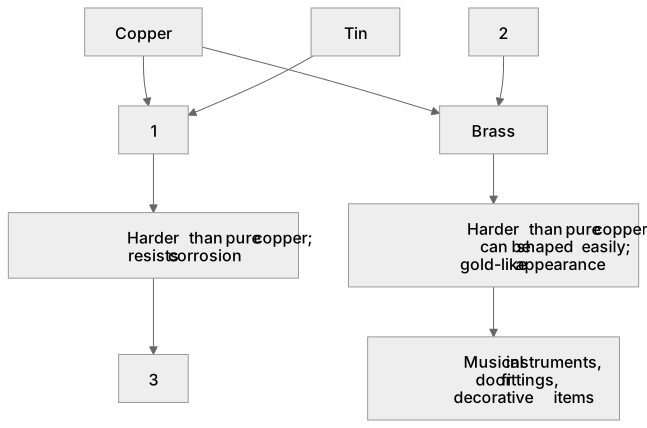
1Box 1
2Box 2
3Box 3
There is more to this lesson
The full lesson goes on to check your understanding and help you earn the marks. Create a free account to carry on, with your progress saved.
A week of Premium from your first lesson · Then the free plan continues · No card, no charge
Test your understanding of Alloys as useful materials: Bronze is an alloy of copper and tin. Brass is an alloy of copper and zinc.
Active recall beats re-reading. Take an instant quiz now to test what you’ve learned and lock it into long-term memory.
A week of Premium from your first lesson · Then the free plan continues · No card, no charge