AQA · GCSE · Chemistry
Course version: 8462 · Version from Sept 2018
Gold used as jewellery is usually an alloy with silver, copper and zinc.
Full specification wording
Alloys as useful materials: Gold used as jewellery is usually an alloy with silver, copper and zinc.
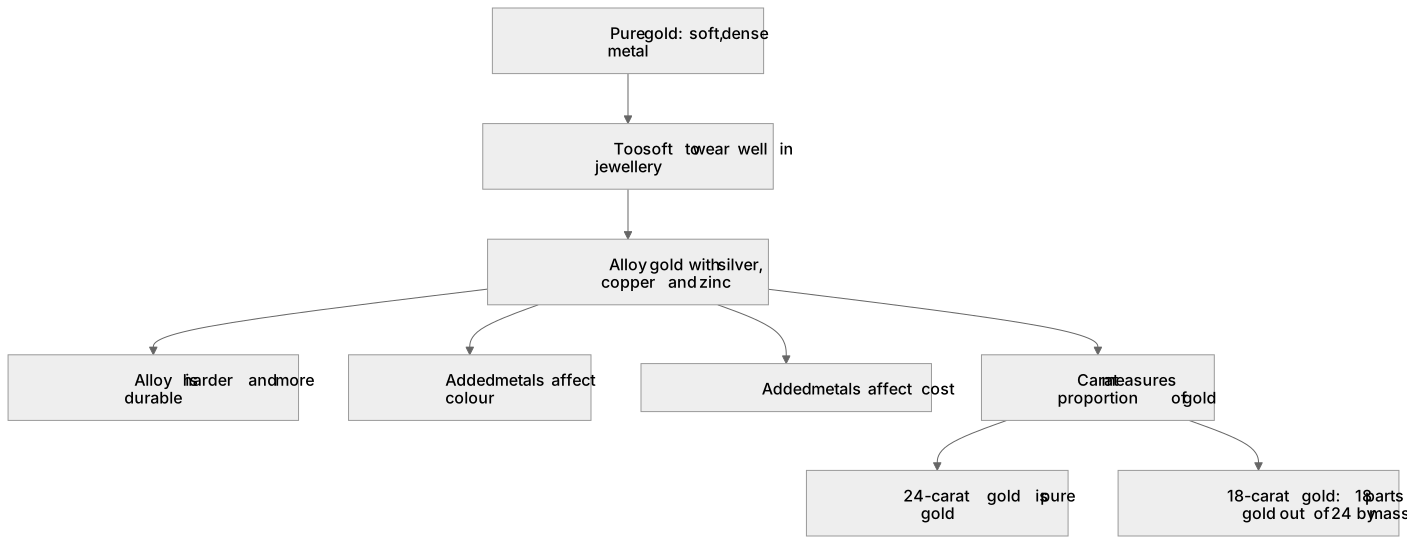
Pure gold is a soft, dense metal that is too soft to wear well in jewellery, so it is usually alloyed with other metals such as silver, copper and zinc.
Checked against the AQA 8462 specification (opens in a new tab) on .
- Point 3 of 10
- 4 key terms
Study notes
From the checked teaching notes for this specification point.
The idea
Pure gold is a soft, dense metal that is too soft to wear well in jewellery, so it is usually alloyed with other metals such as silver, copper and zinc. These added metals make the gold harder and more durable while keeping its attractive appearance. The proportion of gold in the alloy is measured in carats: 24-carat gold is pure gold, while 18-carat gold contains 18 parts gold out of 24 by mass, and the rest is other metals. Different added metals also affect colour, giving yellow, white or rose gold. Because the alloy is a mixture, its composition can be adjusted to produce the desired hardness, colour and cost. This is an everyday example of how alloying changes the properties of a metal.
What earns the marks
- States that jewellery gold is an alloy of gold with silver, copper and zinc.
- Explains that pure gold is too soft for most jewellery, so alloying makes it harder and more durable.
- Describes carat as a measure of the proportion of gold in the alloy, with 24-carat gold being pure gold.
- Links the added metals to properties such as hardness, colour or cost.
- Recognises that the alloy is a mixture, so its composition and properties can be varied.
Common mistakes and how to put them right
Thinking that jewellery gold is pure gold.
Put it right: It is usually an alloy containing silver, copper and zinc.
Believing that adding other metals always makes the alloy softer.
Put it right: Alloying usually makes gold harder and more suitable for jewellery.
Confusing carat with a unit of mass.
Put it right: Carat describes the proportion of gold in the alloy, not its mass.
Exam tips
- Name the three added metals: silver, copper and zinc.
- Use the idea that pure gold is soft to explain why alloying is needed for jewellery.
- If carat is mentioned, state that 24-carat gold is pure and lower carats contain more other metals.
Try the lesson
The start of the Alloys as useful materials: Gold used as jewellery is usually an alloy with silver, copper and zinc. lesson, made from checked teaching notes for this specification point.
Have a go first
Gold used to make jewellery is usually an alloy. Which group of metals is commonly alloyed with gold for this purpose?
Listen
Pure gold is a soft, dense metal that is too soft to wear well in jewellery, so it is usually alloyed with other metals such as silver, copper and zinc. These added metals make the gold harder and more durable while keeping its attractive appearance. The proportion of gold in the alloy is measured in carats: 24-carat gold is pure gold, while 18-carat gold contains 18 parts gold out of 24 by mass, and the rest is other metals. Different added metals also affect colour, giving yellow, white or rose gold. Because the alloy is a mixture, its composition can be adjusted to produce the desired hardness, colour and cost. This is an everyday example of how alloying changes the properties of a metal. A strong answer earns marks for these points. States that jewellery gold is an alloy of gold with silver, copper and zinc. Explains that pure gold is too soft for most jewellery, so alloying makes it harder and more durable. Describes carat as a measure of the proportion of gold in the alloy, with 24-carat gold being pure gold. Links the added metals to properties such as hardness, colour or cost. A common slip: Thinking that jewellery gold is pure gold. Instead, it is usually an alloy containing silver, copper and zinc. Exam tip: Name the three added metals: silver, copper and zinc.
See it
Key words
Say what each word means before you turn the card.
Alloys in everyday use
Try answering aloud or in your head before turning the card.
Properties of gold and its alloys
Try answering aloud or in your head before turning the card.
Composition and carat
Try answering aloud or in your head before turning the card.
Materials selection for function
Try answering aloud or in your head before turning the card.
See every definition
- Alloys in everyday use
- Gold used as jewellery is usually an alloy with silver, copper and zinc, an everyday example of how alloying changes the properties of a metal.
- Properties of gold and its alloys
- Pure gold is a soft, dense metal that is too soft to wear well in jewellery, so added metals make the gold harder and more durable while keeping its attractive appearance.
- Composition and carat
- The proportion of gold in the alloy is measured in carats, with 24-carat gold being pure gold and 18-carat gold containing 18 parts gold out of 24 by mass.
- Materials selection for function
- Because the alloy is a mixture, its composition can be adjusted to produce the desired hardness, colour and cost.
Label the diagram
Some boxes have lost their names. Pick the right name for each number.
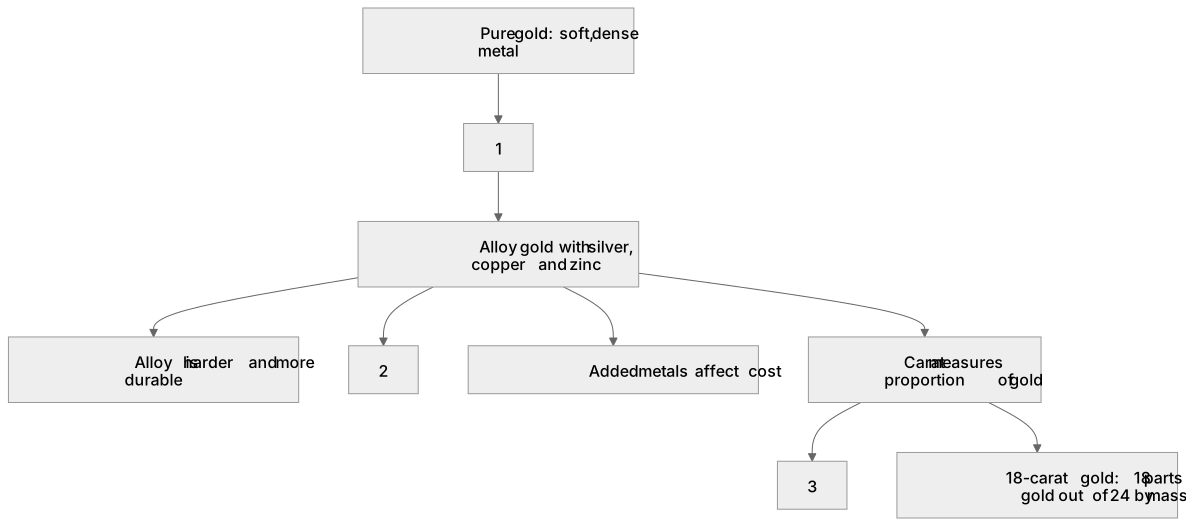
1Box 1
2Box 2
3Box 3
There is more to this lesson
The full lesson goes on to check your understanding and help you earn the marks. Create a free account to carry on, with your progress saved.
A week of Premium from your first lesson · Then the free plan continues · No card, no charge
Test your understanding of Alloys as useful materials: Gold used as jewellery is usually an alloy with silver, copper and zinc.
Active recall beats re-reading. Take an instant quiz now to test what you’ve learned and lock it into long-term memory.
A week of Premium from your first lesson · Then the free plan continues · No card, no charge