AQA · GCSE · Chemistry
Course version: 8462 · Version from Sept 2018
Steels containing chromium and nickel (stainless steels) are hard and…
Full specification wording
Alloys as useful materials: Steels containing chromium and nickel (stainless steels) are hard and resistant to corrosion.
Steel is an alloy of iron with carbon.
Checked against the AQA 8462 specification (opens in a new tab) on .
- Point 8 of 10
- 4 key terms
Study notes
From the checked teaching notes for this specification point.
The idea
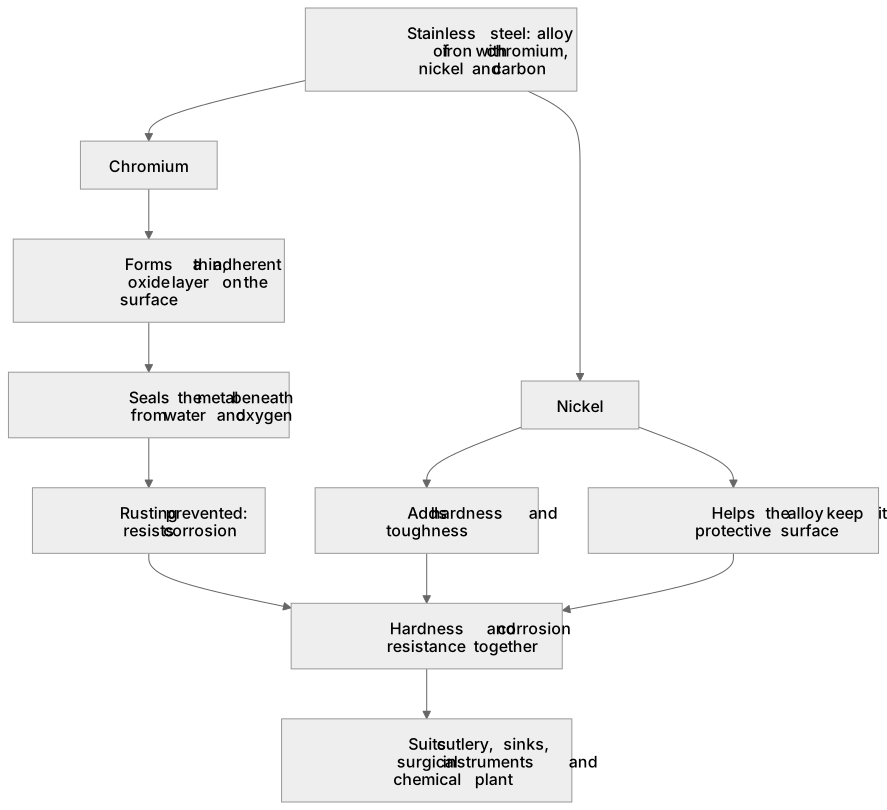
Steel is an alloy of iron with carbon. Adding chromium and nickel produces stainless steel, which is harder than pure iron and resists corrosion. Chromium forms a thin, adherent oxide layer on the surface that seals the metal beneath from water and oxygen, so rusting is prevented; nickel adds toughness and helps the alloy keep its protective surface. Because stainless steel does not flake away like rusted iron, it is chosen for cutlery, sinks, surgical instruments and chemical plant. In an exam, link composition to property and then to a named use: chromium and nickel give hardness and corrosion resistance, so the alloy suits wet, hygienic or outdoor applications.
What earns the marks
- Stainless steel is an alloy of iron with chromium and nickel, and also contains carbon.
- Chromium provides resistance to corrosion by forming a protective oxide layer on the surface.
- Nickel contributes hardness and toughness and helps maintain the protective surface.
- The combination of hardness and corrosion resistance makes stainless steel suitable for cutlery, sinks, surgical instruments and chemical plant.
- Ordinary carbon steel is harder than pure iron but still rusts, so it is unsuitable where water and oxygen are present.
Common mistakes and how to put them right
Saying stainless steel is an element or a pure metal.
Put it right by describing it as a mixture of iron with chromium, nickel and carbon.
Claiming chromium makes steel rust faster.
Put it right by stating that chromium forms a protective oxide layer that resists corrosion.
Confusing hardness with corrosion resistance.
Put it right by treating them as separate properties, both needed for uses such as cutlery.
Exam tips
- Name the three main elements in stainless steel: iron, chromium and nickel.
- Always link each property to a use, for example corrosion resistance to kitchen sinks.
- Use the term alloy and state that it is a mixture of a metal with other elements.
Try the lesson
The start of the Alloys as useful materials: Steels containing chromium and nickel (stainless steels) are hard and resistant to corrosion. lesson, made from checked teaching notes for this specification point.
Have a go first
Which two metals are added to iron to make stainless steel?
Listen
Steel is an alloy of iron with carbon. Adding chromium and nickel produces stainless steel, which is harder than pure iron and resists corrosion. Chromium forms a thin, adherent oxide layer on the surface that seals the metal beneath from water and oxygen, so rusting is prevented; nickel adds toughness and helps the alloy keep its protective surface. Because stainless steel does not flake away like rusted iron, it is chosen for cutlery, sinks, surgical instruments and chemical plant. In an exam, link composition to property and then to a named use: chromium and nickel give hardness and corrosion resistance, so the alloy suits wet, hygienic or outdoor applications. A strong answer earns marks for these points. Stainless steel is an alloy of iron with chromium and nickel, and also contains carbon. Chromium provides resistance to corrosion by forming a protective oxide layer on the surface. Nickel contributes hardness and toughness and helps maintain the protective surface. The combination of hardness and corrosion resistance makes stainless steel suitable for cutlery, sinks, surgical instruments and chemical plant. A common slip: Saying stainless steel is an element or a pure metal. Instead, describing it as a mixture of iron with chromium, nickel and carbon. Exam tip: Name the three main elements in stainless steel: iron, chromium and nickel.
See it
Key words
Say what each word means before you turn the card.
Alloy
Try answering aloud or in your head before turning the card.
Corrosion resistance
Try answering aloud or in your head before turning the card.
Stainless steel
Try answering aloud or in your head before turning the card.
Protective oxide layer
Try answering aloud or in your head before turning the card.
See every definition
- Alloy
- A mixture of a metal with other elements, such as iron with chromium, nickel and carbon.
- Corrosion resistance
- The ability to resist corrosion, provided in stainless steel by chromium forming a protective oxide layer on the surface.
- Stainless steel
- An alloy of iron with chromium and nickel, and also containing carbon, that is hard and resistant to corrosion.
- Protective oxide layer
- A thin, adherent oxide layer formed on the surface by chromium that seals the metal beneath from water and oxygen.
Label the diagram
Some boxes have lost their names. Pick the right name for each number.
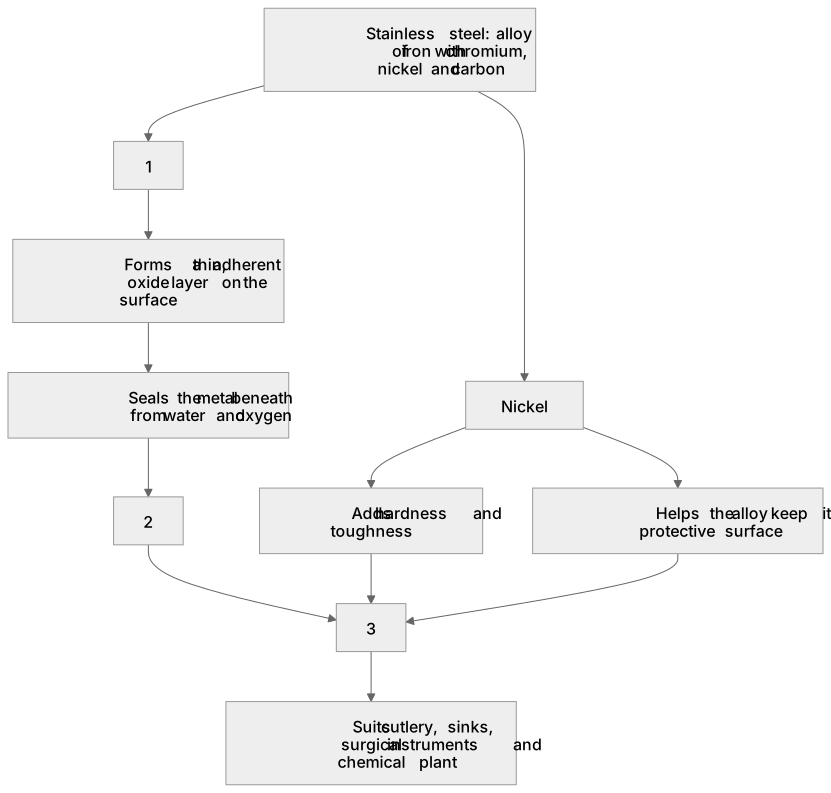
1Box 1
2Box 2
3Box 3
There is more to this lesson
The full lesson goes on to check your understanding and help you earn the marks. Create a free account to carry on, with your progress saved.
A week of Premium from your first lesson · Then the free plan continues · No card, no charge
Test your understanding of Alloys as useful materials: Steels containing chromium and nickel (stainless steels) are hard and resistant to corrosion.
Active recall beats re-reading. Take an instant quiz now to test what you’ve learned and lock it into long-term memory.
A week of Premium from your first lesson · Then the free plan continues · No card, no charge