AQA · GCSE · Chemistry
Course version: 8462 · Version from Sept 2018
Alloys as useful materials: Aluminium alloys are low density.
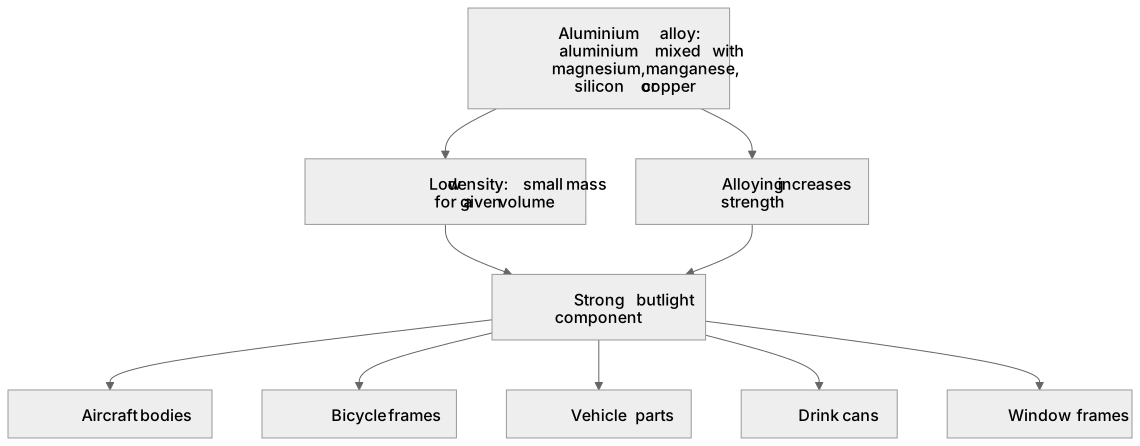
Pure aluminium is already a light metal, and alloying it with elements such as magnesium, manganese, silicon or copper produces materials that keep a low density while gaining strength.
Checked against the AQA 8462 specification (opens in a new tab) on .
- Point 9 of 10
- 3 key terms
Study notes
From the checked teaching notes for this specification point.
The idea
Pure aluminium is already a light metal, and alloying it with elements such as magnesium, manganese, silicon or copper produces materials that keep a low density while gaining strength. Density is mass per unit volume, so a low-density alloy gives a strong but light component. This matters in aircraft bodies, bicycle frames, car wheels, drink cans and window frames, where reducing mass saves fuel or makes handling easier. In an exam, compare the alloy with steel: for the same volume, an aluminium alloy has much less mass, so it is chosen where low weight is more important than the very high strength of steel.
What earns the marks
- An aluminium alloy is a mixture of aluminium with other elements such as magnesium, manganese, silicon or copper.
- Low density means a small mass for a given volume.
- Alloying can increase strength while the material remains much less dense than steel.
- Low density makes aluminium alloys suitable for aircraft, bicycles, vehicle parts and drink cans.
- Choosing a material involves balancing density, strength, cost and corrosion resistance.
Common mistakes and how to put them right
Confusing density with strength.
Put it right by explaining that low density means low mass per unit volume, while strength is about resisting forces.
Stating that alloying always lowers density.
Put it right by saying the alloy is designed to keep a low density while improving strength.
Writing that aluminium alloys are lighter than air.
Put it right by saying they have a lower density than steel, not that they float.
Exam tips
- Define density as mass per unit volume before using the term low density.
- Compare aluminium alloys with steel to justify a choice for a named use.
- Give a specific application such as aircraft bodies or bicycle frames.
Try the lesson
The start of the Alloys as useful materials: Aluminium alloys are low density. lesson, made from checked teaching notes for this specification point.
Have a go first
Which of the following is a characteristic property of aluminium alloys?
Listen
Pure aluminium is already a light metal, and alloying it with elements such as magnesium, manganese, silicon or copper produces materials that keep a low density while gaining strength. Density is mass per unit volume, so a low-density alloy gives a strong but light component. This matters in aircraft bodies, bicycle frames, car wheels, drink cans and window frames, where reducing mass saves fuel or makes handling easier. In an exam, compare the alloy with steel: for the same volume, an aluminium alloy has much less mass, so it is chosen where low weight is more important than the very high strength of steel. A strong answer earns marks for these points. An aluminium alloy is a mixture of aluminium with other elements such as magnesium, manganese, silicon or copper. Low density means a small mass for a given volume. Alloying can increase strength while the material remains much less dense than steel. Low density makes aluminium alloys suitable for aircraft, bicycles, vehicle parts and drink cans. A common slip: Confusing density with strength. Instead, explaining that low density means low mass per unit volume, while strength is about resisting forces. Exam tip: Define density as mass per unit volume before using the term low density.
See it
Key words
Say what each word means before you turn the card.
Density
Try answering aloud or in your head before turning the card.
Aluminium alloy
Try answering aloud or in your head before turning the card.
Low density
Try answering aloud or in your head before turning the card.
See every definition
- Density
- Mass per unit volume, so a low-density alloy gives a strong but light component.
- Aluminium alloy
- A mixture of aluminium with other elements such as magnesium, manganese, silicon or copper.
- Low density
- A small mass for a given volume, which makes aluminium alloys suitable for aircraft, bicycles, vehicle parts and drink cans.
Label the diagram
Some boxes have lost their names. Pick the right name for each number.
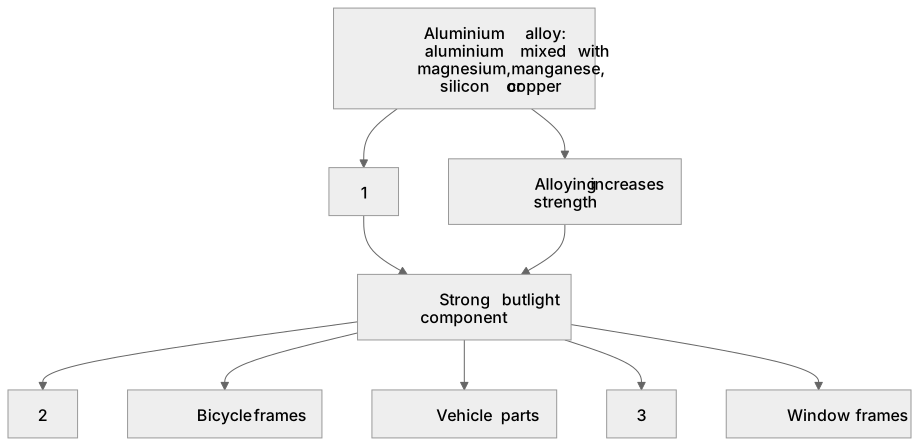
1Box 1
2Box 2
3Box 3
There is more to this lesson
The full lesson goes on to check your understanding and help you earn the marks. Create a free account to carry on, with your progress saved.
A week of Premium from your first lesson · Then the free plan continues · No card, no charge
Test your understanding of Alloys as useful materials: Aluminium alloys are low density.
Active recall beats re-reading. Take an instant quiz now to test what you’ve learned and lock it into long-term memory.
A week of Premium from your first lesson · Then the free plan continues · No card, no charge