AQA · GCSE · Chemistry
Course version: 8462 · Version from Sept 2018
Chemical reactions can be represented by word equations or equations using…
Full specification wording
Atoms, elements and compounds: Chemical reactions can be represented by word equations or equations using symbols and formulae.
A chemical reaction can be written as a word equation, naming reactants and products, or as a symbol equation using formulae.
Checked against the AQA 8462 specification (opens in a new tab) on .
- Point 8 of 10
- 4 key terms
Study notes
From the checked teaching notes for this specification point.
The idea
A chemical reaction can be written as a word equation, naming reactants and products, or as a symbol equation using formulae. Word equations show what reacts and what forms, for example magnesium + oxygen → magnesium oxide. Symbol equations give the same information more precisely, for example 2Mg + O₂ → 2MgO, and can be balanced so the number of each type of atom is the same on both sides. State symbols (s), (l), (g) and (aq) may be added to show physical states. Balancing is needed because atoms are conserved. Word equations are useful for describing reactions, while symbol equations allow counting atoms and quantitative work.
What earns the marks
- A word equation names the reactants on the left and the products on the right, separated by an arrow.
- A symbol equation uses chemical formulae instead of names and gives the same reaction information more precisely.
- Symbol equations must be balanced so that the number of atoms of each element is equal on both sides.
- State symbols (s), (l), (g) and (aq) can show the physical state of each substance in a symbol equation.
- Balancing is achieved by placing whole-number coefficients in front of formulae, never by changing subscripts within a formula.
Common mistakes and how to put them right
Changing a subscript to balance an equation.
Put it right: Adjust only the large coefficients in front of formulae.
Writing products on the left and reactants on the right.
Put it right: Reactants go on the left and products on the right of the arrow.
Leaving an equation unbalanced after writing formulae.
Put it right: Count atoms of each element and add coefficients until both sides match.
Exam tips
- Write the word equation first to identify reactants and products, then convert names to formulae.
- Balance one element at a time, starting with elements that appear in only one substance on each side.
- Check the final equation by counting every atom on both sides before adding state symbols.
Try the lesson
The start of the Atoms, elements and compounds: Chemical reactions can be represented by word equations or equations using symbols and formulae. lesson, made from checked teaching notes for this specification point.
Have a go first
Which word equation represents the reaction between sodium and chlorine to form sodium chloride?
Listen
A chemical reaction can be written as a word equation, naming reactants and products, or as a symbol equation using formulae. Word equations show what reacts and what forms, for example magnesium + oxygen → magnesium oxide. Symbol equations give the same information more precisely, for example 2Mg + O₂ → 2MgO, and can be balanced so the number of each type of atom is the same on both sides. State symbols (s), (l), (g) and (aq) may be added to show physical states. Balancing is needed because atoms are conserved. Word equations are useful for describing reactions, while symbol equations allow counting atoms and quantitative work. A strong answer earns marks for these points. A word equation names the reactants on the left and the products on the right, separated by an arrow. A symbol equation uses chemical formulae instead of names and gives the same reaction information more precisely. Symbol equations must be balanced so that the number of atoms of each element is equal on both sides. State symbols (s), (l), (g) and (aq) can show the physical state of each substance in a symbol equation. A common slip: Changing a subscript to balance an equation. Instead, adjust only the large coefficients in front of formulae. Exam tip: Write the word equation first to identify reactants and products, then convert names to formulae.
See it
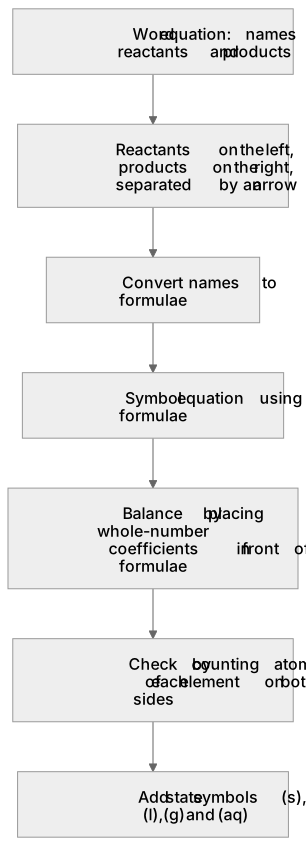
Put it in order
Put these steps in the order they happen.
- 1. Add state symbols (s), (l), (g) and (aq)
- 2. Check by counting atoms of each element on both sides
- 3. Convert names to formulae
- 4. Balance by placing whole-number coefficients in front of formulae
- 5. Word equation: names of reactants and products
- 6. Reactants on the left, products on the right, separated by an arrow
- 7. Symbol equation using formulae
Key words
Say what each word means before you turn the card.
Word equation
Try answering aloud or in your head before turning the card.
Symbol equation
Try answering aloud or in your head before turning the card.
Balanced equation
Try answering aloud or in your head before turning the card.
State symbols
Try answering aloud or in your head before turning the card.
See every definition
- Word equation
- A way of representing a reaction that names the reactants on the left and the products on the right, separated by an arrow.
- Symbol equation
- A way of representing a reaction that uses chemical formulae instead of names and gives the same reaction information more precisely.
- Balanced equation
- A symbol equation in which the number of atoms of each element is equal on both sides, achieved by placing whole-number coefficients in front of formulae.
- State symbols
- The labels (s), (l), (g) and (aq) that may be added to show the physical state of each substance in a symbol equation.
Label the diagram
Some boxes have lost their names. Pick the right name for each number.
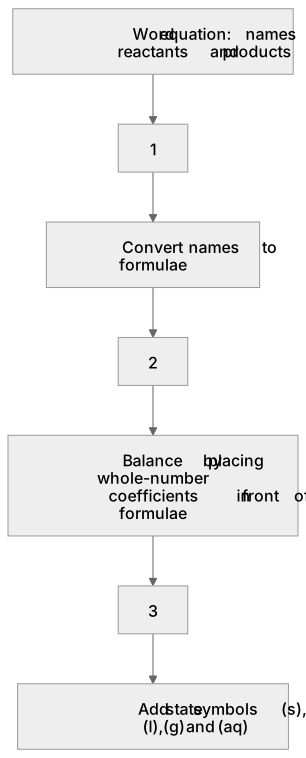
1Box 1
2Box 2
3Box 3
There is more to this lesson
The full lesson goes on to check your understanding and help you earn the marks. Create a free account to carry on, with your progress saved.
A week of Premium from your first lesson · Then the free plan continues · No card, no charge
Test your understanding of Atoms, elements and compounds: Chemical reactions can be represented by word equations or equations using symbols and formulae.
Active recall beats re-reading. Take an instant quiz now to test what you’ve learned and lock it into long-term memory.
A week of Premium from your first lesson · Then the free plan continues · No card, no charge