AQA · GCSE · Chemistry
Course version: 8462 · Version from Sept 2018
Students will be supplied with a periodic table for the exam and should be…
Full specification wording
Atoms, elements and compounds: Students will be supplied with a periodic table for the exam and should be able to: use the names and symbols of the first 20 elements in the periodic table, the elements in Groups 1 and 7, and other elements in this specification name compounds of these elements from given formulae or symbol equations write word equations for the reactions in this specification write formulae and balanced chemical equations for the reactions in this specification.
This cluster of skills underpins all of GCSE Chemistry: reading the supplied periodic table to name and symbolise elements, converting between names and formulae, and representing reactions as…
Checked against the AQA 8462 specification (opens in a new tab) on .
- Point 9 of 10
- 3 key terms
Study notes
From the checked teaching notes for this specification point.
The idea
This cluster of skills underpins all of GCSE Chemistry: reading the supplied periodic table to name and symbolise elements, converting between names and formulae, and representing reactions as word equations or balanced symbol equations. You must know the first 20 elements by name and symbol, the Group 1 and Group 7 elements, and other specified elements such as Fe, Cu, Zn, Ag and Au. From a formula such as Ca(OH)₂ you name calcium hydroxide; from a symbol equation you identify compounds by their formulae. Word equations name reactants and products, for example hydrochloric acid + sodium hydroxide → sodium chloride + water. Balanced equations use formulae with state symbols where required and conserve atoms of each element.
What earns the marks
- Correctly names and writes symbols for the first 20 elements, Group 1 elements (Li, Na, K, Rb, Cs) and Group 7 elements (F, Cl, Br, I, At), plus other specified elements such as Fe, Cu, Zn, Ag and Au.
- Names compounds from given formulae, including those with brackets and Roman numerals where appropriate, for example FeCl₂ is iron(II) chloride and Ca(OH)₂ is calcium hydroxide.
- Writes word equations that identify all reactants and products by name for the reactions in this specification, including neutralisation, combustion, displacement and precipitation.
- Writes formulae for reactants and products using the periodic table to deduce ions and combining ratios, for example Al³⁺ with O²⁻ gives Al₂O₃.
- Balances symbol equations by adjusting coefficients so that the number of atoms of each element is the same on both sides, and includes state symbols where the question requires them.
- Checks that a balanced equation is consistent with the word equation and with conservation of mass, and that formulae contain correct subscripts and charges.
Common mistakes and how to put them right
Writing element symbols with incorrect capitalisation, such as co for cobalt instead of Co.
Put it right: Use one capital letter followed by lower-case letters as shown on the periodic table.
Balancing by changing subscripts in a formula, for example turning H₂O into H₂O₂ to balance hydrogen.
Put it right: Change only the large coefficient in front of a formula.
Omitting state symbols or using them inconsistently when the question asks for them.
Put it right: Add (s), (l), (g) or (aq) after each formula as appropriate.
Exam tips
- Spend a moment checking every symbol against the periodic table before writing, especially for elements with similar names such as magnesium and manganese.
- When balancing, count atoms element by element and write the counts beside the equation; adjust coefficients and recount until each element matches.
- For word equations, use the exact chemical names from the specification rather than everyday names, and include the correct products for the reaction type.
Try the lesson
The start of the Atoms, elements and compounds: Students will be supplied with a periodic table for the exam and should be able to: use the names and symbols of the first 20 elements in the periodic table, the elements in Groups 1 and 7, and other elements in this specification name compounds of these elements from given formulae or symbol equations write word equations for the reactions in this specification write formulae and balanced chemical equations for the reactions in this specification. lesson, made from checked teaching notes for this specification point.
Have a go first
Using the periodic table, which symbol represents the element potassium?
Listen
This cluster of skills underpins all of GCSE Chemistry: reading the supplied periodic table to name and symbolise elements, converting between names and formulae, and representing reactions as word equations or balanced symbol equations. You must know the first 20 elements by name and symbol, the Group 1 and Group 7 elements, and other specified elements such as Fe, Cu, Zn, Ag and Au. From a formula such as Ca(OH)₂ you name calcium hydroxide; from a symbol equation you identify compounds by their formulae. Word equations name reactants and products, for example hydrochloric acid + sodium hydroxide → sodium chloride + water. Balanced equations use formulae with state symbols where required and conserve atoms of each element. A strong answer earns marks for these points. Correctly names and writes symbols for the first 20 elements, Group 1 elements (Li, Na, K, Rb, Cs) and Group 7 elements (F, Cl, Br, I, At), plus other specified elements such as Fe, Cu, Zn, Ag and Au. Names compounds from given formulae, including those with brackets and Roman numerals where appropriate, for example FeCl₂ is iron(II) chloride and Ca(OH)₂ is calcium hydroxide. Writes word equations that identify all reactants and products by name for the reactions in this specification, including neutralisation, combustion, displacement and precipitation. Writes formulae for reactants and products using the periodic table to deduce ions and combining ratios, for example Al³⁺ with O²⁻ gives Al₂O₃. A common slip: Writing element symbols with incorrect capitalisation, such as co for cobalt instead of Co. Instead, use one capital letter followed by lower-case letters as shown on the periodic table. Exam tip: Spend a moment checking every symbol against the periodic table before writing, especially for elements with similar names such as magnesium and manganese.
See it
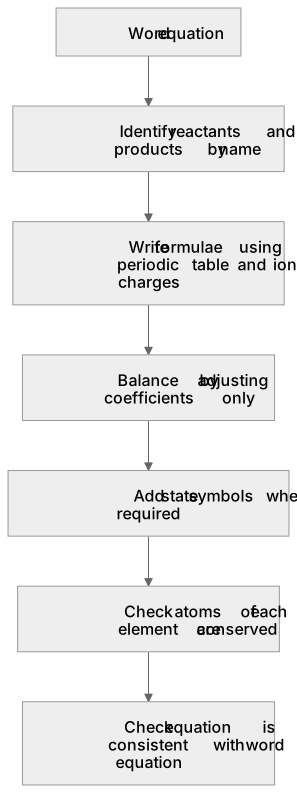
Put it in order
Put these steps in the order they happen.
- 1. Check equation is consistent with word equation
- 2. Check atoms of each element are conserved
- 3. Write formulae using periodic table and ion charges
- 4. Add state symbols where required
- 5. Word equation
- 6. Identify reactants and products by name
- 7. Balance by adjusting coefficients only
Key words
Say what each word means before you turn the card.
Word equation
Try answering aloud or in your head before turning the card.
Balanced chemical equation
Try answering aloud or in your head before turning the card.
State symbols
Try answering aloud or in your head before turning the card.
See every definition
- Word equation
- A way of representing a reaction that names all reactants and products, for example hydrochloric acid + sodium hydroxide → sodium chloride + water.
- Balanced chemical equation
- A symbol equation in which coefficients are adjusted so that the number of atoms of each element is the same on both sides.
- State symbols
- Labels such as (s), (l), (g) or (aq) added after each formula where the question requires them.
Label the diagram
Some boxes have lost their names. Pick the right name for each number.
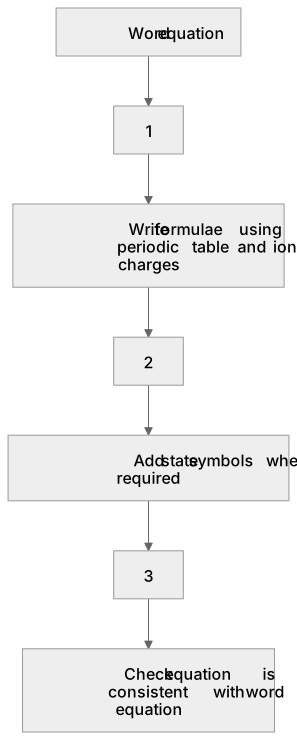
1Box 1
2Box 2
3Box 3
There is more to this lesson
The full lesson goes on to check your understanding and help you earn the marks. Create a free account to carry on, with your progress saved.
A week of Premium from your first lesson · Then the free plan continues · No card, no charge
Test your understanding of Atoms, elements and compounds: Students will be supplied with a periodic table for the exam and should be able to: use the names and symbols of the first 20 elements in the periodic table, the elements in Groups 1 and 7, and other elements in this specification name compounds of these elements from given formulae or symbol equations write word equations for the reactions in this specification write formulae and balanced chemical equations for the reactions in this specification.
Active recall beats re-reading. Take an instant quiz now to test what you’ve learned and lock it into long-term memory.
A week of Premium from your first lesson · Then the free plan continues · No card, no charge