AQA · GCSE · Chemistry
Course version: 8462 · Version from Sept 2018
Clay ceramics, including pottery and bricks, are made by shaping wet clay…
Full specification wording
Ceramics, polymers and composites: Clay ceramics, including pottery and bricks, are made by shaping wet clay and then heating in a furnace.
Clay is a naturally occurring material made of tiny mineral particles.
Checked against the AQA 8462 specification (opens in a new tab) on .
- Point 3 of 11
Study notes
From the checked teaching notes for this specification point.
The idea
Clay is a naturally occurring material made of tiny mineral particles. When mixed with water it becomes soft and mouldable, so it can be shaped by hand, pressed into a mould or extruded. The shaped object is then heated in a furnace or kiln to a high temperature. Heating drives off water and causes the particles to fuse together, producing a hard, strong, brittle ceramic that keeps its shape. Pottery and bricks are common examples. The key sequence is: mix clay with water, shape the wet clay, then heat it in a furnace. The heating stage is essential because unheated clay would soften again if it got wet, whereas the fired ceramic is durable and water-resistant.
What earns the marks
- Clay is mixed with water to make it soft and mouldable.
- The wet clay is shaped, for example by hand, in a mould or by extrusion.
- The shaped clay is heated in a furnace or kiln.
- Heating causes the clay particles to fuse, producing a hard, brittle ceramic.
- Pottery and bricks are named examples of clay ceramics.
- The order of the process must be shaping first and heating second.
Common mistakes and how to put them right
Stating that clay is heated before it is shaped.
Put it right: The correct order is to shape the wet clay first and then heat it.
Describing clay ceramics as flexible or elastic after firing.
Put it right: The correct description is hard and brittle.
Omitting water from the process.
Put it right: The correct method mixes clay with water so that it can be shaped.
Exam tips
- Use the words shape and furnace or kiln to make the two main stages clear.
- Give a named example such as a brick or a plant pot to anchor the general description.
- If asked to sequence the process, write the stages in order rather than as a list of separate facts.
Try the lesson
The start of the Ceramics, polymers and composites: Clay ceramics, including pottery and bricks, are made by shaping wet clay and then heating in a furnace. lesson, made from checked teaching notes for this specification point.
Have a go first
What is the first step in making a clay ceramic such as a brick?
Listen
Clay is a naturally occurring material made of tiny mineral particles. When mixed with water it becomes soft and mouldable, so it can be shaped by hand, pressed into a mould or extruded. The shaped object is then heated in a furnace or kiln to a high temperature. Heating drives off water and causes the particles to fuse together, producing a hard, strong, brittle ceramic that keeps its shape. Pottery and bricks are common examples. The key sequence is: mix clay with water, shape the wet clay, then heat it in a furnace. The heating stage is essential because unheated clay would soften again if it got wet, whereas the fired ceramic is durable and water-resistant. A strong answer earns marks for these points. Clay is mixed with water to make it soft and mouldable. The wet clay is shaped, for example by hand, in a mould or by extrusion. The shaped clay is heated in a furnace or kiln. Heating causes the clay particles to fuse, producing a hard, brittle ceramic. Exam tip: Use the words shape and furnace or kiln to make the two main stages clear.
See it
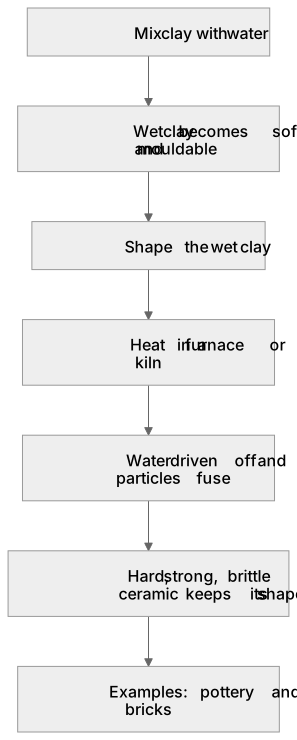
Put it in order
Put these steps in the order they happen.
- 1. Examples: pottery and bricks
- 2. Hard, strong, brittle ceramic keeps its shape
- 3. Shape the wet clay
- 4. Water driven off and particles fuse
- 5. Mix clay with water
- 6. Wet clay becomes soft and mouldable
- 7. Heat in a furnace or kiln
Label the diagram
Some boxes have lost their names. Pick the right name for each number.
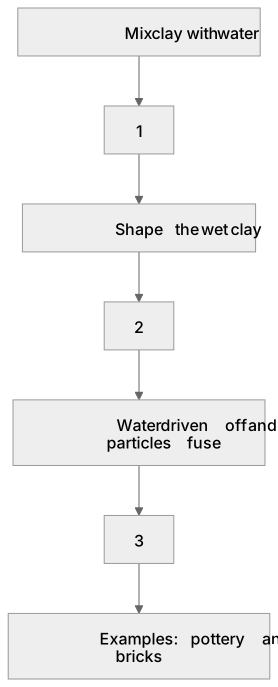
1Box 1
2Box 2
3Box 3
There is more to this lesson
The full lesson goes on to check your understanding and help you earn the marks. Create a free account to carry on, with your progress saved.
A week of Premium from your first lesson · Then the free plan continues · No card, no charge
Test your understanding of Ceramics, polymers and composites: Clay ceramics, including pottery and bricks, are made by shaping wet clay and then heating in a furnace.
Active recall beats re-reading. Take an instant quiz now to test what you’ve learned and lock it into long-term memory.
A week of Premium from your first lesson · Then the free plan continues · No card, no charge