AQA · GCSE · Chemistry
Course version: 8462 · Version from Sept 2018
Borosilicate glass, made from sand and boron trioxide, melts at higher…
Full specification wording
Ceramics, polymers and composites: Borosilicate glass, made from sand and boron trioxide, melts at higher temperatures than soda-lime glass.
Glass is a ceramic material made mainly from sand, which is silicon dioxide.
Checked against the AQA 8462 specification (opens in a new tab) on .
- Point 2 of 11
- 3 key terms
Study notes
From the checked teaching notes for this specification point.
The idea
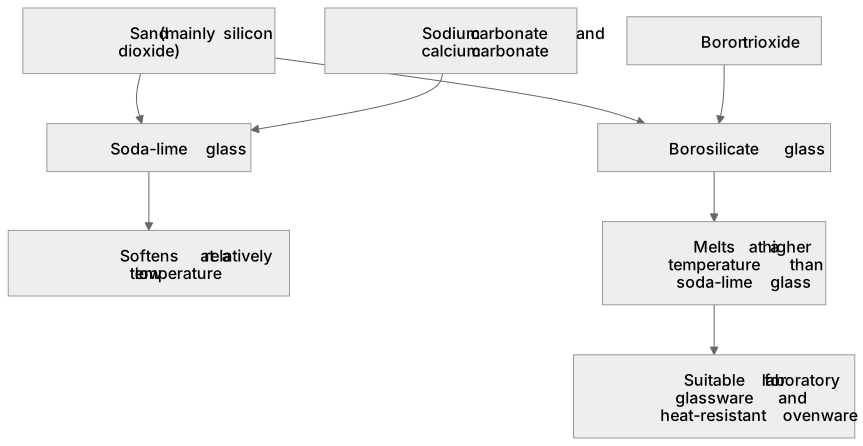
Glass is a ceramic material made mainly from sand, which is silicon dioxide. Soda-lime glass is produced by heating sand with sodium carbonate and calcium carbonate; it softens at a relatively low temperature, so it is easy to shape into bottles and windows. Borosilicate glass is made by heating sand with boron trioxide instead. The boron trioxide alters the structure of the silicon dioxide network, raising the melting point, so borosilicate glass softens only at much higher temperatures. This makes it suitable for laboratory glassware, ovenware and other items that must withstand heating without deforming. When comparing the two glasses, state both the raw materials and the property difference: borosilicate contains boron trioxide and melts at a higher temperature than soda-lime glass.
What earns the marks
- Soda-lime glass is made from sand with sodium carbonate and calcium carbonate.
- Borosilicate glass is made from sand with boron trioxide.
- Borosilicate glass has a higher melting point than soda-lime glass.
- The higher melting point makes borosilicate glass suitable for laboratory glassware and heat-resistant ovenware.
- A comparison must mention both types of glass and the direction of the difference in melting point.
Common mistakes and how to put them right
Saying borosilicate glass melts at a lower temperature than soda-lime glass.
Put it right: The correct comparison is that borosilicate melts at a higher temperature.
Naming boron trioxide as the only raw material for borosilicate glass and omitting sand.
Put it right: The correct composition includes sand and boron trioxide.
Confusing the additives used in the two glasses, for example stating that soda-lime glass contains boron trioxide.
Put it right: The correct additive for soda-lime glass is a mixture of sodium carbonate and calcium carbonate.
Exam tips
- Write the comparison as a full sentence that names both glasses and states which one has the higher melting point.
- Link the higher melting point to a named use, such as laboratory glassware, to show understanding rather than recall alone.
- Check that chemical names are spelled correctly, especially boron trioxide and silicon dioxide.
Try the lesson
The start of the Ceramics, polymers and composites: Borosilicate glass, made from sand and boron trioxide, melts at higher temperatures than soda-lime glass. lesson, made from checked teaching notes for this specification point.
Have a go first
Which two substances are used to make borosilicate glass?
Listen
Glass is a ceramic material made mainly from sand, which is silicon dioxide. Soda-lime glass is produced by heating sand with sodium carbonate and calcium carbonate; it softens at a relatively low temperature, so it is easy to shape into bottles and windows. Borosilicate glass is made by heating sand with boron trioxide instead. The boron trioxide alters the structure of the silicon dioxide network, raising the melting point, so borosilicate glass softens only at much higher temperatures. This makes it suitable for laboratory glassware, ovenware and other items that must withstand heating without deforming. When comparing the two glasses, state both the raw materials and the property difference: borosilicate contains boron trioxide and melts at a higher temperature than soda-lime glass. A strong answer earns marks for these points. Soda-lime glass is made from sand with sodium carbonate and calcium carbonate. Borosilicate glass is made from sand with boron trioxide. Borosilicate glass has a higher melting point than soda-lime glass. The higher melting point makes borosilicate glass suitable for laboratory glassware and heat-resistant ovenware. Exam tip: Write the comparison as a full sentence that names both glasses and states which one has the higher melting point.
See it
Key words
Say what each word means before you turn the card.
Ceramics
Try answering aloud or in your head before turning the card.
Raw materials
Try answering aloud or in your head before turning the card.
Structure-property relationships
Try answering aloud or in your head before turning the card.
See every definition
- Ceramics
- Glass is a ceramic material made mainly from sand, which is silicon dioxide.
- Raw materials
- Soda-lime glass is made from sand with sodium carbonate and calcium carbonate, while borosilicate glass is made from sand with boron trioxide.
- Structure-property relationships
- The boron trioxide alters the structure of the silicon dioxide network, raising the melting point, so borosilicate glass softens only at much higher temperatures.
Label the diagram
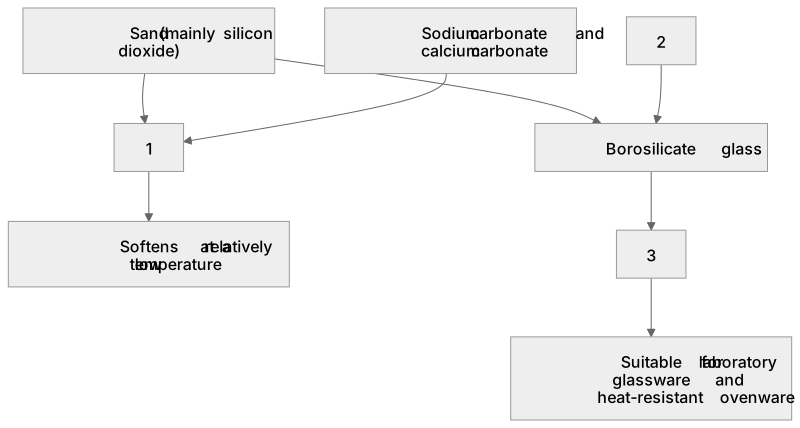
Some boxes have lost their names. Pick the right name for each number.
1Box 1
2Box 2
3Box 3
There is more to this lesson
The full lesson goes on to check your understanding and help you earn the marks. Create a free account to carry on, with your progress saved.
A week of Premium from your first lesson · Then the free plan continues · No card, no charge
Test your understanding of Ceramics, polymers and composites: Borosilicate glass, made from sand and boron trioxide, melts at higher temperatures than soda-lime glass.
Active recall beats re-reading. Take an instant quiz now to test what you’ve learned and lock it into long-term memory.
A week of Premium from your first lesson · Then the free plan continues · No card, no charge