AQA · GCSE · Chemistry
Course version: 8462 · Version from Sept 2018
Most of the glass we use is soda-lime glass, made by heating a mixture of…
Full specification wording
Ceramics, polymers and composites: Most of the glass we use is soda-lime glass, made by heating a mixture of sand, sodium carbonate and limestone.
Soda-lime glass is the common glass used for windows, bottles and drinking glasses.
Checked against the AQA 8462 specification (opens in a new tab) on .
- Point 1 of 11
- 4 key terms
Study notes
From the checked teaching notes for this specification point.
The idea
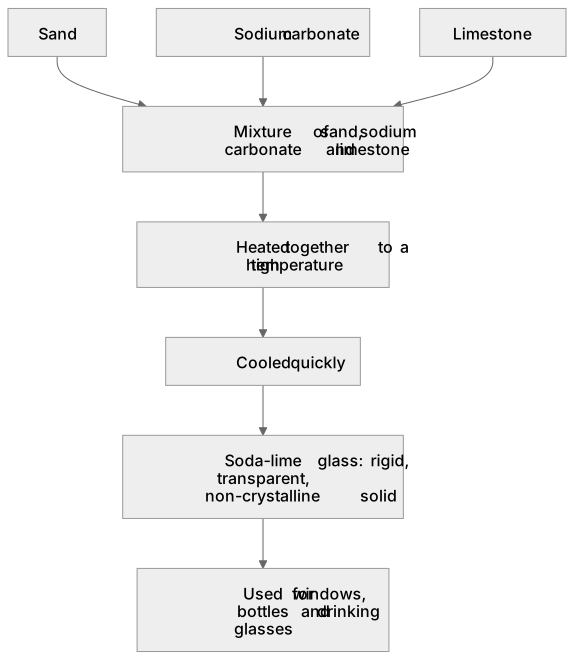
Soda-lime glass is the common glass used for windows, bottles and drinking glasses. It is made by heating a mixture of sand, sodium carbonate and limestone to a high temperature. Sand supplies silicon dioxide, the main network former; sodium carbonate lowers the melting point so the mixture fuses more easily; limestone, mainly calcium carbonate, stabilises the glass and helps it resist water. The molten mixture is then cooled quickly so it solidifies without forming an ordered crystal lattice, giving a rigid, transparent, non-crystalline solid. In an exam, name all three starting materials and state that they are heated together, then cooled.
What earns the marks
- Soda-lime glass is made from sand, sodium carbonate and limestone.
- The three materials are heated together to a high temperature and then cooled.
- Sand provides silicon dioxide, the main component of the glass.
- Sodium carbonate lowers the melting point of the mixture, and limestone helps stabilise the glass.
- Soda-lime glass is used for windows, bottles and drinking glasses because it is transparent, rigid and relatively cheap.
Common mistakes and how to put them right
Naming only sand as the raw material.
Put it right by listing sand, sodium carbonate and limestone.
Saying the mixture is melted and left to form crystals.
Put it right by stating it is cooled quickly to form a non-crystalline solid.
Confusing limestone with limewater.
Put it right by naming limestone as calcium carbonate used in the mixture.
Exam tips
- Learn the three raw materials as a set: sand, sodium carbonate and limestone.
- State that the materials are heated together, not simply mixed.
- Link the properties of soda-lime glass to a common use such as windows or bottles.
Try the lesson
The start of the Ceramics, polymers and composites: Most of the glass we use is soda-lime glass, made by heating a mixture of sand, sodium carbonate and limestone. lesson, made from checked teaching notes for this specification point.
Have a go first
A manufacturer is producing soda-lime glass. They heat a mixture containing sand and limestone. Which other raw material must be included in this mixture?
Listen
Soda-lime glass is the common glass used for windows, bottles and drinking glasses. It is made by heating a mixture of sand, sodium carbonate and limestone to a high temperature. Sand supplies silicon dioxide, the main network former; sodium carbonate lowers the melting point so the mixture fuses more easily; limestone, mainly calcium carbonate, stabilises the glass and helps it resist water. The molten mixture is then cooled quickly so it solidifies without forming an ordered crystal lattice, giving a rigid, transparent, non-crystalline solid. In an exam, name all three starting materials and state that they are heated together, then cooled. A strong answer earns marks for these points. Soda-lime glass is made from sand, sodium carbonate and limestone. The three materials are heated together to a high temperature and then cooled. Sand provides silicon dioxide, the main component of the glass. Sodium carbonate lowers the melting point of the mixture, and limestone helps stabilise the glass. A common slip: Naming only sand as the raw material. Instead, listing sand, sodium carbonate and limestone. Exam tip: Learn the three raw materials as a set: sand, sodium carbonate and limestone.
See it
Key words
Say what each word means before you turn the card.
Soda-lime glass
Try answering aloud or in your head before turning the card.
Raw materials and their functions
Try answering aloud or in your head before turning the card.
Heating and cooling in material manufacture
Try answering aloud or in your head before turning the card.
Properties linked to uses
Try answering aloud or in your head before turning the card.
See every definition
- Soda-lime glass
- The common glass used for windows, bottles and drinking glasses, made by heating a mixture of sand, sodium carbonate and limestone.
- Raw materials and their functions
- Sand supplies silicon dioxide, sodium carbonate lowers the melting point, and limestone stabilises the glass and helps it resist water.
- Heating and cooling in material manufacture
- The three materials are heated together to a high temperature and then cooled quickly so the mixture solidifies without forming an ordered crystal lattice.
- Properties linked to uses
- Soda-lime glass is used for windows, bottles and drinking glasses because it is transparent, rigid and relatively cheap.
Label the diagram
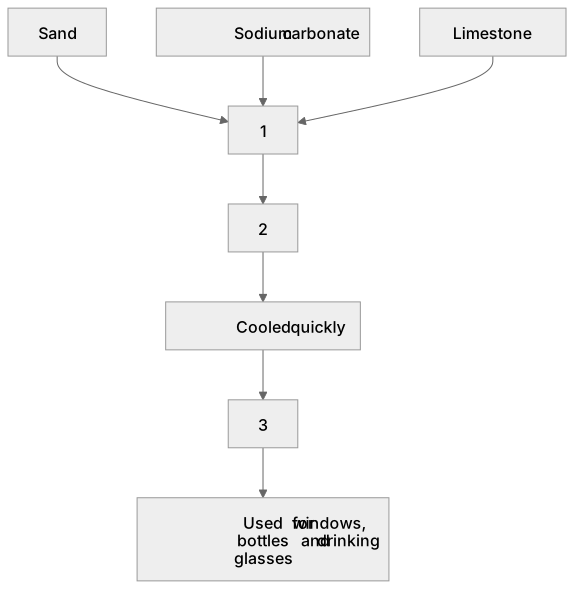
Some boxes have lost their names. Pick the right name for each number.
1Box 1
2Box 2
3Box 3
There is more to this lesson
The full lesson goes on to check your understanding and help you earn the marks. Create a free account to carry on, with your progress saved.
A week of Premium from your first lesson · Then the free plan continues · No card, no charge
Test your understanding of Ceramics, polymers and composites: Most of the glass we use is soda-lime glass, made by heating a mixture of sand, sodium carbonate and limestone.
Active recall beats re-reading. Take an instant quiz now to test what you’ve learned and lock it into long-term memory.
A week of Premium from your first lesson · Then the free plan continues · No card, no charge