AQA · GCSE · Chemistry
Course version: 8462 · Version from Sept 2018
For covalent bonding the particles are atoms which share pairs of…
Full specification wording
Chemical bonds: For covalent bonding the particles are atoms which share pairs of electrons. For metallic bonding the particles are atoms which share delocalised electrons.
Covalent bonding occurs between non-metal atoms that share pairs of electrons to achieve stable electron arrangements.
Checked against the AQA 8462 specification (opens in a new tab) on .
- Point 2 of 6
- 4 key terms
Study notes
From the checked teaching notes for this specification point.
The idea
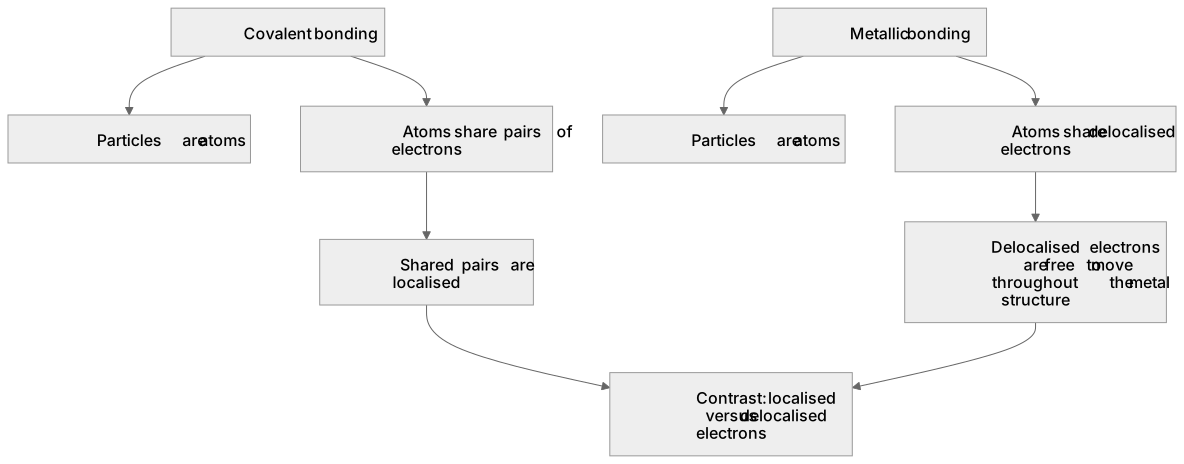
Covalent bonding occurs between non-metal atoms that share pairs of electrons to achieve stable electron arrangements. Each shared pair is attracted to both nuclei, holding the atoms together. For example, in H₂ each hydrogen atom contributes one electron to a shared pair, and in H₂O oxygen shares two pairs, one with each hydrogen. Metallic bonding occurs in metals, where positive metal ions are surrounded by a sea of delocalised electrons. The particles in metallic bonding are often described as positive ions, but the specification phrase 'atoms which share delocalised electrons' emphasises that the outer electrons are not attached to any single atom. You should be able to contrast the two: covalent bonding involves localised shared pairs between specific atoms, while metallic bonding involves delocalised electrons shared across the whole structure.
What earns the marks
- States that covalent bonding involves atoms sharing pairs of electrons.
- Gives an example such as H₂, Cl₂, O₂, H₂O or CH₄ with the correct number of shared pairs.
- States that metallic bonding involves delocalised electrons shared between atoms or positive ions.
- Explains that delocalised electrons are free to move throughout the metal structure.
- Contrasts covalent and metallic bonding in terms of localised versus delocalised electrons.
Common mistakes and how to put them right
Saying covalent bonding involves transfer of electrons.
Put it right: Covalent bonding involves sharing pairs of electrons.
Describing metallic bonding as covalent sharing between specific pairs.
Put it right: Metallic bonding involves delocalised electrons shared across the whole lattice.
Writing formulas with baseline indices, for example writing the hydrogen count inline.
Put it right: Use subscripts such as H₂, O₂ and CH₄.
Exam tips
- Use dot-and-cross diagrams to show shared pairs clearly, especially for simple molecules.
- For metallic bonding, describe the structure as positive ions in a sea of delocalised electrons.
- When comparing, use the words 'localised' for covalent shared pairs and 'delocalised' for metallic electrons.
Try the lesson
The start of the Chemical bonds: For covalent bonding the particles are atoms which share pairs of electrons. For metallic bonding the particles are atoms which share delocalised electrons. lesson, made from checked teaching notes for this specification point.
Have a go first
In covalent bonding, what do the particles share?
Listen
Covalent bonding occurs between non-metal atoms that share pairs of electrons to achieve stable electron arrangements. Each shared pair is attracted to both nuclei, holding the atoms together. For example, in H₂ each hydrogen atom contributes one electron to a shared pair, and in H₂O oxygen shares two pairs, one with each hydrogen. Metallic bonding occurs in metals, where positive metal ions are surrounded by a sea of delocalised electrons. The particles in metallic bonding are often described as positive ions, but the specification phrase 'atoms which share delocalised electrons' emphasises that the outer electrons are not attached to any single atom. You should be able to contrast the two: covalent bonding involves localised shared pairs between specific atoms, while metallic bonding involves delocalised electrons shared across the whole structure. A strong answer earns marks for these points. States that covalent bonding involves atoms sharing pairs of electrons. Gives an example such as H₂, Cl₂, O₂, H₂O or CH₄ with the correct number of shared pairs. States that metallic bonding involves delocalised electrons shared between atoms or positive ions. Explains that delocalised electrons are free to move throughout the metal structure. A common slip: Saying covalent bonding involves transfer of electrons. Instead, covalent bonding involves sharing pairs of electrons. Exam tip: Use dot-and-cross diagrams to show shared pairs clearly, especially for simple molecules.
See it
Key words
Say what each word means before you turn the card.
Covalent bonding
Try answering aloud or in your head before turning the card.
Metallic bonding
Try answering aloud or in your head before turning the card.
Delocalised electrons
Try answering aloud or in your head before turning the card.
Electron sharing
Try answering aloud or in your head before turning the card.
See every definition
- Covalent bonding
- A type of bonding in which the particles are atoms which share pairs of electrons.
- Metallic bonding
- A type of bonding in which the particles are atoms which share delocalised electrons.
- Delocalised electrons
- Electrons that are shared between atoms in metallic bonding and are not attached to any single atom.
- Electron sharing
- The process in which atoms share pairs of electrons, as in covalent bonding.
There is more to this lesson
The full lesson goes on to check your understanding and help you earn the marks. Create a free account to carry on, with your progress saved.
A week of Premium from your first lesson · Then the free plan continues · No card, no charge
Test your understanding of Chemical bonds: For covalent bonding the particles are atoms which share pairs of electrons. For metallic bonding the particles are atoms which share delocalised electrons.
Active recall beats re-reading. Take an instant quiz now to test what you’ve learned and lock it into long-term memory.
A week of Premium from your first lesson · Then the free plan continues · No card, no charge