AQA · GCSE · Chemistry
Course version: 8462 · Version from Sept 2018
Ionic bonding occurs in compounds formed from metals combined with…
Full specification wording
Chemical bonds: Ionic bonding occurs in compounds formed from metals combined with non-metals.
Ionic bonding is found in compounds made from a metal and a non-metal.
Checked against the AQA 8462 specification (opens in a new tab) on .
- Point 3 of 6
- 4 key terms
Study notes
From the checked teaching notes for this specification point.
The idea
Ionic bonding is found in compounds made from a metal and a non-metal. The metal atoms lose electrons to form positive ions, and the non-metal atoms gain electrons to form negative ions. The oppositely charged ions are held together by strong electrostatic attraction in a giant ionic lattice. For example, magnesium reacts with oxygen to form magnesium oxide, MgO, containing Mg²⁺ and O²⁻ ions. Sodium chloride, NaCl, contains Na⁺ and Cl⁻ ions. You should be able to identify from a formula or a reaction whether ionic bonding is present by checking that a metal is combined with a non-metal. You should also be able to explain why the compound is neutral overall: the total positive charge equals the total negative charge. This rule helps you work out formulas such as MgCl₂, where one Mg²⁺ balances two Cl⁻ ions.
What earns the marks
- States that ionic bonding occurs in compounds formed from metals combined with non-metals.
- Identifies the metal as the element that forms positive ions and the non-metal as the element that forms negative ions.
- Gives an example such as NaCl, MgO or CaCl₂ and names the ions present.
- Explains that the overall compound is neutral because positive and negative charges balance.
- Uses the charges to deduce a formula, for example Mg²⁺ with Cl⁻ gives MgCl₂.
Common mistakes and how to put them right
Saying ionic bonding occurs between two non-metals.
Put it right: Ionic bonding occurs between a metal and a non-metal; two non-metals usually form covalent bonds.
Writing ion charges with baseline signs, for example writing the charge inline.
Put it right: Use superscript signs such as Mg²⁺, O²⁻ and Cl⁻.
Forgetting to balance charges when writing a formula.
Put it right: Check that the total positive charge equals the total negative charge, as in MgCl₂.
Exam tips
- Check the periodic table: metals are on the left and centre, non-metals on the right.
- When writing a formula, write the ions first with their charges, then balance them.
- Link the formation of ions to the transfer of electrons from metal to non-metal.
Try the lesson
The start of the Chemical bonds: Ionic bonding occurs in compounds formed from metals combined with non-metals. lesson, made from checked teaching notes for this specification point.
Have a go first
Ionic bonding occurs in compounds formed from which combination of elements?
Listen
Ionic bonding is found in compounds made from a metal and a non-metal. The metal atoms lose electrons to form positive ions, and the non-metal atoms gain electrons to form negative ions. The oppositely charged ions are held together by strong electrostatic attraction in a giant ionic lattice. For example, magnesium reacts with oxygen to form magnesium oxide, MgO, containing Mg²⁺ and O²⁻ ions. Sodium chloride, NaCl, contains Na⁺ and Cl⁻ ions. You should be able to identify from a formula or a reaction whether ionic bonding is present by checking that a metal is combined with a non-metal. You should also be able to explain why the compound is neutral overall: the total positive charge equals the total negative charge. This rule helps you work out formulas such as MgCl₂, where one Mg²⁺ balances two Cl⁻ ions. A strong answer earns marks for these points. States that ionic bonding occurs in compounds formed from metals combined with non-metals. Identifies the metal as the element that forms positive ions and the non-metal as the element that forms negative ions. Gives an example such as NaCl, MgO or CaCl₂ and names the ions present. Explains that the overall compound is neutral because positive and negative charges balance. A common slip: Saying ionic bonding occurs between two non-metals. Instead, ionic bonding occurs between a metal and a non-metal; two non-metals usually form covalent bonds. Exam tip: Check the periodic table: metals are on the left and centre, non-metals on the right.
See it
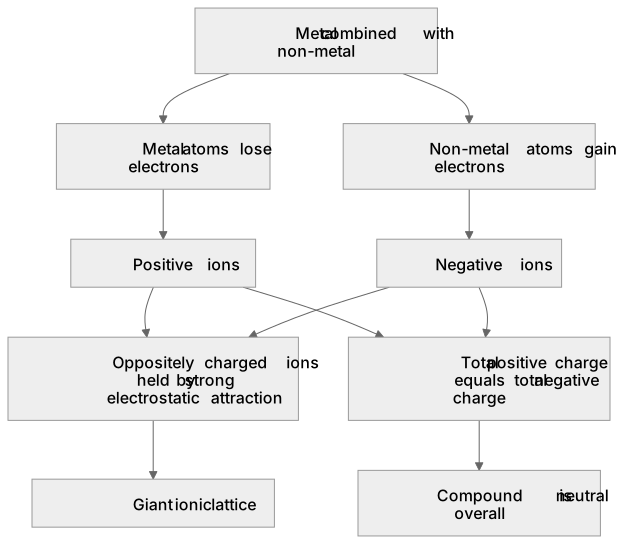
Key words
Say what each word means before you turn the card.
Ionic bonding
Try answering aloud or in your head before turning the card.
Metal and non-metal compounds
Try answering aloud or in your head before turning the card.
Ion formation
Try answering aloud or in your head before turning the card.
Charge balance
Try answering aloud or in your head before turning the card.
See every definition
- Ionic bonding
- Occurs in compounds formed from metals combined with non-metals, where oppositely charged ions are held together by strong electrostatic attraction in a giant ionic lattice.
- Metal and non-metal compounds
- Compounds in which the metal atoms lose electrons to form positive ions and the non-metal atoms gain electrons to form negative ions.
- Ion formation
- Metal atoms lose electrons to form positive ions, and non-metal atoms gain electrons to form negative ions.
- Charge balance
- The overall compound is neutral because the total positive charge equals the total negative charge, which helps work out formulas.
Label the diagram
Some boxes have lost their names. Pick the right name for each number.
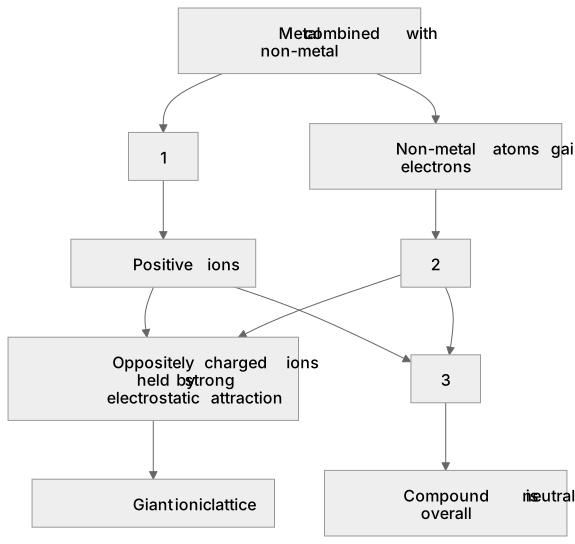
1Box 1
2Box 2
3Box 3
There is more to this lesson
The full lesson goes on to check your understanding and help you earn the marks. Create a free account to carry on, with your progress saved.
A week of Premium from your first lesson · Then the free plan continues · No card, no charge
Test your understanding of Chemical bonds: Ionic bonding occurs in compounds formed from metals combined with non-metals.
Active recall beats re-reading. Take an instant quiz now to test what you’ve learned and lock it into long-term memory.
A week of Premium from your first lesson · Then the free plan continues · No card, no charge