AQA · GCSE · Chemistry
Course version: 8462 · Version from Sept 2018
Whenever a measurement is made there is always some uncertainty about the…
Full specification wording
Chemical measurements: Whenever a measurement is made there is always some uncertainty about the result obtained.
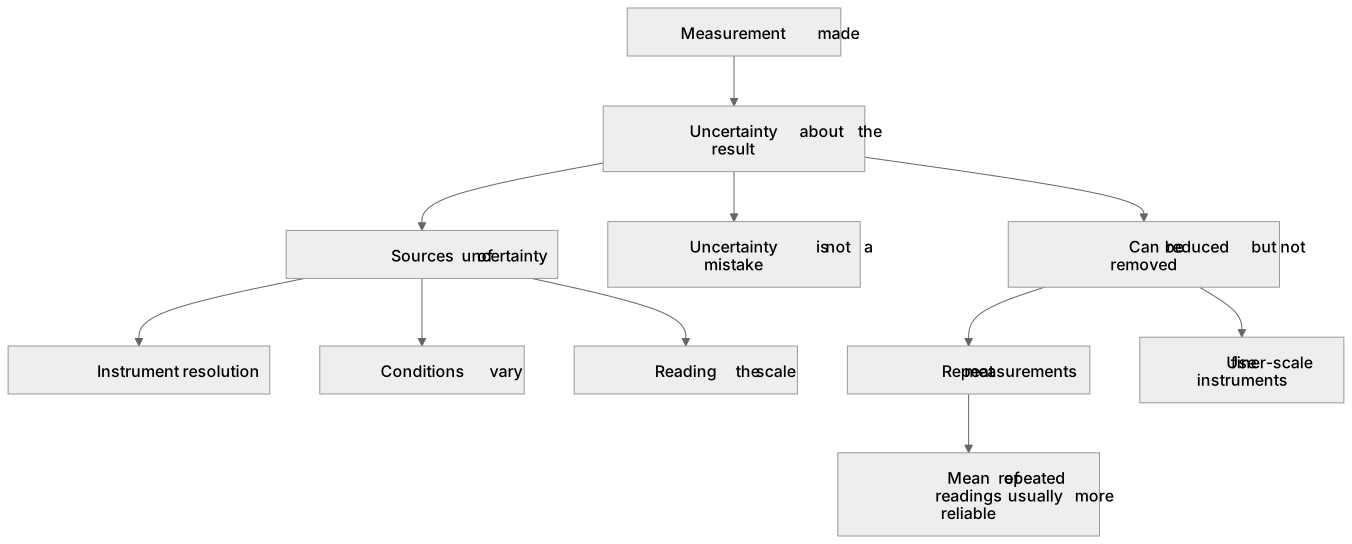
Every measurement has uncertainty because instruments have limited resolution, conditions vary and the person reading the scale may make small errors.
Checked against the AQA 8462 specification (opens in a new tab) on .
- Point 1 of 2
- 3 key terms
Study notes
From the checked teaching notes for this specification point.
The idea
Every measurement has uncertainty because instruments have limited resolution, conditions vary and the person reading the scale may make small errors. Uncertainty is the range of values within which the true value is likely to lie. For example, a balance reading to the nearest 0.01 g has an uncertainty of about ±0.01 g, while a thermometer read to the nearest 1 °C has an uncertainty of about ±0.5 °C if you estimate between marks. Uncertainty is not the same as a mistake: it is unavoidable and can be reduced but not removed. Repeating measurements and using finer-scale instruments can reduce uncertainty, and the mean of repeated readings is usually more reliable.
What earns the marks
- State that all measurements have some uncertainty.
- Identify a source of uncertainty, such as instrument resolution or reading the scale.
- Distinguish uncertainty from a mistake or a gross error.
- Explain that repeating measurements or using a finer scale can reduce uncertainty.
- Use the resolution of an instrument to estimate the uncertainty in a single reading.
Common mistakes and how to put them right
Treating uncertainty as a mistake.
Put it right by explaining that uncertainty is unavoidable and affects every measurement.
Believing that a more precise instrument removes uncertainty completely.
Put it right by stating that it only reduces uncertainty.
Confusing uncertainty with accuracy.
Put it right by explaining that uncertainty describes the spread of possible values, while accuracy describes closeness to the true value.
Exam tips
- Quote the instrument resolution when asked to estimate uncertainty.
- Use the phrase true value when defining uncertainty.
- Give a specific example, such as a balance reading to the nearest 0.01 g, rather than a vague statement.
Try the lesson
The start of the Chemical measurements: Whenever a measurement is made there is always some uncertainty about the result obtained. lesson, made from checked teaching notes for this specification point.
Have a go first
A student records the volume of gas collected in a measuring cylinder as 24 cm³. Why is this value not exact?
Listen
Every measurement has uncertainty because instruments have limited resolution, conditions vary and the person reading the scale may make small errors. Uncertainty is the range of values within which the true value is likely to lie. For example, a balance reading to the nearest 0.01 g has an uncertainty of about ±0.01 g, while a thermometer read to the nearest 1 °C has an uncertainty of about ±0.5 °C if you estimate between marks. Uncertainty is not the same as a mistake: it is unavoidable and can be reduced but not removed. Repeating measurements and using finer-scale instruments can reduce uncertainty, and the mean of repeated readings is usually more reliable. A strong answer earns marks for these points. State that all measurements have some uncertainty. Identify a source of uncertainty, such as instrument resolution or reading the scale. Distinguish uncertainty from a mistake or a gross error. Explain that repeating measurements or using a finer scale can reduce uncertainty. A common slip: Treating uncertainty as a mistake. Instead, explaining that uncertainty is unavoidable and affects every measurement. Exam tip: Quote the instrument resolution when asked to estimate uncertainty.
See it
Key words
Say what each word means before you turn the card.
Measurement and uncertainty
Try answering aloud or in your head before turning the card.
Instrument resolution
Try answering aloud or in your head before turning the card.
Repeat measurements
Try answering aloud or in your head before turning the card.
See every definition
- Measurement and uncertainty
- Whenever a measurement is made there is always some uncertainty about the result obtained, which is the range of values within which the true value is likely to lie.
- Instrument resolution
- Instruments have limited resolution, and the resolution of an instrument can be used to estimate the uncertainty in a single reading.
- Repeat measurements
- Repeating measurements can reduce uncertainty, and the mean of repeated readings is usually more reliable.
Label the diagram
Some boxes have lost their names. Pick the right name for each number.
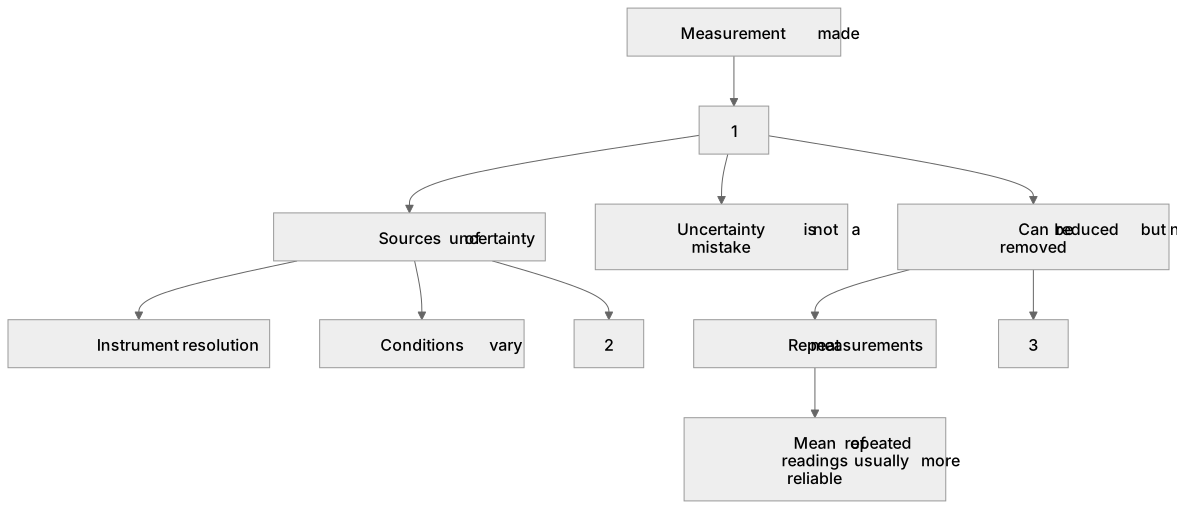
1Box 1
2Box 2
3Box 3
There is more to this lesson
The full lesson goes on to check your understanding and help you earn the marks. Create a free account to carry on, with your progress saved.
A week of Premium from your first lesson · Then the free plan continues · No card, no charge
Test your understanding of Chemical measurements: Whenever a measurement is made there is always some uncertainty about the result obtained.
Active recall beats re-reading. Take an instant quiz now to test what you’ve learned and lock it into long-term memory.
A week of Premium from your first lesson · Then the free plan continues · No card, no charge