AQA · GCSE · Chemistry
Course version: 8462 · Version from Sept 2018
Required practical 6: investigate how paper chromatography can be used to…
Full specification wording
Chromatography: Required practical 6: investigate how paper chromatography can be used to separate and tell the difference between coloured substances. Students should calculate R values.
Paper chromatography separates coloured substances by allowing a solvent to move up paper, carrying dissolved dyes at different rates.
Checked against the AQA 8462 specification (opens in a new tab) on .
- Point 4 of 4
- 4 key terms
Study notes
From the checked teaching notes for this specification point.
The idea
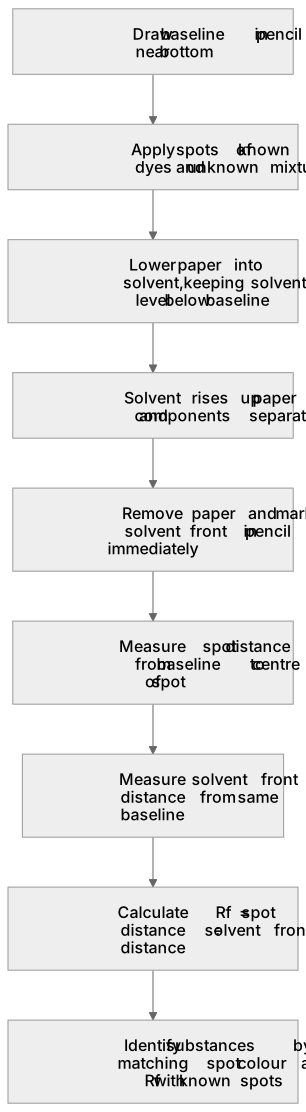
Paper chromatography separates coloured substances by allowing a solvent to move up paper, carrying dissolved dyes at different rates. A pencil baseline is drawn near the bottom, small spots of known dyes and an unknown mixture are applied, and the paper is lowered into solvent so the baseline stays above the liquid. As solvent rises, components partition between mobile and stationary phases and separate. The distance each spot travels relative to the solvent front gives its Rf value. Comparing Rf values and spot colours identifies components in an unknown mixture.
For example: A purple ink may separate into red and blue spots matching known dyes.
What earns the marks
- Draw the baseline in pencil, not ink, because ink would dissolve and contaminate the chromatogram.
- Keep the solvent level below the baseline so the applied spots do not wash directly into the solvent reservoir.
- Allow the solvent front to rise most of the paper length, then remove the paper and mark the solvent front immediately in pencil before it evaporates.
- Measure the distance travelled by each spot from the baseline to the centre of the spot, and measure the solvent front distance from the same baseline.
- Calculate Rf as spot distance divided by solvent front distance; Rf has no units and is always less than 1.
- Identify substances by matching both spot colour and Rf value with known reference spots run on the same chromatogram.
Common mistakes and how to put them right
Using a pen to draw the baseline, which dissolves and adds extra spots.
Put it right: Use a pencil because graphite is insoluble in the solvent.
Placing the baseline below the solvent surface, so spots dissolve into the solvent rather than separating.
Put it right: Keep the solvent level below the baseline.
Measuring spot distance to the top edge of a spot rather than its centre, which skews Rf.
Put it right: Measure from the baseline to the centre of the spot.
Exam tips
- State the formula Rf = distance moved by spot ÷ distance moved by solvent front before substituting values.
- Give Rf values to two significant figures or as a decimal, and never attach units because it is a ratio.
- When identifying an unknown, compare its Rf and colour with known spots run on the same paper under the same conditions.
Try the lesson
The start of the Chromatography: Required practical 6: investigate how paper chromatography can be used to separate and tell the difference between coloured substances. Students should calculate R values. lesson, made from checked teaching notes for this specification point.
Have a go first
In a paper chromatography experiment, a coloured spot travels 4.0 cm from the pencil line and the solvent front travels 10.0 cm from the pencil line. What is the Rf value of the spot?
Listen
Paper chromatography separates coloured substances by allowing a solvent to move up paper, carrying dissolved dyes at different rates. A pencil baseline is drawn near the bottom, small spots of known dyes and an unknown mixture are applied, and the paper is lowered into solvent so the baseline stays above the liquid. As solvent rises, components partition between mobile and stationary phases and separate. The distance each spot travels relative to the solvent front gives its Rf value. Comparing Rf values and spot colours identifies components in an unknown mixture. For example, a purple ink may separate into red and blue spots matching known dyes. A strong answer earns marks for these points. Draw the baseline in pencil, not ink, because ink would dissolve and contaminate the chromatogram. Keep the solvent level below the baseline so the applied spots do not wash directly into the solvent reservoir. Allow the solvent front to rise most of the paper length, then remove the paper and mark the solvent front immediately in pencil before it evaporates. Measure the distance travelled by each spot from the baseline to the centre of the spot, and measure the solvent front distance from the same baseline. A common slip: Using a pen to draw the baseline, which dissolves and adds extra spots. Instead, use a pencil because graphite is insoluble in the solvent. Exam tip: State the formula Rf = distance moved by spot ÷ distance moved by solvent front before substituting values.
See it
Key words
Say what each word means before you turn the card.
Mobile and stationary phases
Try answering aloud or in your head before turning the card.
Rf values and identification
Try answering aloud or in your head before turning the card.
Practical measurement and accuracy
Try answering aloud or in your head before turning the card.
Separation techniques
Try answering aloud or in your head before turning the card.
See every definition
- Mobile and stationary phases
- Components partition between these two phases as the solvent rises, which separates them.
- Rf values and identification
- The distance each spot travels relative to the solvent front gives its Rf value, and matching both spot colour and Rf value with known reference spots identifies substances.
- Practical measurement and accuracy
- Measure the distance travelled by each spot from the baseline to the centre of the spot, and measure the solvent front distance from the same baseline.
- Separation techniques
- Paper chromatography separates coloured substances by allowing a solvent to move up paper, carrying dissolved dyes at different rates.
Label the diagram
Some boxes have lost their names. Pick the right name for each number.
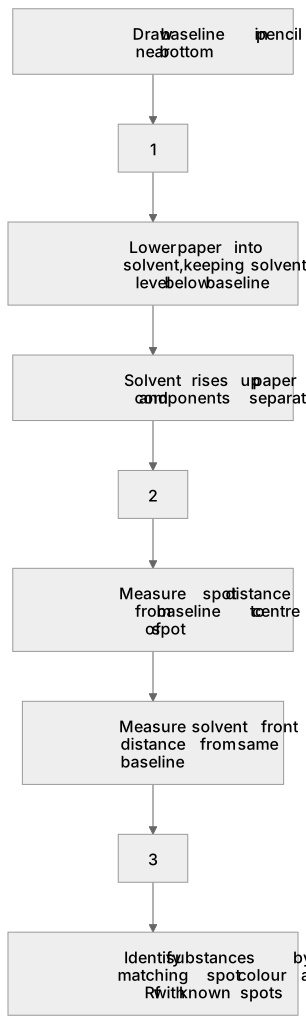
1Box 1
2Box 2
3Box 3
There is more to this lesson
The full lesson goes on to check your understanding and help you earn the marks. Create a free account to carry on, with your progress saved.
A week of Premium from your first lesson · Then the free plan continues · No card, no charge
Test your understanding of Chromatography: Required practical 6: investigate how paper chromatography can be used to separate and tell the difference between coloured substances. Students should calculate R values.
Active recall beats re-reading. Take an instant quiz now to test what you’ve learned and lock it into long-term memory.
A week of Premium from your first lesson · Then the free plan continues · No card, no charge