AQA · GCSE · Chemistry
Course version: 8462 · Version from Sept 2018
Separation depends on the distribution of substances between the phases.
Full specification wording
Chromatography: Separation depends on the distribution of substances between the phases.
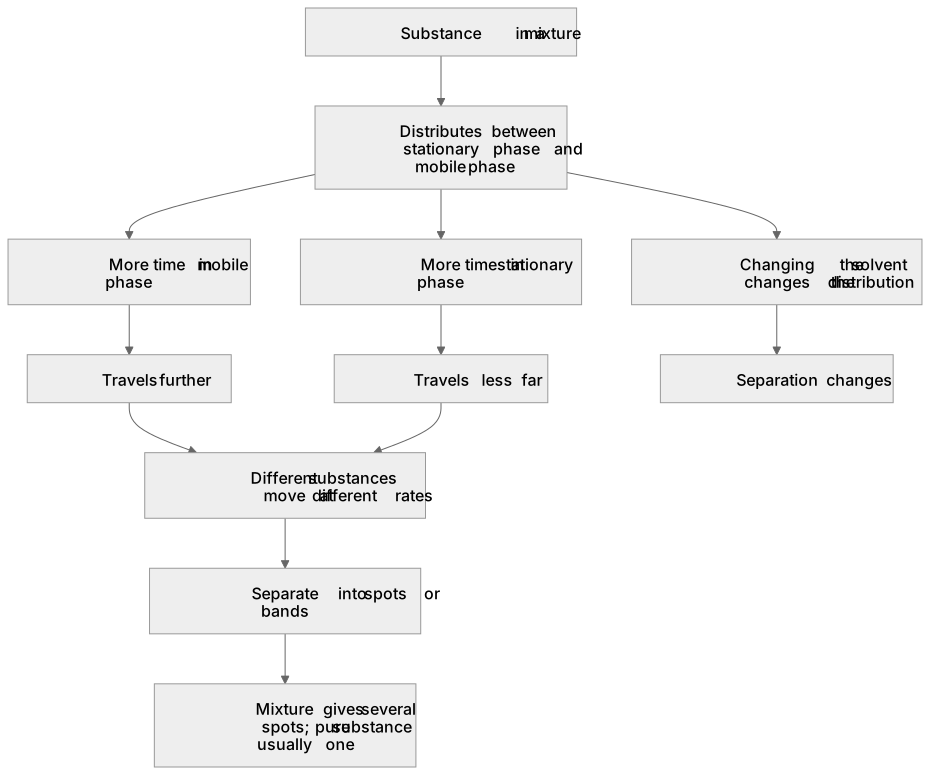
In chromatography, each substance in a mixture distributes itself between the stationary phase and the mobile phase.
Checked against the AQA 8462 specification (opens in a new tab) on .
- Point 3 of 4
- 4 key terms
Study notes
From the checked teaching notes for this specification point.
The idea
In chromatography, each substance in a mixture distributes itself between the stationary phase and the mobile phase. Distribution means that some of the substance is held by the stationary phase while some is carried by the mobile phase. A substance that is more strongly attracted to, or more soluble in, the mobile phase spends more time moving and travels further. A substance that is more strongly attracted to the stationary phase spends more time held back and travels less far. Because different substances have different distributions, they move at different rates and separate into spots or bands. This explains why a mixture produces several spots while a pure substance usually produces one. The distribution also explains why changing the solvent can change the separation.
What earns the marks
- State that each substance distributes between the stationary phase and the mobile phase.
- Explain that a substance spending more time in the mobile phase travels further up the chromatogram.
- Explain that a substance spending more time in the stationary phase travels less far.
- Link different distributions of different substances to the separation of a mixture into separate spots or bands.
- Use the idea of distribution to explain why changing the solvent or phase can change the separation.
Common mistakes and how to put them right
Saying that heavier substances always travel further.
Put it right by explaining that distance travelled depends on distribution between the phases, not mass alone.
Thinking all substances travel the same distance because they are in the same solvent.
Put it right by stating that each substance has its own distribution and therefore its own rate of movement.
Describing separation as substances being filtered by size.
Put it right by explaining that separation depends on how each substance distributes between the stationary and mobile phases.
Exam tips
- Use the phrase distribution between the phases when explaining why substances separate.
- Link the distance travelled to the time spent in each phase rather than to a vague idea of attraction.
- When a question gives a changed solvent, explain the effect by referring to the changed distribution of the substances.
Try the lesson
The start of the Chromatography: Separation depends on the distribution of substances between the phases. lesson, made from checked teaching notes for this specification point.
Have a go first
In chromatography, why do different substances in a mixture separate from each other?
Listen
In chromatography, each substance in a mixture distributes itself between the stationary phase and the mobile phase. Distribution means that some of the substance is held by the stationary phase while some is carried by the mobile phase. A substance that is more strongly attracted to, or more soluble in, the mobile phase spends more time moving and travels further. A substance that is more strongly attracted to the stationary phase spends more time held back and travels less far. Because different substances have different distributions, they move at different rates and separate into spots or bands. This explains why a mixture produces several spots while a pure substance usually produces one. The distribution also explains why changing the solvent can change the separation. A strong answer earns marks for these points. State that each substance distributes between the stationary phase and the mobile phase. Explain that a substance spending more time in the mobile phase travels further up the chromatogram. Explain that a substance spending more time in the stationary phase travels less far. Link different distributions of different substances to the separation of a mixture into separate spots or bands. A common slip: Saying that heavier substances always travel further. Instead, explaining that distance travelled depends on distribution between the phases, not mass alone. Exam tip: Use the phrase distribution between the phases when explaining why substances separate.
See it
Key words
Say what each word means before you turn the card.
Distribution between phases
Try answering aloud or in your head before turning the card.
Rate of movement
Try answering aloud or in your head before turning the card.
Separation of mixtures
Try answering aloud or in your head before turning the card.
Effect of changing conditions
Try answering aloud or in your head before turning the card.
See every definition
- Distribution between phases
- Some of a substance is held by the stationary phase while some is carried by the mobile phase.
- Rate of movement
- A substance spending more time in the mobile phase moves more and travels further, while one held back by the stationary phase travels less far.
- Separation of mixtures
- Because different substances have different distributions, they move at different rates and separate into spots or bands.
- Effect of changing conditions
- Changing the solvent can change the separation because the distribution of the substances changes.
Label the diagram
Some boxes have lost their names. Pick the right name for each number.
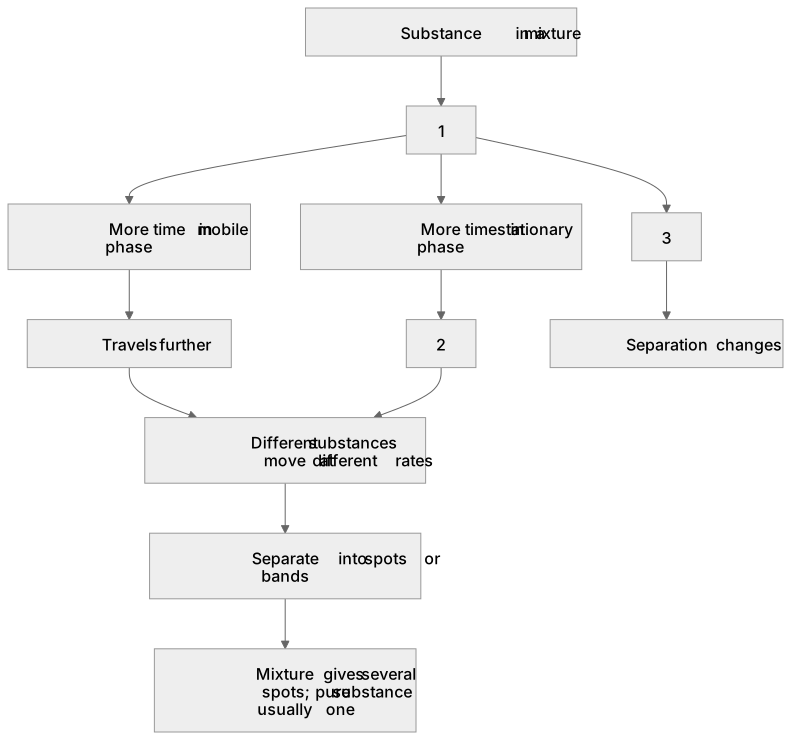
1Box 1
2Box 2
3Box 3
There is more to this lesson
The full lesson goes on to check your understanding and help you earn the marks. Create a free account to carry on, with your progress saved.
A week of Premium from your first lesson · Then the free plan continues · No card, no charge
Test your understanding of Chromatography: Separation depends on the distribution of substances between the phases.
Active recall beats re-reading. Take an instant quiz now to test what you’ve learned and lock it into long-term memory.
A week of Premium from your first lesson · Then the free plan continues · No card, no charge