AQA · GCSE · Chemistry
Course version: 8462 · Version from Sept 2018
According to this theory, chemical reactions can occur only when reacting…
Full specification wording
Collision theory and activation energy: According to this theory, chemical reactions can occur only when reacting particles collide with each other and with sufficient energy.
This statement gives the central condition of collision theory: a reaction happens only when particles collide and the collision has at least the activation energy.
Checked against the AQA 8462 specification (opens in a new tab) on .
- Point 2 of 7
- 4 key terms
Study notes
From the checked teaching notes for this specification point.
The idea
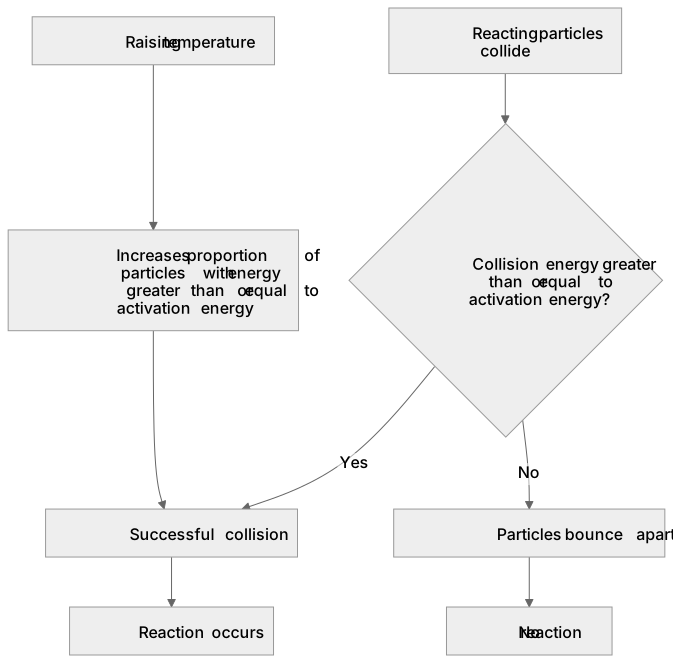
This statement gives the central condition of collision theory: a reaction happens only when particles collide and the collision has at least the activation energy. A collision with less energy does not lead to reaction because the particles simply bounce apart. The minimum energy needed is called the activation energy. For example, in the reaction between hydrogen and oxygen, most collisions at room temperature do not have enough energy, so the reaction is very slow; a spark provides enough energy for some collisions to succeed, and the reaction then proceeds rapidly. This idea explains why temperature has such a strong effect: raising temperature increases the proportion of particles with energy greater than or equal to the activation energy, so more collisions are successful.
What earns the marks
- States that reacting particles must collide with each other for a reaction to occur.
- States that the collision must have sufficient energy, called the activation energy, for a reaction to occur.
- Explains that collisions with less than the activation energy do not lead to a reaction.
- Links temperature to an increased proportion of particles with energy greater than or equal to the activation energy.
- Uses the idea of successful collisions to explain why rate increases when temperature rises.
Common mistakes and how to put them right
Saying that any collision causes a reaction.
Put it right: Only collisions with energy greater than or equal to the activation energy are successful.
Confusing activation energy with the energy released by a reaction.
Put it right: Activation energy is the minimum energy particles need to react.
Saying that raising temperature increases the activation energy.
Put it right: It increases the proportion of particles with energy greater than or equal to the activation energy.
Exam tips
- Use the phrase 'energy greater than or equal to the activation energy' when describing successful collisions.
- Distinguish clearly between collision frequency and collision energy in your explanations.
- Apply the theory to a named reaction, such as magnesium with hydrochloric acid, to make your answer concrete.
Try the lesson
The start of the Collision theory and activation energy: According to this theory, chemical reactions can occur only when reacting particles collide with each other and with sufficient energy. lesson, made from checked teaching notes for this specification point.
Have a go first
According to collision theory, which two conditions must be met for a chemical reaction to occur?
Listen
This statement gives the central condition of collision theory: a reaction happens only when particles collide and the collision has at least the activation energy. A collision with less energy does not lead to reaction because the particles simply bounce apart. The minimum energy needed is called the activation energy. For example, in the reaction between hydrogen and oxygen, most collisions at room temperature do not have enough energy, so the reaction is very slow; a spark provides enough energy for some collisions to succeed, and the reaction then proceeds rapidly. This idea explains why temperature has such a strong effect: raising temperature increases the proportion of particles with energy greater than or equal to the activation energy, so more collisions are successful. A strong answer earns marks for these points. States that reacting particles must collide with each other for a reaction to occur. States that the collision must have sufficient energy, called the activation energy, for a reaction to occur. Explains that collisions with less than the activation energy do not lead to a reaction. Links temperature to an increased proportion of particles with energy greater than or equal to the activation energy. A common slip: Saying that any collision causes a reaction. Instead, only collisions with energy greater than or equal to the activation energy are successful. Exam tip: Use the phrase 'energy greater than or equal to the activation energy' when describing successful collisions.
See it
Key words
Say what each word means before you turn the card.
Activation energy
Try answering aloud or in your head before turning the card.
Successful collisions
Try answering aloud or in your head before turning the card.
Effect of temperature on collision energy
Try answering aloud or in your head before turning the card.
Explaining reaction rate in particle terms
Try answering aloud or in your head before turning the card.
See every definition
- Activation energy
- The minimum energy needed for a reaction to occur when reacting particles collide.
- Successful collisions
- Collisions of reacting particles that have energy greater than or equal to the activation energy, so a reaction occurs.
- Effect of temperature on collision energy
- Raising temperature increases the proportion of particles with energy greater than or equal to the activation energy, so more collisions are successful.
- Explaining reaction rate in particle terms
- A reaction occurs only when reacting particles collide with each other and with sufficient energy; collisions with less energy do not lead to reaction.
There is more to this lesson
The full lesson goes on to check your understanding and help you earn the marks. Create a free account to carry on, with your progress saved.
A week of Premium from your first lesson · Then the free plan continues · No card, no charge
Test your understanding of Collision theory and activation energy: According to this theory, chemical reactions can occur only when reacting particles collide with each other and with sufficient energy.
Active recall beats re-reading. Take an instant quiz now to test what you’ve learned and lock it into long-term memory.
A week of Premium from your first lesson · Then the free plan continues · No card, no charge