AQA · GCSE · Chemistry
Course version: 8462 · Version from Sept 2018
The minimum amount of energy that particles must have to react is called…
Full specification wording
Collision theory and activation energy: The minimum amount of energy that particles must have to react is called the activation energy.
Particles in a gas or solution move randomly and collide constantly, but most collisions do not produce a reaction.
Checked against the AQA 8462 specification (opens in a new tab) on .
- Point 3 of 7
- 4 key terms
Study notes
From the checked teaching notes for this specification point.
The idea
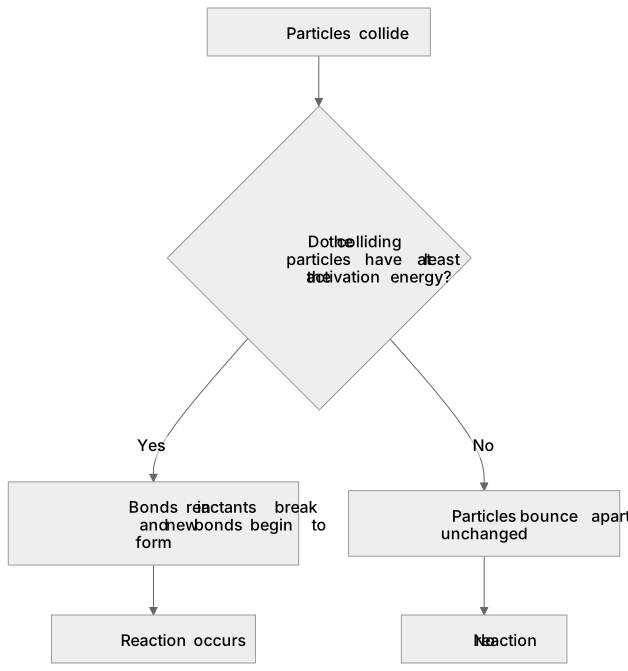
Particles in a gas or solution move randomly and collide constantly, but most collisions do not produce a reaction. For a reaction to occur, the colliding particles must have at least a certain minimum energy, called the activation energy. This energy is needed to break the bonds in the reactants and begin forming new bonds. If the particles collide with less than the activation energy, they simply bounce apart unchanged. A useful model is a ball needing a push to roll over a hill: the height of the hill represents the activation energy. Reactions with low activation energy, such as neutralisation between H⁺ and OH⁻ ions, happen rapidly at room temperature, while reactions with high activation energy, such as burning methane, need a flame to start.
What earns the marks
- Activation energy is defined as the minimum energy that colliding particles must possess for a reaction to take place.
- Collisions with energy below the activation energy do not lead to reaction; the particles separate unchanged.
- The activation energy is associated with breaking bonds in reactant particles before new bonds form.
- A reaction with a low activation energy can proceed readily at room temperature, whereas a high activation energy requires heating or a flame.
- The concept applies to all reactions, including those in solution and in the gas phase, not only to gases.
Common mistakes and how to put them right
Confusing activation energy with the overall energy change of a reaction.
Put it right: Activation energy is the energy barrier to starting a reaction, while overall energy change is the difference in energy between reactants and products.
Thinking that any collision causes a reaction.
Put it right: Only collisions with energy equal to or greater than the activation energy are successful.
Believing that activation energy is the energy released when products form.
Put it right: It is the minimum energy input needed for reactant particles to react.
Exam tips
- When defining activation energy, include the words minimum, energy and particles, and link it to a successful collision.
- Use the phrase successful collisions when explaining why some collisions do not cause reaction.
- If asked to explain a rate change, refer back to whether particles have enough energy to overcome the activation energy.
Try the lesson
The start of the Collision theory and activation energy: The minimum amount of energy that particles must have to react is called the activation energy. lesson, made from checked teaching notes for this specification point.
Have a go first
What name is given to the minimum amount of energy that particles must have in order to react when they collide?
Listen
Particles in a gas or solution move randomly and collide constantly, but most collisions do not produce a reaction. For a reaction to occur, the colliding particles must have at least a certain minimum energy, called the activation energy. This energy is needed to break the bonds in the reactants and begin forming new bonds. If the particles collide with less than the activation energy, they simply bounce apart unchanged. A useful model is a ball needing a push to roll over a hill: the height of the hill represents the activation energy. Reactions with low activation energy, such as neutralisation between H⁺ and OH⁻ ions, happen rapidly at room temperature, while reactions with high activation energy, such as burning methane, need a flame to start. A strong answer earns marks for these points. Activation energy is defined as the minimum energy that colliding particles must possess for a reaction to take place. Collisions with energy below the activation energy do not lead to reaction; the particles separate unchanged. The activation energy is associated with breaking bonds in reactant particles before new bonds form. A reaction with a low activation energy can proceed readily at room temperature, whereas a high activation energy requires heating or a flame. A common slip: Confusing activation energy with the overall energy change of a reaction. Instead, activation energy is the energy barrier to starting a reaction, while overall energy change is the difference in energy between reactants and products. Exam tip: When defining activation energy, include the words minimum, energy and particles, and link it to a successful collision.
See it
Key words
Say what each word means before you turn the card.
Activation energy
Try answering aloud or in your head before turning the card.
Collision theory
Try answering aloud or in your head before turning the card.
Successful collisions
Try answering aloud or in your head before turning the card.
Energy barriers in reactions
Try answering aloud or in your head before turning the card.
See every definition
- Activation energy
- The minimum amount of energy that particles must have to react, needed to break the bonds in the reactants and begin forming new bonds.
- Collision theory
- Particles in a gas or solution move randomly and collide constantly, but only collisions with at least the activation energy produce a reaction.
- Successful collisions
- Collisions in which the particles have energy equal to or greater than the activation energy, so a reaction takes place.
- Energy barriers in reactions
- The energy barrier to starting a reaction, represented in a model by the height of a hill a ball must be pushed over.
There is more to this lesson
The full lesson goes on to check your understanding and help you earn the marks. Create a free account to carry on, with your progress saved.
A week of Premium from your first lesson · Then the free plan continues · No card, no charge
Test your understanding of Collision theory and activation energy: The minimum amount of energy that particles must have to react is called the activation energy.
Active recall beats re-reading. Take an instant quiz now to test what you’ve learned and lock it into long-term memory.
A week of Premium from your first lesson · Then the free plan continues · No card, no charge