AQA · GCSE · Chemistry
Course version: 8462 · Version from Sept 2018
Predict and explain the effects of changes in the size of pieces of a…
Full specification wording
Collision theory and activation energy: predict and explain the effects of changes in the size of pieces of a reacting solid in terms of surface area to volume ratio use simple ideas about proportionality when using collision theory to explain the effect of a factor on the rate of a reaction.
Reactions involving a solid occur when reactant particles collide at its exposed surface.
Checked against the AQA 8462 specification (opens in a new tab) on .
- Point 7 of 7
Study notes
From the checked teaching notes for this specification point.
The idea
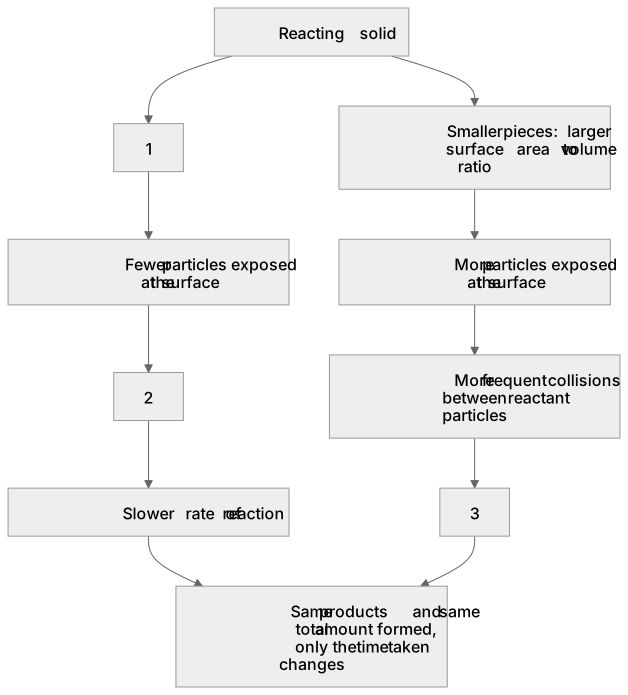
Reactions involving a solid occur when reactant particles collide at its exposed surface. Breaking a solid into smaller pieces raises its surface area to volume ratio, so more particles are exposed and collisions between reactant particles become more frequent, increasing the rate. For a fixed mass of solid, halving the average piece size roughly doubles the total surface area, so the rate increases in proportion to the surface area available. A single large lump has a small surface area to volume ratio and reacts slowly; the same mass as powder has a much larger ratio and reacts quickly. The particles themselves are unchanged, so the same products form and the same total amount of gas or precipitate is produced; only the time taken changes.
What earns the marks
- State that reaction requires collisions between reactant particles at the surface of the solid.
- Explain that smaller pieces have a larger surface area to volume ratio, exposing more particles to collision.
- Link increased frequency of collisions to an increased rate of reaction.
- Use proportionality: for a fixed mass, reducing piece size increases total surface area and therefore increases rate.
- Recognise that the same products and same total amount are formed; only the rate changes.
Common mistakes and how to put them right
Saying smaller pieces have more energy or a higher temperature.
Put it right by stating that particle energy and temperature are unchanged and only the exposed surface area increases.
Claiming more product is made from powder.
Put it right by explaining that the same mass gives the same total amount of product, just faster.
Confusing surface area with volume.
Put it right by referring to the surface area to volume ratio, which increases as pieces get smaller.
Exam tips
- When asked to predict, state the direction of change in rate first, then justify it with surface area and collision frequency.
- Use the phrase surface area to volume ratio rather than surface area alone when comparing pieces of different size.
- If a graph is given, describe the steeper initial gradient for smaller pieces and note that the final volume of gas is the same.
Try the lesson
The start of the Collision theory and activation energy: predict and explain the effects of changes in the size of pieces of a reacting solid in terms of surface area to volume ratio use simple ideas about proportionality when using collision theory to explain the effect of a factor on the rate of a reaction. lesson, made from checked teaching notes for this specification point.
Have a go first
A lump of calcium carbonate is broken into smaller pieces before it is added to dilute hydrochloric acid. What happens to the rate of the reaction?
Listen
Reactions involving a solid occur when reactant particles collide at its exposed surface. Breaking a solid into smaller pieces raises its surface area to volume ratio, so more particles are exposed and collisions between reactant particles become more frequent, increasing the rate. For a fixed mass of solid, halving the average piece size roughly doubles the total surface area, so the rate increases in proportion to the surface area available. A single large lump has a small surface area to volume ratio and reacts slowly; the same mass as powder has a much larger ratio and reacts quickly. The particles themselves are unchanged, so the same products form and the same total amount of gas or precipitate is produced; only the time taken changes. A strong answer earns marks for these points. State that reaction requires collisions between reactant particles at the surface of the solid. Explain that smaller pieces have a larger surface area to volume ratio, exposing more particles to collision. Link increased frequency of collisions to an increased rate of reaction. Use proportionality: for a fixed mass, reducing piece size increases total surface area and therefore increases rate. A common slip: Saying smaller pieces have more energy or a higher temperature. Instead, stating that particle energy and temperature are unchanged and only the exposed surface area increases. Exam tip: When asked to predict, state the direction of change in rate first, then justify it with surface area and collision frequency.
See it
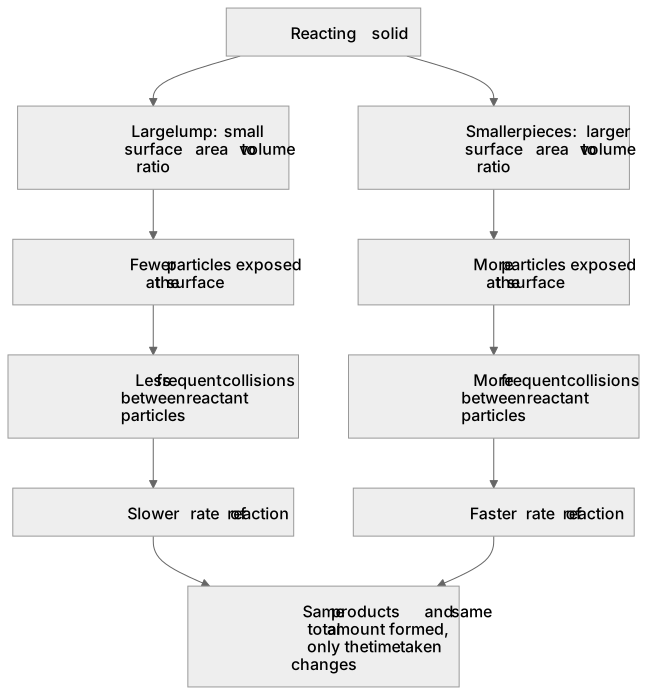
Label the diagram
Some boxes have lost their names. Pick the right name for each number.
1Box 1
2Box 2
3Box 3
There is more to this lesson
The full lesson goes on to check your understanding and help you earn the marks. Create a free account to carry on, with your progress saved.
A week of Premium from your first lesson · Then the free plan continues · No card, no charge
Test your understanding of Collision theory and activation energy: predict and explain the effects of changes in the size of pieces of a reacting solid in terms of surface area to volume ratio use simple ideas about proportionality when using collision theory to explain the effect of a factor on the rate of a reaction.
Active recall beats re-reading. Take an instant quiz now to test what you’ve learned and lock it into long-term memory.
A week of Premium from your first lesson · Then the free plan continues · No card, no charge