AQA · GCSE · Chemistry
Course version: 8462 · Version from Sept 2018
Students should be able to: describe experiments and interpret results to…
Full specification wording
Corrosion and its prevention: Students should be able to: describe experiments and interpret results to show that both air and water are necessary for rusting explain sacrificial protection in terms of relative reactivity.
Rusting is the corrosion of iron, forming hydrated iron(III) oxide.
Checked against the AQA 8462 specification (opens in a new tab) on .
- Point 6 of 6
Study notes
From the checked teaching notes for this specification point.
The idea
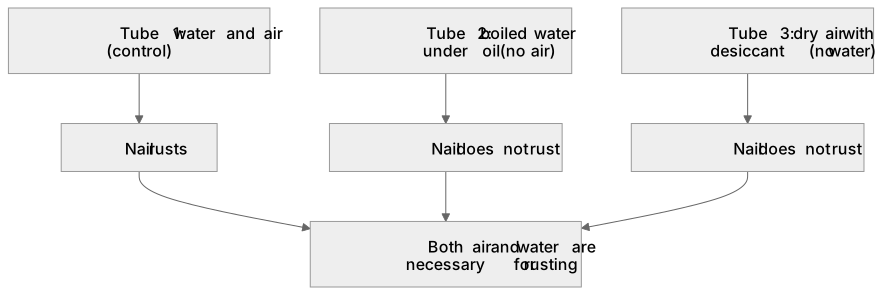
Rusting is the corrosion of iron, forming hydrated iron(III) oxide. To show that both air and water are needed, set up three sealed tubes containing an iron nail. Tube 1 (the control) contains water and air. Tube 2 contains boiled water under oil (no air). Tube 3 contains dry air with a desiccant such as anhydrous calcium chloride (no water). Only the nail in Tube 1 rusts, proving both reactants are required. Interpreting results means identifying which tubes rust and explaining why. Sacrificial protection uses a more reactive metal, such as zinc or magnesium, attached to iron. The more reactive metal is oxidised preferentially, so iron does not corrode. This explains galvanising and blocks on ship hulls.
What earns the marks
- States that rusting needs both oxygen (from air) and water, and that removing either prevents rusting.
- Describes a valid experiment: iron nails in three sealed tubes with water and air (control), boiled water under oil (no air), and dry air with a desiccant (no water).
- Interprets results by identifying that only the tube containing both air and water rusts, supporting the conclusion.
- Explains sacrificial protection: a more reactive metal, such as zinc or magnesium, corrodes instead of iron because it is higher in the reactivity series.
- Applies the idea to examples such as galvanised steel or sacrificial blocks on ships, linking the method to the relative reactivity of the metals.
Common mistakes and how to put them right
Thinking that rusting needs only water or only air.
Put it right: Both oxygen and water are essential, so removing either one prevents rusting.
Believing that a less reactive metal protects iron.
Put it right: The sacrificial metal must be more reactive than iron, so it is oxidised in preference.
Confusing rusting with burning or with the reaction of a metal with acid.
Put it right: Rusting is a slow oxidation of iron by oxygen and water, producing hydrated iron(III) oxide.
Exam tips
- Name each test tube and state what is present or absent, then link the result to the conclusion about air and water.
- Use the reactivity series to justify why zinc protects iron, naming the more reactive metal and the metal it protects.
- When describing sacrificial protection, state that the protective metal is oxidised or corroded instead of the iron, not that it blocks water.
Try the lesson
The start of the Corrosion and its prevention: Students should be able to: describe experiments and interpret results to show that both air and water are necessary for rusting explain sacrificial protection in terms of relative reactivity. lesson, made from checked teaching notes for this specification point.
Have a go first
A student sets up four test tubes containing iron nails. Which test tube will show rusting after several days?
Listen
Rusting is the corrosion of iron, forming hydrated iron(III) oxide. To show that both air and water are needed, set up three sealed tubes containing an iron nail. Tube 1 (the control) contains water and air. Tube 2 contains boiled water under oil (no air). Tube 3 contains dry air with a desiccant such as anhydrous calcium chloride (no water). Only the nail in Tube 1 rusts, proving both reactants are required. Interpreting results means identifying which tubes rust and explaining why. Sacrificial protection uses a more reactive metal, such as zinc or magnesium, attached to iron. The more reactive metal is oxidised preferentially, so iron does not corrode. This explains galvanising and blocks on ship hulls. A strong answer earns marks for these points. States that rusting needs both oxygen (from air) and water, and that removing either prevents rusting. Describes a valid experiment: iron nails in three sealed tubes with water and air (control), boiled water under oil (no air), and dry air with a desiccant (no water). Interprets results by identifying that only the tube containing both air and water rusts, supporting the conclusion. Explains sacrificial protection: a more reactive metal, such as zinc or magnesium, corrodes instead of iron because it is higher in the reactivity series. A common slip: Thinking that rusting needs only water or only air. Instead, both oxygen and water are essential, so removing either one prevents rusting. Exam tip: Name each test tube and state what is present or absent, then link the result to the conclusion about air and water.
See it
There is more to this lesson
The full lesson goes on to check your understanding and help you earn the marks. Create a free account to carry on, with your progress saved.
A week of Premium from your first lesson · Then the free plan continues · No card, no charge
Test your understanding of Corrosion and its prevention: Students should be able to: describe experiments and interpret results to show that both air and water are necessary for rusting explain sacrificial protection in terms of relative reactivity.
Active recall beats re-reading. Take an instant quiz now to test what you’ve learned and lock it into long-term memory.
A week of Premium from your first lesson · Then the free plan continues · No card, no charge