AQA · GCSE · Chemistry
Course version: 8462 · Version from Sept 2018
Students should be able to balance chemical equations as examples of…
Full specification wording
Cracking and alkenes: Students should be able to balance chemical equations as examples of cracking given the formulae of the reactants and products.
A cracking equation must conserve atoms: the number of each type of atom on the left must equal the number on the right.
Checked against the AQA 8462 specification (opens in a new tab) on .
- Point 9 of 11
Study notes
From the checked teaching notes for this specification point.
The idea
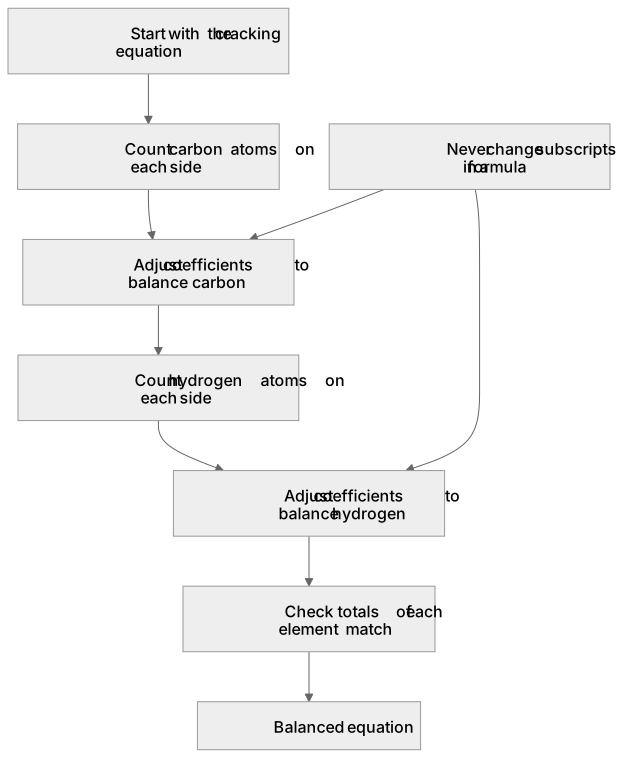
A cracking equation must conserve atoms: the number of each type of atom on the left must equal the number on the right. Given the formulae of the reactant and products, balance by adjusting the large numbers in front of formulae, never by changing the formulae themselves. For example, C₁₀H₂₂ can crack to give C₈H₁₈ and C₂H₄, which is already balanced: 10 carbon atoms and 22 hydrogen atoms on each side. If a product is doubled, such as 2C₂H₄, then the hydrogen count changes and other coefficients may need adjusting. Work atom by atom, starting with carbon and then hydrogen, and check the total at the end.
What earns the marks
- The number of atoms of each element must be the same on both sides of the equation.
- Only coefficients in front of formulae may be changed when balancing.
- Subscripts within a formula must not be altered to balance an equation.
- Carbon atoms are usually balanced first, then hydrogen atoms.
- A final check confirms that the total atoms of each element match on both sides.
- State symbols may be added if required, but balancing concerns the formulae and coefficients.
Common mistakes and how to put them right
Changing a subscript in a formula, such as turning C₂H₄ into C₂H₆.
Put it right: Change only the coefficient in front of the formula.
Balancing carbon but forgetting hydrogen.
Put it right: Check every element, not just the first one.
Writing a coefficient as a subscript, such as C₈H₁₈₂.
Put it right: Place the coefficient before the formula, for example 2C₈H₁₈.
Exam tips
- Count atoms in a table before and after to avoid losing track.
- Balance carbon first, then hydrogen, and recheck both at the end.
- Never alter a formula to make an equation balance; adjust only the coefficients.
Try the lesson
The start of the Cracking and alkenes: Students should be able to balance chemical equations as examples of cracking given the formulae of the reactants and products. lesson, made from checked teaching notes for this specification point.
Have a go first
Cracking decane (C₁₀H₂₂) produces ethene (C₂H₄) and one other hydrocarbon product. Which of the following is the correctly balanced chemical equation for this reaction?
Listen
A cracking equation must conserve atoms: the number of each type of atom on the left must equal the number on the right. Given the formulae of the reactant and products, balance by adjusting the large numbers in front of formulae, never by changing the formulae themselves. For example, C₁₀H₂₂ can crack to give C₈H₁₈ and C₂H₄, which is already balanced: 10 carbon atoms and 22 hydrogen atoms on each side. If a product is doubled, such as 2C₂H₄, then the hydrogen count changes and other coefficients may need adjusting. Work atom by atom, starting with carbon and then hydrogen, and check the total at the end. A strong answer earns marks for these points. The number of atoms of each element must be the same on both sides of the equation. Only coefficients in front of formulae may be changed when balancing. Subscripts within a formula must not be altered to balance an equation. Carbon atoms are usually balanced first, then hydrogen atoms. A common slip: Changing a subscript in a formula, such as turning C₂H₄ into C₂H₆. Instead, change only the coefficient in front of the formula. Exam tip: Count atoms in a table before and after to avoid losing track.
See it
Label the diagram
Some boxes have lost their names. Pick the right name for each number.
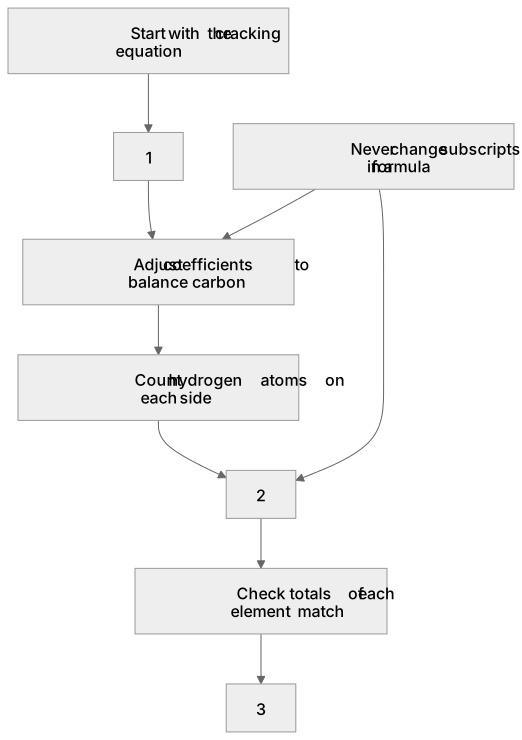
1Box 1
2Box 2
3Box 3
There is more to this lesson
The full lesson goes on to check your understanding and help you earn the marks. Create a free account to carry on, with your progress saved.
A week of Premium from your first lesson · Then the free plan continues · No card, no charge
Test your understanding of Cracking and alkenes: Students should be able to balance chemical equations as examples of cracking given the formulae of the reactants and products.
Active recall beats re-reading. Take an instant quiz now to test what you’ve learned and lock it into long-term memory.
A week of Premium from your first lesson · Then the free plan continues · No card, no charge