AQA · GCSE · Chemistry
Course version: 8462 · Version from Sept 2018
Students should be able to give examples to illustrate the usefulness of…
Full specification wording
Cracking and alkenes: Students should be able to give examples to illustrate the usefulness of cracking.
Cracking turns large, less useful alkanes into smaller, more useful molecules.
Checked against the AQA 8462 specification (opens in a new tab) on .
- Point 10 of 11
Study notes
From the checked teaching notes for this specification point.
The idea
Cracking turns large, less useful alkanes into smaller, more useful molecules. A long-chain fraction such as decane can be cracked to give octane, used in petrol, plus ethene, which is used to make poly(ethene). This matters because demand for petrol and for polymers is high, while long-chain fractions from crude oil are in surplus. Cracking may be thermal or catalytic, and it produces alkanes plus alkenes. The alkenes are the reactive products that feed the polymer industry, and the shorter alkanes are cleaner-burning fuels. A good answer names a starting material, a product and its use, and links the process to matching supply with demand.
What earns the marks
- Cracking converts large alkane molecules into smaller molecules, including alkenes, which are more useful.
- An example is cracking decane to produce octane for petrol and ethene for making poly(ethene).
- Alkenes from cracking are used to make polymers such as poly(ethene) and poly(propene).
- Shorter-chain alkanes produced by cracking are used as fuels because they burn more cleanly than heavy fractions.
- Cracking helps match supply to demand: heavy fractions are in surplus while fuels and polymer feedstocks are in demand.
- Award credit for a named product and a specific use, not just the word cracking.
Common mistakes and how to put them right
Saying cracking makes only alkenes.
Put it right: Cracking produces alkanes and alkenes.
Giving no named product or use.
Put it right: State a product such as ethene and its use in making poly(ethene).
Confusing cracking with fractional distillation.
Put it right: Fractional distillation separates crude oil without changing molecules, while cracking breaks large molecules into smaller ones.
Exam tips
- Name the starting alkane, the products and one use for each product.
- Link the example to supply and demand to show why cracking is useful.
- Use the terms thermal cracking and catalytic cracking correctly if you mention conditions.
Try the lesson
The start of the Cracking and alkenes: Students should be able to give examples to illustrate the usefulness of cracking. lesson, made from checked teaching notes for this specification point.
Have a go first
Cracking is a useful industrial process because it produces smaller, more useful molecules. Which of the following is a common use for the alkenes produced by cracking?
Listen
Cracking turns large, less useful alkanes into smaller, more useful molecules. A long-chain fraction such as decane can be cracked to give octane, used in petrol, plus ethene, which is used to make poly(ethene). This matters because demand for petrol and for polymers is high, while long-chain fractions from crude oil are in surplus. Cracking may be thermal or catalytic, and it produces alkanes plus alkenes. The alkenes are the reactive products that feed the polymer industry, and the shorter alkanes are cleaner-burning fuels. A good answer names a starting material, a product and its use, and links the process to matching supply with demand. A strong answer earns marks for these points. Cracking converts large alkane molecules into smaller molecules, including alkenes, which are more useful. An example is cracking decane to produce octane for petrol and ethene for making poly(ethene). Alkenes from cracking are used to make polymers such as poly(ethene) and poly(propene). Shorter-chain alkanes produced by cracking are used as fuels because they burn more cleanly than heavy fractions. A common slip: Saying cracking makes only alkenes. Instead, cracking produces alkanes and alkenes. Exam tip: Name the starting alkane, the products and one use for each product.
See it
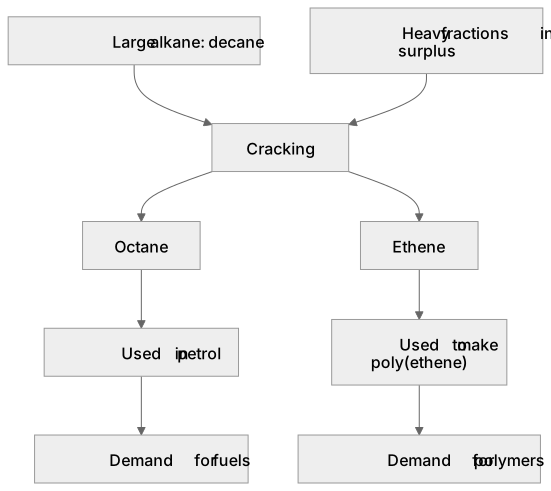
Label the diagram
Some boxes have lost their names. Pick the right name for each number.
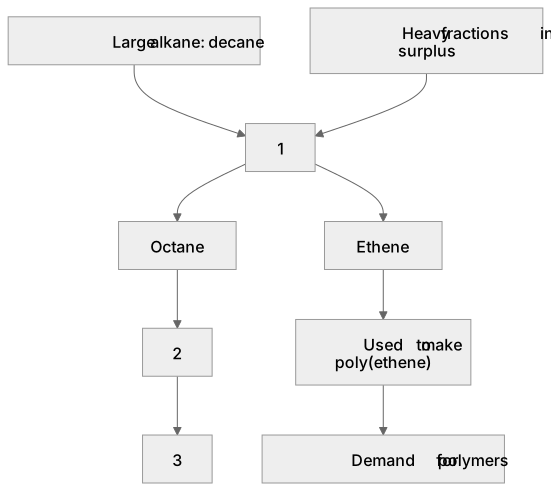
1Box 1
2Box 2
3Box 3
There is more to this lesson
The full lesson goes on to check your understanding and help you earn the marks. Create a free account to carry on, with your progress saved.
A week of Premium from your first lesson · Then the free plan continues · No card, no charge
Test your understanding of Cracking and alkenes: Students should be able to give examples to illustrate the usefulness of cracking.
Active recall beats re-reading. Take an instant quiz now to test what you’ve learned and lock it into long-term memory.
A week of Premium from your first lesson · Then the free plan continues · No card, no charge