AQA · GCSE · Chemistry
Course version: 8462 · Version from Sept 2018
Elements with properties predicted by Mendeleev were discovered and filled…
Full specification wording
Development of the periodic table: Elements with properties predicted by Mendeleev were discovered and filled the gaps.
Mendeleev's table became widely accepted because later discoveries matched his predictions.
Checked against the AQA 8462 specification (opens in a new tab) on .
- Point 4 of 6
- 4 key terms
Study notes
From the checked teaching notes for this specification point.
The idea
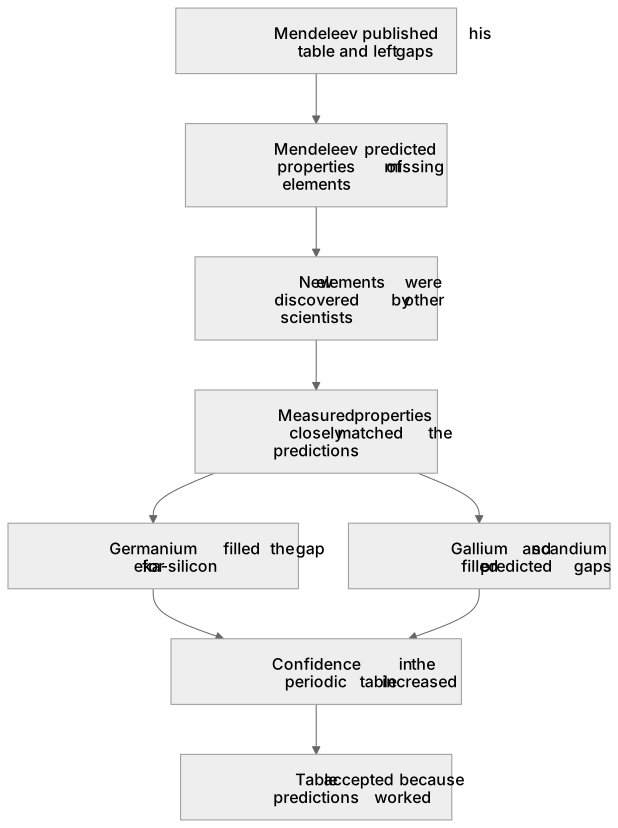
Mendeleev's table became widely accepted because later discoveries matched his predictions. When chemists found new elements, their measured properties closely resembled the values Mendeleev had forecast from the surrounding groups. Germanium, for example, filled the gap he had left for eka-silicon, and its density and reactivity were close to his estimates. Gallium and scandium similarly filled predicted gaps. These successes showed that the periodic table was not merely a convenient list but a model with genuine predictive power. The agreement between prediction and discovery provided strong evidence that the underlying pattern was real, even though the reason for the pattern was not understood until protons, neutrons and electrons were discovered. This is a clear example of a scientific model being tested and strengthened by new evidence.
What earns the marks
- State that new elements were discovered after Mendeleev published his table.
- Explain that the properties of these new elements matched Mendeleev's predictions.
- Give a named example, such as germanium filling the gap for eka-silicon.
- Recognise that the agreement between prediction and discovery increased confidence in the periodic table.
- Link the acceptance of the table to its predictive success rather than to the discovery of sub-atomic particles.
Common mistakes and how to put them right
Saying Mendeleev discovered the missing elements himself.
Put it right by distinguishing prediction from discovery.
Claiming the predictions were exact in every detail.
Put it right by describing them as close matches.
Confusing the reason for the pattern with the evidence for the pattern.
Put it right by separating evidence from explanation.
Exam tips
- Name one predicted element and the real element that filled its gap to show secure knowledge.
- Explain how a successful prediction supports a scientific model, using the periodic table as the example.
- Avoid saying the table was accepted immediately; describe how repeated successful predictions built confidence over time.
Try the lesson
The start of the Development of the periodic table: Elements with properties predicted by Mendeleev were discovered and filled the gaps. lesson, made from checked teaching notes for this specification point.
Have a go first
Mendeleev left gaps in his periodic table for elements that had not yet been discovered. What happened later that proved his ideas were correct?
Listen
Mendeleev's table became widely accepted because later discoveries matched his predictions. When chemists found new elements, their measured properties closely resembled the values Mendeleev had forecast from the surrounding groups. Germanium, for example, filled the gap he had left for eka-silicon, and its density and reactivity were close to his estimates. Gallium and scandium similarly filled predicted gaps. These successes showed that the periodic table was not merely a convenient list but a model with genuine predictive power. The agreement between prediction and discovery provided strong evidence that the underlying pattern was real, even though the reason for the pattern was not understood until protons, neutrons and electrons were discovered. This is a clear example of a scientific model being tested and strengthened by new evidence. A strong answer earns marks for these points. State that new elements were discovered after Mendeleev published his table. Explain that the properties of these new elements matched Mendeleev's predictions. Give a named example, such as germanium filling the gap for eka-silicon. Recognise that the agreement between prediction and discovery increased confidence in the periodic table. A common slip: Saying Mendeleev discovered the missing elements himself; he predicted them, and other scientists later discovered them. Instead, distinguishing prediction from discovery. Exam tip: Name one predicted element and the real element that filled its gap to show secure knowledge.
See it
Key words
Say what each word means before you turn the card.
Prediction and confirmation in science
Try answering aloud or in your head before turning the card.
Evidence-based acceptance of models
Try answering aloud or in your head before turning the card.
Discovery of new elements
Try answering aloud or in your head before turning the card.
Development of the periodic table
Try answering aloud or in your head before turning the card.
See every definition
- Prediction and confirmation in science
- Mendeleev forecast the properties of missing elements, and later discoveries matched his predictions, showing a model tested and strengthened by new evidence.
- Evidence-based acceptance of models
- The periodic table became widely accepted because the agreement between prediction and discovery provided strong evidence that the underlying pattern was real.
- Discovery of new elements
- Chemists found new elements whose measured properties closely resembled the values Mendeleev had forecast from the surrounding groups.
- Development of the periodic table
- Mendeleev's table was not merely a convenient list but a model with genuine predictive power, and its predictive success increased confidence in it.
Label the diagram
Some boxes have lost their names. Pick the right name for each number.
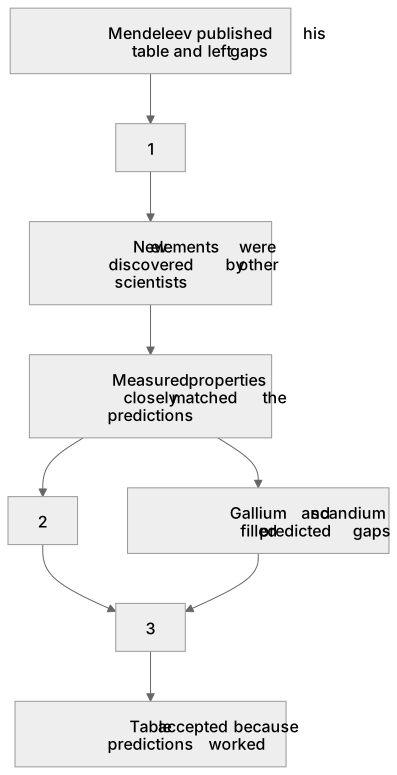
1Box 1
2Box 2
3Box 3
There is more to this lesson
The full lesson goes on to check your understanding and help you earn the marks. Create a free account to carry on, with your progress saved.
A week of Premium from your first lesson · Then the free plan continues · No card, no charge
Test your understanding of Development of the periodic table: Elements with properties predicted by Mendeleev were discovered and filled the gaps.
Active recall beats re-reading. Take an instant quiz now to test what you’ve learned and lock it into long-term memory.
A week of Premium from your first lesson · Then the free plan continues · No card, no charge