AQA · GCSE · Chemistry
Course version: 8462 · Version from Sept 2018
Knowledge of isotopes made it possible to explain why the order based on…
Full specification wording
Development of the periodic table: Knowledge of isotopes made it possible to explain why the order based on atomic weights was not always correct.
Early periodic tables arranged elements by relative atomic weight, but a few pairs appeared to be in the wrong order for their chemistry.
Checked against the AQA 8462 specification (opens in a new tab) on .
- Point 5 of 6
- 2 key terms
Study notes
From the checked teaching notes for this specification point.
The idea
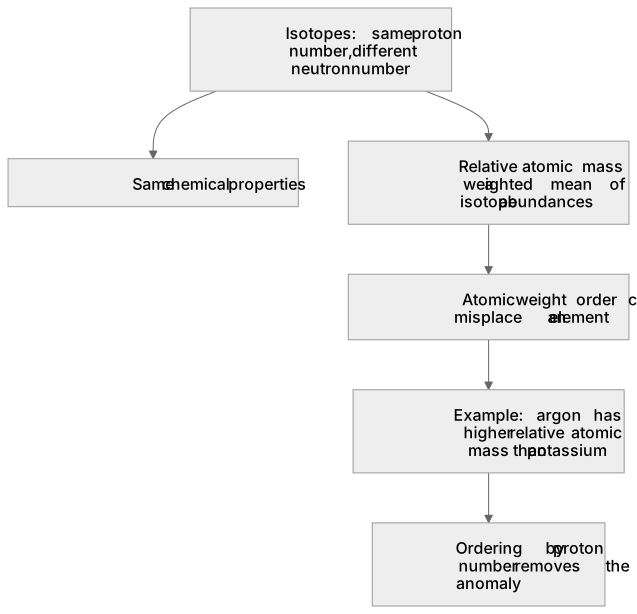
Early periodic tables arranged elements by relative atomic weight, but a few pairs appeared to be in the wrong order for their chemistry. Isotopes explain this: atoms of the same element can have different mass numbers because they have different numbers of neutrons, yet they have identical proton number and identical chemical properties. The weighted mean relative atomic mass of an element depends on the abundances of its isotopes, so it need not follow a simple whole-number sequence. For example, argon has a higher relative atomic mass than potassium, yet argon is a noble gas placed before potassium because proton number, not mass, fixes position. Knowing isotopes exist shows that ordering by atomic weight can misplace an element, whereas ordering by proton number removes the anomaly.
What earns the marks
- State that isotopes are atoms of the same element with the same number of protons but different numbers of neutrons.
- Explain that isotopes of an element have the same proton number and therefore the same chemical properties.
- Explain that relative atomic mass is a weighted mean that depends on the abundance of each isotope.
- Use a named example, such as argon before potassium, to show that atomic weight order can conflict with chemical behaviour.
- Conclude that ordering by proton number, rather than atomic weight, gives the correct sequence and removes anomalies.
Common mistakes and how to put them right
Saying isotopes have different numbers of protons.
Put it right by stating that proton number is the same and only neutron number differs.
Claiming that relative atomic mass is always a whole number.
Put it right by explaining it is a weighted mean of isotope masses.
Thinking the isotope explanation changes chemical properties.
Put it right by stating that chemical behaviour depends on electron arrangement, which is unchanged.
Exam tips
- Link the word isotope directly to proton number and neutron number before discussing the periodic table.
- Use one named pair, such as argon and potassium, to show the anomaly rather than describing it in the abstract.
- Finish by stating that proton number gives the modern order, so the explanation answers the whole statement.
Try the lesson
The start of the Development of the periodic table: Knowledge of isotopes made it possible to explain why the order based on atomic weights was not always correct. lesson, made from checked teaching notes for this specification point.
Have a go first
In the early periodic table, elements were placed in order of atomic weight. Which discovery later explained why this order was not always correct?
Listen
Early periodic tables arranged elements by relative atomic weight, but a few pairs appeared to be in the wrong order for their chemistry. Isotopes explain this: atoms of the same element can have different mass numbers because they have different numbers of neutrons, yet they have identical proton number and identical chemical properties. The weighted mean relative atomic mass of an element depends on the abundances of its isotopes, so it need not follow a simple whole-number sequence. For example, argon has a higher relative atomic mass than potassium, yet argon is a noble gas placed before potassium because proton number, not mass, fixes position. Knowing isotopes exist shows that ordering by atomic weight can misplace an element, whereas ordering by proton number removes the anomaly. A strong answer earns marks for these points. State that isotopes are atoms of the same element with the same number of protons but different numbers of neutrons. Explain that isotopes of an element have the same proton number and therefore the same chemical properties. Explain that relative atomic mass is a weighted mean that depends on the abundance of each isotope. Use a named example, such as argon before potassium, to show that atomic weight order can conflict with chemical behaviour. A common slip: Saying isotopes have different numbers of protons. Instead, stating that proton number is the same and only neutron number differs. Exam tip: Link the word isotope directly to proton number and neutron number before discussing the periodic table.
See it
Key words
Say what each word means before you turn the card.
Isotopes
Try answering aloud or in your head before turning the card.
Relative atomic mass
Try answering aloud or in your head before turning the card.
See every definition
- Isotopes
- Atoms of the same element with the same number of protons but different numbers of neutrons.
- Relative atomic mass
- A weighted mean that depends on the abundance of each isotope of an element.
Label the diagram
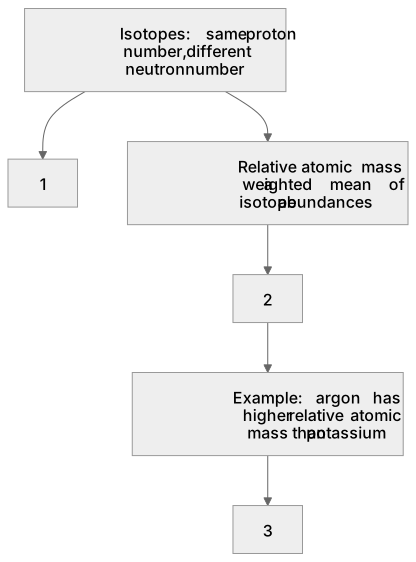
Some boxes have lost their names. Pick the right name for each number.
1Box 1
2Box 2
3Box 3
There is more to this lesson
The full lesson goes on to check your understanding and help you earn the marks. Create a free account to carry on, with your progress saved.
A week of Premium from your first lesson · Then the free plan continues · No card, no charge
Test your understanding of Development of the periodic table: Knowledge of isotopes made it possible to explain why the order based on atomic weights was not always correct.
Active recall beats re-reading. Take an instant quiz now to test what you’ve learned and lock it into long-term memory.
A week of Premium from your first lesson · Then the free plan continues · No card, no charge