AQA · GCSE · Chemistry
Course version: 8462 · Version from Sept 2018
Students should be able to describe these steps in the development of the…
Full specification wording
Development of the periodic table: Students should be able to describe these steps in the development of the periodic table.
The periodic table developed through several stages.
Checked against the AQA 8462 specification (opens in a new tab) on .
- Point 6 of 6
Study notes
From the checked teaching notes for this specification point.
The idea
The periodic table developed through several stages. Early chemists such as Newlands and Döbereiner noticed patterns, but Mendeleev produced the version that shaped later work. He arranged elements mainly by relative atomic weight, placed elements with similar properties into groups, and left gaps for elements he predicted were undiscovered. When gallium and germanium were later found with properties close to his predictions, confidence in the table grew. Later work on atomic structure showed that proton number, not atomic weight, gives the correct order, and this resolved anomalies such as argon before potassium. The modern table arranges elements by increasing proton number, with groups showing similar properties and periods showing repeating trends.
What earns the marks
- Describe early attempts to find patterns among elements, including ordering by relative atomic weight.
- Describe Mendeleev arranging elements by atomic weight and grouping those with similar properties.
- Describe Mendeleev leaving gaps and predicting properties of undiscovered elements.
- Describe how later discovery of predicted elements supported the table.
- Describe the modern change to ordering by proton number, which resolved anomalies.
Common mistakes and how to put them right
Crediting Mendeleev with ordering by proton number.
Put it right by stating he used atomic weight and that proton number came later.
Saying Mendeleev left gaps because he had no data.
Put it right by explaining the gaps were for elements not yet discovered.
Treating the periodic table as a single invention.
Put it right by describing it as a sequence of improvements over time.
Exam tips
- Use a clear sequence: early patterns, Mendeleev's table, predictions, later proton-number ordering.
- Name at least one predicted element, such as gallium or germanium, to support the description.
- Keep the account chronological so the examiner can follow the development.
Try the lesson
The start of the Development of the periodic table: Students should be able to describe these steps in the development of the periodic table. lesson, made from checked teaching notes for this specification point.
Have a go first
In the development of the periodic table, what did early scientists first do to arrange the known elements?
Listen
The periodic table developed through several stages. Early chemists such as Newlands and Döbereiner noticed patterns, but Mendeleev produced the version that shaped later work. He arranged elements mainly by relative atomic weight, placed elements with similar properties into groups, and left gaps for elements he predicted were undiscovered. When gallium and germanium were later found with properties close to his predictions, confidence in the table grew. Later work on atomic structure showed that proton number, not atomic weight, gives the correct order, and this resolved anomalies such as argon before potassium. The modern table arranges elements by increasing proton number, with groups showing similar properties and periods showing repeating trends. A strong answer earns marks for these points. Describe early attempts to find patterns among elements, including ordering by relative atomic weight. Describe Mendeleev arranging elements by atomic weight and grouping those with similar properties. Describe Mendeleev leaving gaps and predicting properties of undiscovered elements. Describe how later discovery of predicted elements supported the table. A common slip: Crediting Mendeleev with ordering by proton number. Instead, stating he used atomic weight and that proton number came later. Exam tip: Use a clear sequence: early patterns, Mendeleev's table, predictions, later proton-number ordering.
See it
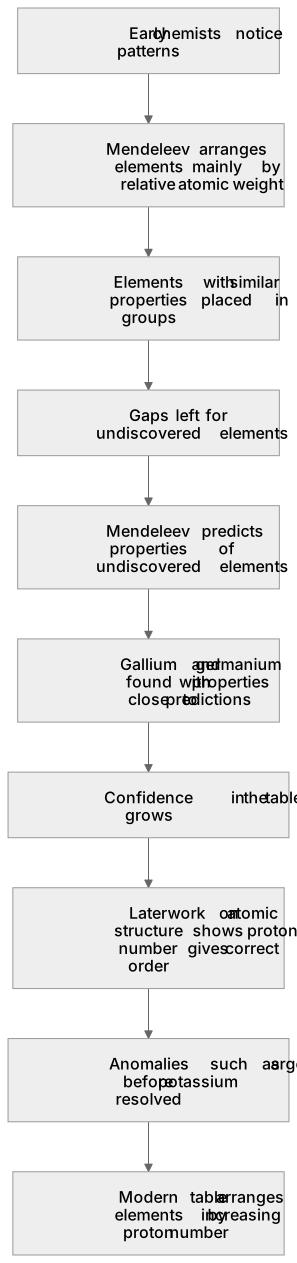
Label the diagram
Some boxes have lost their names. Pick the right name for each number.
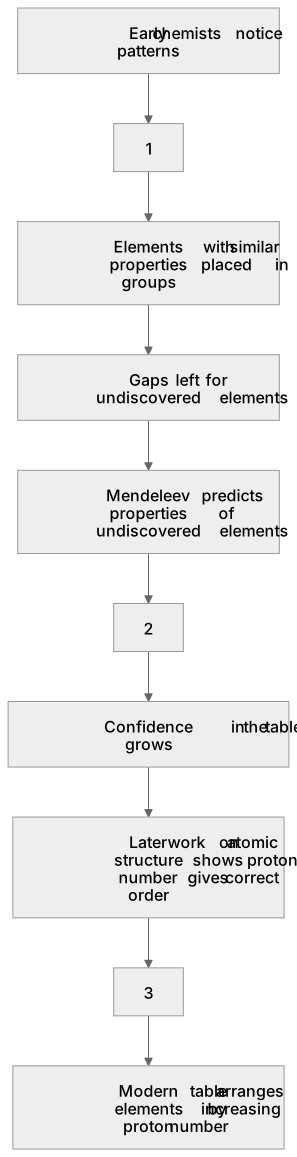
1Box 1
2Box 2
3Box 3
There is more to this lesson
The full lesson goes on to check your understanding and help you earn the marks. Create a free account to carry on, with your progress saved.
A week of Premium from your first lesson · Then the free plan continues · No card, no charge
Test your understanding of Development of the periodic table: Students should be able to describe these steps in the development of the periodic table.
Active recall beats re-reading. Take an instant quiz now to test what you’ve learned and lock it into long-term memory.
A week of Premium from your first lesson · Then the free plan continues · No card, no charge