AQA · GCSE · Chemistry
Course version: 8462 · Version from Sept 2018
Other naturally occurring polymers important for life include proteins,…
Full specification wording
DNA (deoxyribonucleic acid) and other naturally occurring polymers: Other naturally occurring polymers important for life include proteins, starch and cellulose.
Naturally occurring polymers are large molecules built from repeating smaller units joined by covalent bonds.
Checked against the AQA 8462 specification (opens in a new tab) on .
- Point 4 of 5
Study notes
From the checked teaching notes for this specification point.
The idea
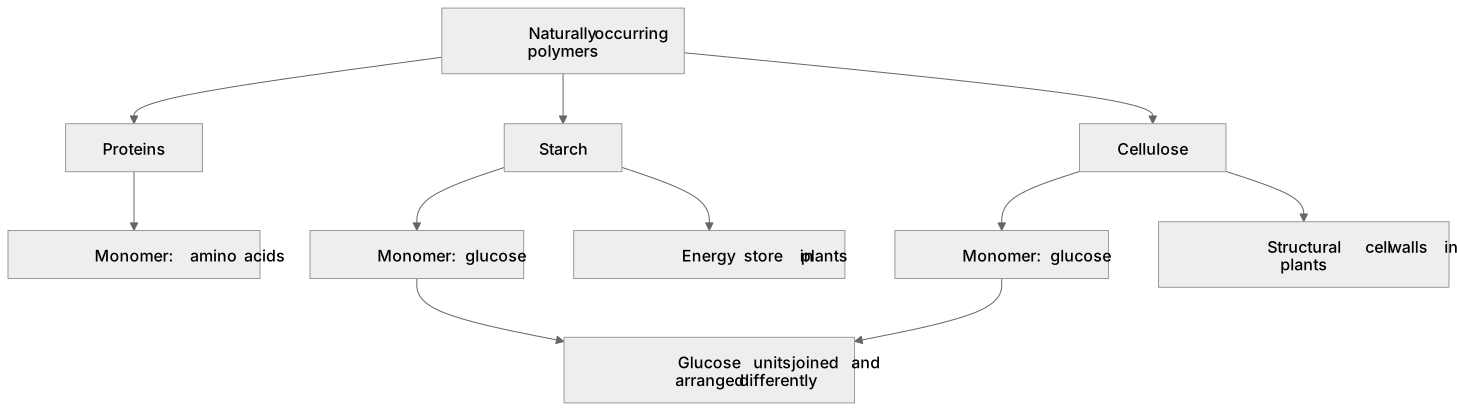
Naturally occurring polymers are large molecules built from repeating smaller units joined by covalent bonds. Proteins are polymers of amino acids; the sequence of different amino acids gives each protein its specific shape and function, such as enzymes or structural collagen. Starch and cellulose are both polymers of glucose, but they differ in how the glucose units are joined and arranged. Starch is a storage polysaccharide in plants, while cellulose forms strong plant cell walls. Recognising that these materials are polymers, and identifying the type of monomer each is built from, links biological molecules to the polymer chemistry you study elsewhere.
For example: A protein chain can be represented as a sequence of amino acid units, whereas cellulose can be represented as a chain of glucose units.
What earns the marks
- Proteins are polymers formed from amino acid monomers joined by covalent bonds.
- Starch is a polymer of glucose and acts as an energy store in plants.
- Cellulose is also a polymer of glucose but forms structural cell walls in plants.
- Starch and cellulose differ in the arrangement and bonding of their glucose units, giving different properties.
- Naturally occurring polymers are important for life because they form structures and carry out functions in living organisms.
Common mistakes and how to put them right
Thinking that starch and cellulose are made from different monomers.
Put it right: Both are made from glucose, but the glucose units are joined differently.
Describing proteins as being made from glucose or fatty acids.
Put it right: Proteins are made from amino acids.
Assuming all naturally occurring polymers are identical to each other.
Put it right: Proteins, starch and cellulose have different monomers or different arrangements of the same monomer.
Exam tips
- When asked to name the monomer, give the specific monomer: amino acid for proteins, glucose for starch and cellulose.
- Use the phrase 'polymer of glucose' for both starch and cellulose, then explain the difference in terms of how the glucose units are joined or arranged.
- Link each polymer to its role in living organisms to show understanding rather than just naming it.
Try the lesson
The start of the DNA (deoxyribonucleic acid) and other naturally occurring polymers: Other naturally occurring polymers important for life include proteins, starch and cellulose. lesson, made from checked teaching notes for this specification point.
Have a go first
Starch and cellulose are naturally occurring polymers important for life. Which other substance is also a naturally occurring polymer important for life?
Listen
Naturally occurring polymers are large molecules built from repeating smaller units joined by covalent bonds. Proteins are polymers of amino acids; the sequence of different amino acids gives each protein its specific shape and function, such as enzymes or structural collagen. Starch and cellulose are both polymers of glucose, but they differ in how the glucose units are joined and arranged. Starch is a storage polysaccharide in plants, while cellulose forms strong plant cell walls. Recognising that these materials are polymers, and identifying the type of monomer each is built from, links biological molecules to the polymer chemistry you study elsewhere. For example, a protein chain can be represented as a sequence of amino acid units, whereas cellulose can be represented as a chain of glucose units. A strong answer earns marks for these points. Proteins are polymers formed from amino acid monomers joined by covalent bonds. Starch is a polymer of glucose and acts as an energy store in plants. Cellulose is also a polymer of glucose but forms structural cell walls in plants. Starch and cellulose differ in the arrangement and bonding of their glucose units, giving different properties. Exam tip: When asked to name the monomer, give the specific monomer: amino acid for proteins, glucose for starch and cellulose.
See it
There is more to this lesson
The full lesson goes on to check your understanding and help you earn the marks. Create a free account to carry on, with your progress saved.
A week of Premium from your first lesson · Then the free plan continues · No card, no charge
Test your understanding of DNA (deoxyribonucleic acid) and other naturally occurring polymers: Other naturally occurring polymers important for life include proteins, starch and cellulose.
Active recall beats re-reading. Take an instant quiz now to test what you’ve learned and lock it into long-term memory.
A week of Premium from your first lesson · Then the free plan continues · No card, no charge