AQA · GCSE · Chemistry
Course version: 8462 · Version from Sept 2018
Unreactive metals such as gold are found in the Earth as the metal itself…
Full specification wording
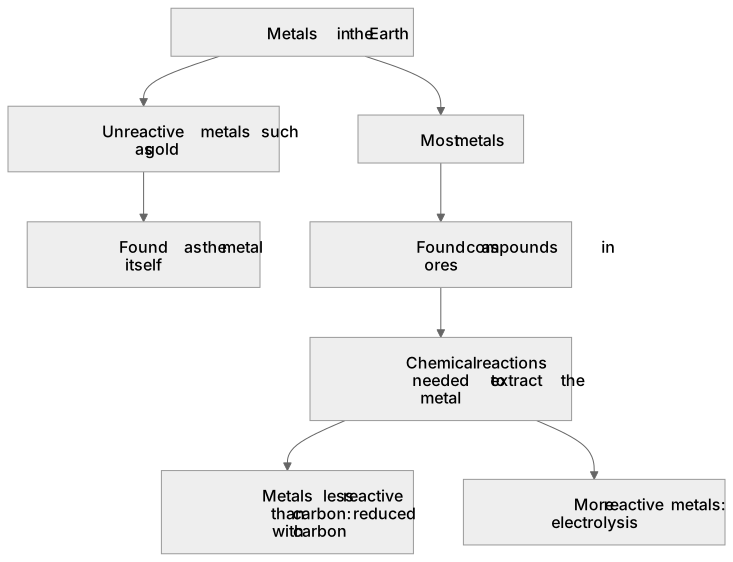
Extraction of metals and reduction: Unreactive metals such as gold are found in the Earth as the metal itself but most metals are found as compounds that require chemical reactions to extract the metal.
Gold is so unreactive that it occurs native, meaning it is found in the Earth as the metal itself, often as nuggets or grains in rock.
Checked against the AQA 8462 specification (opens in a new tab) on .
- Point 1 of 4
- 4 key terms
Study notes
From the checked teaching notes for this specification point.
The idea
Gold is so unreactive that it occurs native, meaning it is found in the Earth as the metal itself, often as nuggets or grains in rock. Most other metals, such as iron, aluminium and zinc, are too reactive to exist naturally as the free metal and are found combined in compounds called ores. An ore is a rock containing enough of a metal compound to make extraction worthwhile. Because the metal is chemically bonded in the compound, a chemical reaction is needed to extract it. The method chosen depends on the metal's position in the reactivity series: metals less reactive than carbon can be reduced with carbon, while more reactive metals need electrolysis. This links the reactivity series to industrial extraction.
What earns the marks
- States that unreactive metals such as gold are found in the Earth as the metal itself, described as native.
- Explains that most metals are found as compounds in ores and are not present as the free metal.
- Defines an ore as a rock containing a metal compound in sufficient amount to be extracted economically.
- Explains that chemical reactions are required to extract a metal from its compound because the metal is chemically combined.
- Links the extraction method to the reactivity series, for example carbon reduction for metals less reactive than carbon and electrolysis for more reactive metals.
- Uses a named example, such as gold occurring native or iron extracted from iron oxide, to illustrate the difference.
Common mistakes and how to put them right
Writing that all metals are found native in the Earth.
Put it right: Only unreactive metals such as gold are found as the metal itself, while most are found as compounds.
Confusing an ore with a pure metal.
Put it right: An ore is a rock containing a metal compound, often mixed with other minerals.
Thinking that physical separation alone can extract a reactive metal from its ore.
Put it right: Chemical reactions are needed to break the metal-compound bonds.
Exam tips
- Name a specific unreactive metal and a specific reactive metal when contrasting native occurrence with compound occurrence.
- Define ore in terms of both the metal compound and the idea of economic extraction, not just any rock.
- When explaining extraction, refer to the reactivity series to justify the method rather than listing methods without reasons.
Try the lesson
The start of the Extraction of metals and reduction: Unreactive metals such as gold are found in the Earth as the metal itself but most metals are found as compounds that require chemical reactions to extract the metal. lesson, made from checked teaching notes for this specification point.
Have a go first
Which metal is found in the Earth as the metal itself because it is unreactive?
Listen
Gold is so unreactive that it occurs native, meaning it is found in the Earth as the metal itself, often as nuggets or grains in rock. Most other metals, such as iron, aluminium and zinc, are too reactive to exist naturally as the free metal and are found combined in compounds called ores. An ore is a rock containing enough of a metal compound to make extraction worthwhile. Because the metal is chemically bonded in the compound, a chemical reaction is needed to extract it. The method chosen depends on the metal's position in the reactivity series: metals less reactive than carbon can be reduced with carbon, while more reactive metals need electrolysis. This links the reactivity series to industrial extraction. A strong answer earns marks for these points. States that unreactive metals such as gold are found in the Earth as the metal itself, described as native. Explains that most metals are found as compounds in ores and are not present as the free metal. Defines an ore as a rock containing a metal compound in sufficient amount to be extracted economically. Explains that chemical reactions are required to extract a metal from its compound because the metal is chemically combined. A common slip: Writing that all metals are found native in the Earth. Instead, only unreactive metals such as gold are found as the metal itself, while most are found as compounds. Exam tip: Name a specific unreactive metal and a specific reactive metal when contrasting native occurrence with compound occurrence.
See it
Key words
Say what each word means before you turn the card.
Native metals
Try answering aloud or in your head before turning the card.
Ores and metal compounds
Try answering aloud or in your head before turning the card.
Reactivity series and extraction methods
Try answering aloud or in your head before turning the card.
Chemical versus physical separation
Try answering aloud or in your head before turning the card.
See every definition
- Native metals
- Unreactive metals such as gold are found in the Earth as the metal itself, described as native.
- Ores and metal compounds
- Most metals are found as compounds in ores, which are rocks containing a metal compound in sufficient amount to be extracted economically.
- Reactivity series and extraction methods
- The method chosen depends on the metal's position in the reactivity series, with carbon reduction for metals less reactive than carbon and electrolysis for more reactive metals.
- Chemical versus physical separation
- Because the metal is chemically bonded in the compound, chemical reactions are needed to extract it, as physical separation alone cannot break the metal-compound bonds.
Label the diagram
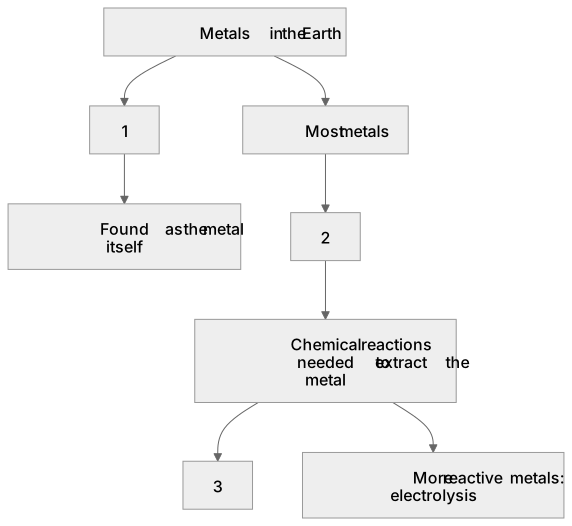
Some boxes have lost their names. Pick the right name for each number.
1Box 1
2Box 2
3Box 3
There is more to this lesson
The full lesson goes on to check your understanding and help you earn the marks. Create a free account to carry on, with your progress saved.
A week of Premium from your first lesson · Then the free plan continues · No card, no charge
Test your understanding of Extraction of metals and reduction: Unreactive metals such as gold are found in the Earth as the metal itself but most metals are found as compounds that require chemical reactions to extract the metal.
Active recall beats re-reading. Take an instant quiz now to test what you’ve learned and lock it into long-term memory.
A week of Premium from your first lesson · Then the free plan continues · No card, no charge