AQA · GCSE · Chemistry
Course version: 8462 · Version from Sept 2018
This should be an investigation involving developing a hypothesis.
Full specification wording
Factors which affect the rates of chemical reactions: This should be an investigation involving developing a hypothesis.
A hypothesis is a testable prediction linked to scientific reasoning.
Checked against the AQA 8462 specification (opens in a new tab) on .
- Point 4 of 4
- 4 key terms
Study notes
From the checked teaching notes for this specification point.
The idea
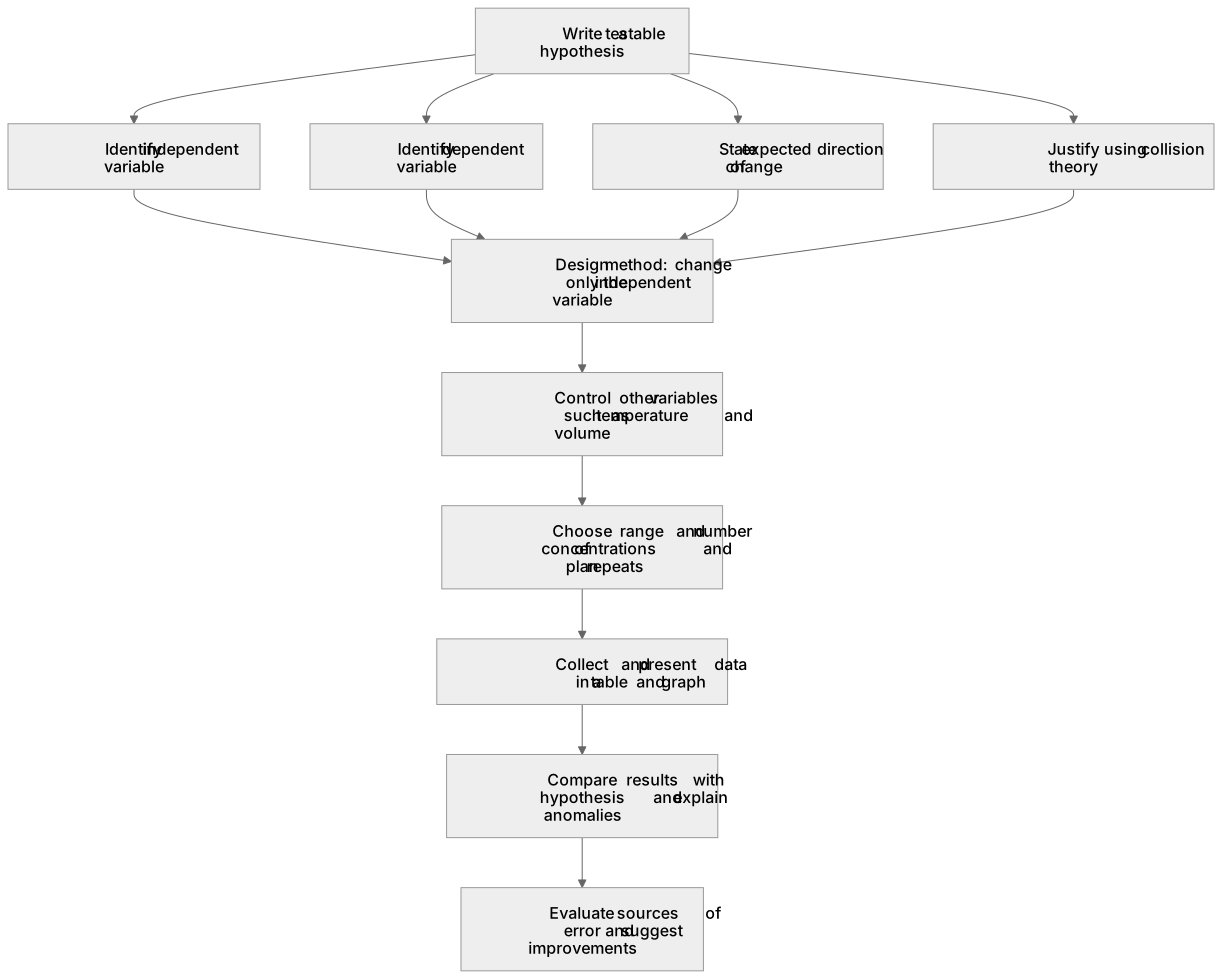
A hypothesis is a testable prediction linked to scientific reasoning. For this practical, you might predict that as the concentration of a reactant increases, the time taken for a cross to disappear decreases, because more reactant particles in the same volume collide more frequently. The hypothesis must identify the independent variable, the dependent variable and the expected direction of change, and it should be justified using collision theory. You then design a method that produces evidence capable of supporting or refuting the prediction. This means choosing suitable concentrations, controlling variables such as temperature and volume, deciding how many readings and repeats to take, and selecting a measurement that genuinely reflects rate. Finally, you compare your results with the hypothesis and explain any anomalies.
What earns the marks
- Write a hypothesis that predicts a relationship between the independent variable, such as concentration, and the dependent variable, such as time or volume of gas.
- Justify the hypothesis using collision theory, for example more particles per unit volume lead to more frequent successful collisions.
- Design a method that changes only the independent variable and controls other variables such as temperature, volumes and reactant amounts.
- Select a suitable range and number of concentrations, and plan repeats so that a pattern can be identified and anomalies recognised.
- Collect and present data in a table and graph, then use the evidence to state whether the hypothesis is supported.
- Evaluate the investigation by discussing sources of error, such as timing reactions by eye, and suggest improvements.
Common mistakes and how to put them right
Writing a hypothesis as a question or a vague statement.
Put it right: Write a clear prediction such as increasing concentration will decrease the time taken for the cross to disappear.
Changing more than one variable at a time.
Put it right: Identify the independent variable and keep all other relevant variables constant.
Ignoring anomalous results when drawing a conclusion.
Put it right: Identify anomalies, consider repeating them and base the conclusion on the overall pattern.
Exam tips
- Use the structure if concentration increases, then rate increases because collision frequency increases when writing a hypothesis.
- Name the independent variable, dependent variable and control variables explicitly in your plan.
- Refer back to the hypothesis in your conclusion and state whether the evidence supports it, using data values as evidence.
Try the lesson
The start of the Factors which affect the rates of chemical reactions: This should be an investigation involving developing a hypothesis. lesson, made from checked teaching notes for this specification point.
Have a go first
A student plans an investigation into how the concentration of acid affects the rate of reaction. Which statement is a hypothesis that the investigation could test?
Listen
A hypothesis is a testable prediction linked to scientific reasoning. For this practical, you might predict that as the concentration of a reactant increases, the time taken for a cross to disappear decreases, because more reactant particles in the same volume collide more frequently. The hypothesis must identify the independent variable, the dependent variable and the expected direction of change, and it should be justified using collision theory. You then design a method that produces evidence capable of supporting or refuting the prediction. This means choosing suitable concentrations, controlling variables such as temperature and volume, deciding how many readings and repeats to take, and selecting a measurement that genuinely reflects rate. Finally, you compare your results with the hypothesis and explain any anomalies. A strong answer earns marks for these points. Write a hypothesis that predicts a relationship between the independent variable, such as concentration, and the dependent variable, such as time or volume of gas. Justify the hypothesis using collision theory, for example more particles per unit volume lead to more frequent successful collisions. Design a method that changes only the independent variable and controls other variables such as temperature, volumes and reactant amounts. Select a suitable range and number of concentrations, and plan repeats so that a pattern can be identified and anomalies recognised. A common slip: Writing a hypothesis as a question or a vague statement. Instead, write a clear prediction such as increasing concentration will decrease the time taken for the cross to disappear. Exam tip: Use the structure if concentration increases, then rate increases because collision frequency increases when writing a hypothesis.
See it
Key words
Say what each word means before you turn the card.
Hypothesis
Try answering aloud or in your head before turning the card.
Collision theory
Try answering aloud or in your head before turning the card.
Variables and control
Try answering aloud or in your head before turning the card.
Evidence and conclusion
Try answering aloud or in your head before turning the card.
See every definition
- Hypothesis
- A testable prediction linked to scientific reasoning that identifies the independent variable, the dependent variable and the expected direction of change.
- Collision theory
- The idea that more particles per unit volume lead to more frequent successful collisions, used to justify the hypothesis.
- Variables and control
- Changing only the independent variable and controlling other variables such as temperature, volumes and reactant amounts.
- Evidence and conclusion
- Using collected data to state whether the hypothesis is supported, identifying anomalies and basing the conclusion on the overall pattern.
Label the diagram
Some boxes have lost their names. Pick the right name for each number.
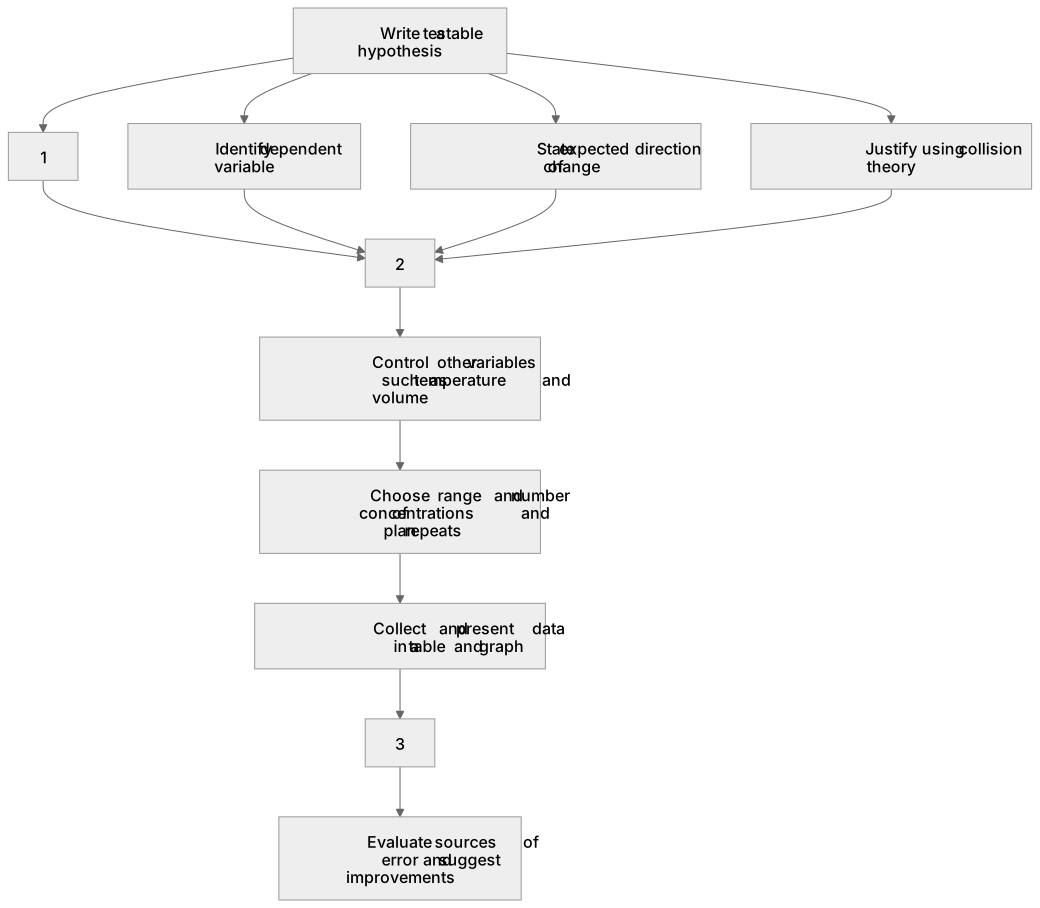
1Box 1
2Box 2
3Box 3
There is more to this lesson
The full lesson goes on to check your understanding and help you earn the marks. Create a free account to carry on, with your progress saved.
A week of Premium from your first lesson · Then the free plan continues · No card, no charge
Test your understanding of Factors which affect the rates of chemical reactions: This should be an investigation involving developing a hypothesis.
Active recall beats re-reading. Take an instant quiz now to test what you’ve learned and lock it into long-term memory.
A week of Premium from your first lesson · Then the free plan continues · No card, no charge