AQA · GCSE · Chemistry
Course version: 8462 · Version from Sept 2018
If a sample containing a mixture of ions is used some flame colours can be…
Full specification wording
Flame tests: If a sample containing a mixture of ions is used some flame colours can be masked.
When a sample contains more than one metal cation, the flame test can give a misleading result because one colour may hide another.
Checked against the AQA 8462 specification (opens in a new tab) on .
- Point 3 of 4
- 4 key terms
Study notes
From the checked teaching notes for this specification point.
The idea
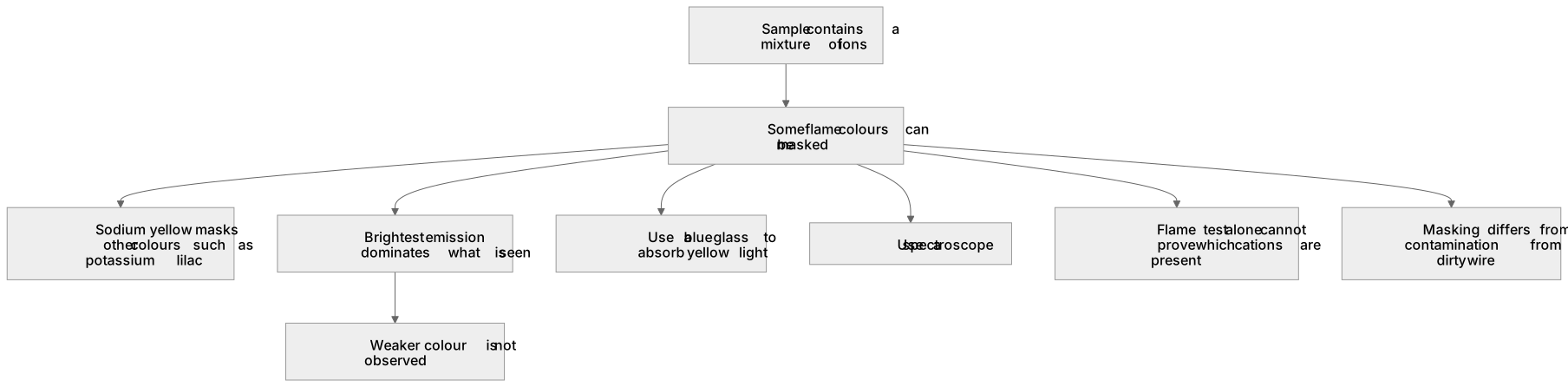
When a sample contains more than one metal cation, the flame test can give a misleading result because one colour may hide another. Sodium is the common example: its intense yellow emission can dominate the flame and mask the lilac of potassium or the crimson of lithium. Masking happens because the eye sees the brightest colour, and the weaker emission from the other cation is not visible against it. To reduce the problem of masking in a mixture, a blue glass can be placed between the eye and the flame to absorb yellow light so that a lilac colour becomes visible, or a spectroscope can be used. A flame test alone cannot prove which cations are present in a mixture. Note that masking within a mixture is different from contamination, which is prevented by cleaning the wire between tests.
What earns the marks
- States that a mixture of cations can give a flame colour that hides the colour of another cation.
- Identifies sodium yellow as a common colour that masks other flame colours such as potassium lilac.
- Explains that the brightest emission dominates what is seen, so the weaker colour is not observed.
- Suggests a control measure for masking such as using a blue glass to filter yellow light or using a spectroscope.
- Concludes that a flame test alone may not identify all cations in a mixture and that further chemical tests may be needed.
- Distinguishes masking by another ion in a mixture from contamination caused by a dirty wire.
Common mistakes and how to put them right
Assuming the flame colour shows every cation present.
Put it right: The error is treating one colour as complete identification, and the correction is to state that some colours may be masked and further tests may be needed.
Confusing masking with contamination.
Put it right: The error is suggesting that cleaning the wire reduces masking in a mixture, and the correction is to distinguish an impurity on the wire from a second cation in the sample itself.
Ignoring the problem and reporting only the dominant colour.
Put it right: The error is an incomplete identification, and the correction is to note that a masked cation may still be present.
Exam tips
- Use the word masked and give sodium yellow hiding potassium lilac as the standard example.
- Suggest a practical measure such as a blue glass to view potassium in the presence of sodium.
- End with a limitation statement: a flame test on a mixture may not identify every cation present.
Try the lesson
The start of the Flame tests: If a sample containing a mixture of ions is used some flame colours can be masked. lesson, made from checked teaching notes for this specification point.
Have a go first
What happens to the observed flame colour if a sample contains a mixture of different metal ions?
Listen
When a sample contains more than one metal cation, the flame test can give a misleading result because one colour may hide another. Sodium is the common example: its intense yellow emission can dominate the flame and mask the lilac of potassium or the crimson of lithium. Masking happens because the eye sees the brightest colour, and the weaker emission from the other cation is not visible against it. To reduce the problem of masking in a mixture, a blue glass can be placed between the eye and the flame to absorb yellow light so that a lilac colour becomes visible, or a spectroscope can be used. A flame test alone cannot prove which cations are present in a mixture. Note that masking within a mixture is different from contamination, which is prevented by cleaning the wire between tests. A strong answer earns marks for these points. States that a mixture of cations can give a flame colour that hides the colour of another cation. Identifies sodium yellow as a common colour that masks other flame colours such as potassium lilac. Explains that the brightest emission dominates what is seen, so the weaker colour is not observed. Suggests a control measure for masking such as using a blue glass to filter yellow light or using a spectroscope. Exam tip: Use the word masked and give sodium yellow hiding potassium lilac as the standard example.
See it
Key words
Say what each word means before you turn the card.
Masked
Try answering aloud or in your head before turning the card.
Dominant emission
Try answering aloud or in your head before turning the card.
Blue glass
Try answering aloud or in your head before turning the card.
Contamination
Try answering aloud or in your head before turning the card.
See every definition
- Masked
- Describes a flame colour that is hidden when a sample containing a mixture of ions is used, because one colour can hide another.
- Dominant emission
- The brightest colour that the eye sees, so that the weaker emission from another cation is not visible against it.
- Blue glass
- Placed between the eye and the flame to absorb yellow light so that a lilac colour becomes visible.
- Contamination
- Caused by a dirty wire and prevented by cleaning the wire between tests, which is different from masking within a mixture.
Label the diagram
Some boxes have lost their names. Pick the right name for each number.
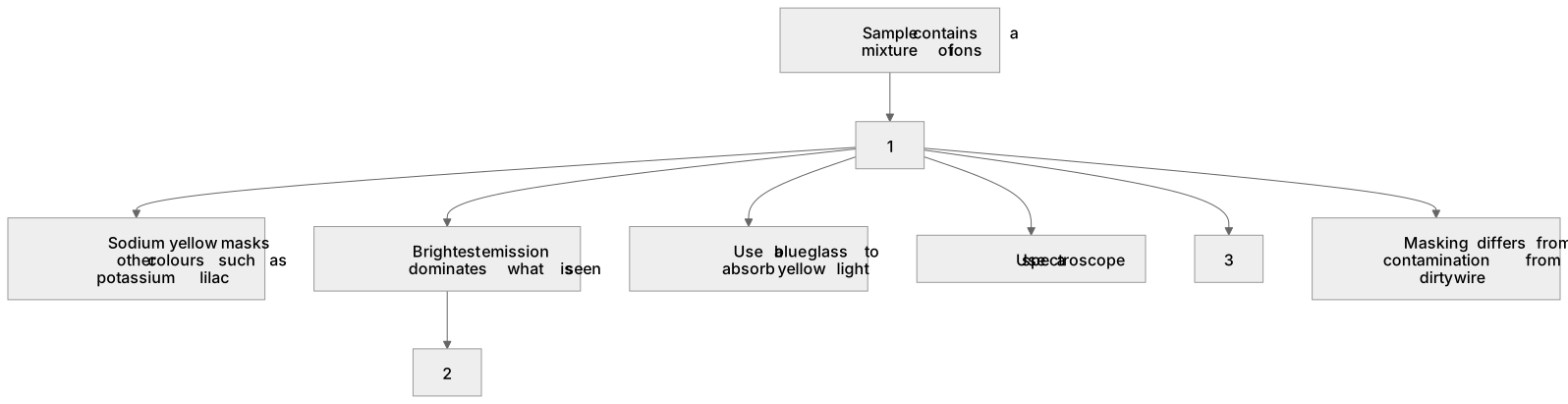
1Box 1
2Box 2
3Box 3
There is more to this lesson
The full lesson goes on to check your understanding and help you earn the marks. Create a free account to carry on, with your progress saved.
A week of Premium from your first lesson · Then the free plan continues · No card, no charge
Test your understanding of Flame tests: If a sample containing a mixture of ions is used some flame colours can be masked.
Active recall beats re-reading. Take an instant quiz now to test what you’ve learned and lock it into long-term memory.
A week of Premium from your first lesson · Then the free plan continues · No card, no charge